
Monograph
Kava, Coffee and Chocolate: The Public Life of Three Drinks and the Future of a Pacific Crop
- 1 American Kava Association; Root of Happiness Kava, Las Vegas, NV, USA
- 2 LaRose Agroforestry (Consulting), Baltimore, Maryland, USA
- 3 American Kava Association; Nakava LLC, Boca Raton, Florida, USA
Correspondence: Tyler Blythe, admin@americankavaassociation.org · ORCID: Tyler Blythe 0009-0006-7884-0650; Jeffrey Bowman 0009-0004-1269-6559
- Received
- 28 October 2026
- Revised
- 16 November 2026
- Accepted
- 20 November 2026
- Published
- 20 November 2026
- Volume
- Volume 2 (2026)
- Article
- 028
- Article type
- Monograph
- Version
- 1.1 (version of record)
- Review
- Computational Manuscript Review (CMR) · Editorially accepted
- Handling editor
- Travis Lowin, Editor
- License
- CC BY 4.0 · © 2026 The Author(s)
Abstract
In the histories of coffee and chocolate, public drinking houses widened the audience for each beverage, while cultivation in new regions changed who supplied it. Drawing on historical and ethnographic accounts, official trade records and the authors’ experience in cultivation and commerce, this article traces kava, coffee and chocolate through seven recurring stages (Indigenous ritual, outsider aversion, entry as medicine, the public house, transfer to new ground, tiering by lineage and origin, and blind judgment) and examines how far kava has followed the same course. In Suva’s kava saloons of the 1920’s, Pohnpei’s roadside sakau bars of the 1970’s and Port Vila’s urban nakamals of the 1980’s, Pacific Islanders developed a retail serving trade by the cup alongside the ceremonial exchange of kava. The first dedicated kava bar on the U.S. mainland, opened in Florida in 2002, adapted this Pacific commercial tradition rather than the traditional ceremony. With mainland farms now supplying some of these bars, the question for Pacific growers is whether new sources of kava will attract additional buyers or displace the Pacific’s sales. As coffee cultivation expanded in Brazil and cacao cultivation in West Africa, some established origins sold more of their crop even as their market shares declined. Kava’s current expansion is led by demand: Fiji’s export volume grew more than sevenfold between 2013 and 2025, and Vanuatu’s green price doubled in 2025. Whether a larger market raises Pacific growers’ incomes through 2035 will depend on buyers’ ability to distinguish Pacific-grown kava by quality and origin, and on the trade’s handling of its chief risks: microbial quality at export, and regulators who may treat kava and kratom alike. By testing all Pacific shipments, ensuring that geographical indications convey demonstrable quality and value to consumers, and securing a share of the resulting price premiums for farmers, Pacific producers can position themselves to benefit if cultivation in new territories supplements global supply.
Keywords: Piper methysticum; Theobroma cacao; Coffea arabica; Coffea canephora; ethnobotany; beverage history; coffeehouse; chocolate house; kava bar; noble kava; crop transfer; commodity markets; geographical indications
Introduction: Three Bitter Cups
On the night of 20 June 1511, the market inspector of Mecca, Khaʼir Beg, found a group of men near the Sacred Mosque passing a drink among themselves by lantern light. They put out the lanterns when he approached. The drink, he learned, was called qahwa, taken “in the fashion of drinkers swallowing an intoxicant,” and sold in places “like taverns” (Hattox, 1985, pp. 32–33). Khaʼir Beg convened the jurists and coffee was banned, but the ban did not hold. Cairo’s official reply condemned the gatherings without prohibiting the drink, and once that was known coffee returned to public use, while Khaʼir Beg, undercut by his superiors, appears to have given up (Hattox, 1985, p. 36). The men by the mosque said they had gathered to keep the Prophet’s birthday, probably truthfully, for in Yemen the Sufis drank coffee to stay awake through their night devotions and the Meccans may simply have followed that custom (Hattox, 1985, pp. 28, 32, 77). A drink taken like an intoxicant in a place like a tavern belonged to one moral order, and the same drink taken to sustain prayer to another.
Eighty years later the same plea settled the question in Istanbul, when a preacher asked the Ottoman empire’s chief jurist, the şeyhülislam Bostanzade Mehmed Efendi, whether coffee was contrary to religion and harmful to health. Bostanzade answered, in a fatwa in verse, that coffee did not intoxicate and “That it keeps one awake until dawn is another virtue; the righteous have called it a pure blessing from God.” (Ayvazoğlu, 2022; Eliaçık, 2020). After 1591–92, the Ottoman scholar Kâtip Çelebi recorded, the coffeehouses “ceased to be prohibited. They were opened everywhere, freely, on every street-corner a coffee-house appeared” (Kâtip Çelebi, 1656/1957, pp. 60–61). Coffee’s category, an intoxicant or an aid to devotion, decided where and when it could lawfully be drunk.
Across the Atlantic the Catholic church would fight a comparable battle over chocolate. At the end of July 1502, off the island of Guanaja near the Honduran coast, Columbus’s fourth expedition stopped a Maya trading canoe whose cargo included what Ferdinand Columbus mistook for almonds. When some fell to the floor, the Maya traders scrambled to retrieve them “as if an eye had fallen out of their heads.” The Europeans saw that the beans were valuable but never learned that they made a drink of considerable socio-religious importance (Encyclopaedia Britannica, n.d.; Juárez-Dappe, 2023). The value of cacao was legible across the cultural boundary, but its category was not. In 1519, on Cortés’s march inland, Aztec emissaries set chocolate before the Spaniards, who feared to touch it until their hosts drank first. Then, in the account the Dominican Diego Durán compiled about 1576–1581 from Indigenous informants and Spanish eyewitnesses, they “realized what a refreshing drink it was” (Encyclopedia of Latin American History and Culture, 2008; Shapiro, 2022). Not every newcomer was convinced so readily.
The Milanese merchant Girolamo Benzoni, in the Spanish Indies from 1541 to 1556, delivered his verdict in his Historia del Mondo Nuovo (Venice, 1565): “It seemed more a drink for pigs, than a drink for humanity.” He refused it for more than a year, then, short of wine and tired of water, drank it like everyone else and conceded that it “satisfies and refreshes the body, but does not inebriate” (Benzoni, 1565/1857; Coe & Coe, 2013, p. 110). Benzoni judged the drink, as the Ottoman jurists judged coffee, by what it did for the body and did not do to the mind.
By the following century the Spanish women of Chiapas had servants bring them chocolate during Mass, insisting they could not endure the long services without it. Bishop Bernardino de Salazar threatened to excommunicate anyone who ate or drank in church, so the women took their attendance, and their chocolate, to the convent churches, where the friars and nuns were more accommodating (Forrest & Najjaj, 2007). Thomas Gage, who told the story, added that when the bishop soon fell ill and died, rumor held that a woman had poisoned his chocolate (Few, 2005). The ban was never repealed, but it died with the man who made it. Behind it lay a question the Church argued over for two centuries: Was chocolate a food, which broke the ecclesiastical fast, or a drink, which did not? Pope Gregory XIII ruled that it did not break the fast, and in 1664 Cardinal Francesco Maria Brancaccio held that chocolate, like wine, was a drink (Brancaccio, 1664; Coe & Coe, 2013, pp. 147–148; Forrest & Najjaj, 2007). Chocolate’s category as a beverage decided when and where it could lawfully be taken.
In September 1773, two centuries after Benzoni, Captain Cook’s Resolution lay at anchor off Raiatea in the Society Islands, and the young naturalist Georg Forster watched the Tahitian passenger Porea bring a new acquaintance into the captain’s cabin to prepare kava. The root was cut small and chewed, spat into a bowl, steeped in coconut water and strained through coconut husk. Forster called it a drink made “in the most disgustful manner that can be imagined” and the result “nauseous stuff.” Porea drank about a pint, lay “dead drunk” on the cabin floor, and after “a sound sleep of several hours” appeared, to Forster, “thoroughly ashamed of his debauch.” Yet in the same passage Forster conceded that the plant was “in high esteem with all the natives of these islands as a sign of peace” (Forster, 1777, Vol. 1, pp. 406–407). One passage thus holds the two readings that would contend for the next century, the outsider’s view of it as an intoxicant and the Islanders’ use of it as an instrument of peace.
The missionaries who followed Cook spent a century trying to end the practice, and the most telling episode came at Lāʻie on Oʻahu. The Hawaiian Latter-day Saints there grew ʻawa as a cash crop with the approval of mission president George Nebeker, selling it through licensed agents for shipment to New York. His successor, Frederick Mitchell, preached a strict Word of Wisdom from the autumn of 1873, and on New Year’s Day 1874, at the close of a lūʻau, he stood in the doorway of the meetinghouse and announced that the ʻawa must be dug up and burned, and anyone who refused punished. His counselor Harvey Cluff thought he delivered it like a konohiki, a chief’s land agent proclaiming the law of the land.
The Hawaiians answered with fury, and Mitchell, fearing violence, had to ask Cluff, whose advice he had earlier refused, how to quiet the crowd. The crop was worth several thousand dollars, and “We need the money badly,” Cluff had protested, yet Mitchell paid only a fraction of its value. One trusted member, Solomona, was soon caught stealing back his own ʻawa. The growers arranged to buy land in Kahana Valley, a few miles down the coast. Mitchell called them before a church court, and when they still meant to leave, the meeting voted to disfellowship them. Asked to close with a hymn, the congregation, in Cluff’s words, “went into demonic yells, the greater part rushing out before the benediction.” The Kahana Saints wrote to Brigham Young. That summer the church leadership in Salt Lake City voted unanimously to release Mitchell, his replacement landed in Honolulu in September, and the Kahana Saints were restored to good standing (Chase, 2000). Refusing ʻawa could not be made a test of belonging, and ʻawa drinking continued. The ʻawa at Lāʻie was already both a ritual substance and a commodity with a price in New York, and the growers surrendered neither. Kava now meets the question of category in the language of modern regulation, as a medicine, a conventional food, a dietary supplement or a food additive, and the classification decides where and how it is sold.
These three scenes belong to one story. Coffee, chocolate and kava are infusions of socio-religious traditional plants, prepared by grinding and steeping. All three were sacred before they were social, and many of the first outsiders to encounter them recoiled before they came to appreciate them. All three entered foreign markets as medicines before they were sold as pleasures and acquired public houses of their own. Coffee and cacao became mass commodities when growers planted them far from their homelands to meet demand. Kava is being planted on new ground, too. Whether it becomes a world commodity is still an open question.
This paper sets the three histories side by side and asks where kava now stands. It is a companion to The Organoleptic Spectrum of Kava (Blythe, LaRose, & Bowman, 2026), which traced outsiders’ descriptions of the taste of kava from Georg Forster in 1777 to online anecdotal reviews in 2026, compared that record with the early European reception of coffee, chocolate and ginger, and proposed a way to describe flavor, mouthfeel and defects in the cup. Where that paper dealt with the mouth, this one deals with the institutions through which a drink enters a society, its names, lineages, rites, medicines, houses and fields.
The authors write from three vantages, each with a hand in part of the story. Tyler Blythe is an ethnobotanist, concerned with how people select, name and use plants, how a beverage moves from village to market, and what the market does to it. He holds a BA in English and a Master of Business, has worked with kava since 2006, operated kava bars since 2012 and grown kava since 2015. He grew up in Napa among wine families whose children were his schoolmates, later studied at the University of California, Davis, and watched at close range as one Old World crop, the wine grape, was carried to new American ground and made to win there, an experience that shaped the model this paper proposes for kava. Since 2013 he has been part of a second such transfer, selecting kava to grow on the American mainland.
Douglas LaRose, an expert cacao farmer and agricultural development practitioner with a master’s degree in cultural anthropology, owns some four hundred acres of cacao plantations in Ghana. Ghana is the new ground of the cacao story, having grown no cacao until the late nineteenth century and become the world’s largest exporter by 1911. He brings the grower’s view from the farm end of the chain, the anthropologist’s attention to how a crop is woven into a society, and the development practitioner’s judgment of what a new crop does to the communities that take it up. In April 2025 he was appointed executive director of the Kava Coalition, the American-based kava industry trade association, whose reports appear under the spelling La Rose.
Jeffrey Bowman co-founded the first dedicated kava bar on the U.S. mainland, in Boca Raton, Florida, and is widely considered the father of the American kava industry. He holds dual engineering degrees and a Master of Business, and has spent more than two decades on the practical side of this paper’s question, how a ceremonial drink from a foreign culture becomes a business that strangers will walk into off the street. Bowman supplies kava to kava bars across the United States and, along with Blythe, is one of the first commercial kava farmers on the American mainland.
The authors’ own work and affiliations, from kava bars and American kava varieties to the Kava Coalition’s figures and standards and the American Kava Association’s technical papers, are cited like any other source, and the reader may weigh them accordingly.
The argument unfolds in three movements across nine chapters. The first six chapters trace the anthropological and historical career of the three plants, following their names (Chapter 1) and dual botanical lineages (Chapter 2) from indigenous ritual (Chapter 3) and Galenic or herbal medicine (Chapter 4) through moral and regulatory panics (Chapter 5) into the urban coffeehouse, chocolate house and kava bar (Chapter 6). Chapters 7 and 8 turn to global trade, tracking each crop onto new growing grounds in Brazil, West Africa and the American mainland, the geographical indications by which origins defend their names, and the blind sensory judgments of Napa wine in Paris, of Panamanian coffee and of Taiwanese chocolate that tested new grounds against old. Chapter 9 brings history and trade to bear on a regulatory and economic forecast for the decade ahead, weighing the conditions under which Pacific origins and new growing regions can expand the market together.
Scope and method
The seven stages, derived inductively from the coffee and chocolate records and tested against kava’s, are a typology of recurring processes, not a sequence. In the older crops they overlapped, and on the dates given below none of the three crops passes through them in numerical order. Kava shows how far the order can shift. Vanuatu enacted its noble-only export rule in 2002, and the Act came into force in 2008 (Republic of Vanuatu, 2002), years before the first mainland American farms of 2015, so kava’s commercial tiering by lineage preceded its agricultural transfer to new ground, just as its Western medical career rose and collapsed before its public house took hold abroad.
Throughout the paper, three kinds of evidence are utilized: Primary historical documents, botanical and chemical studies, surveys and trade series cited to their sources; the authors’ comparative reading of the three commodity histories; and practitioner observations drawn from the authors’ own work in kava cultivation, West African cacao farming and the kava-bar trade, flagged explicitly wherever they appear. The matrix below sets the seven stages against the three crops and marks each entry as direct (D) or interpretive (I).
| Stage | Coffee | Chocolate | Kava |
|---|---|---|---|
| 1. Indigenous ritual | Sufi night devotions, Yemen, 15th century (D); Ethiopian buna (D) | Use in the upper Amazon c. 5,300 years ago (D); Barra-phase residues, Chiapas, 1800–1400 BCE (D) | Lapita settlement c. 3,000 years ago (I); ceremony recorded by Europeans from 1616 (D) |
| 2. Outsider aversion | Mecca ban, 1511 (D) | Benzoni, 1565 (D) | Forster, 1777; mission campaigns (D) |
| 3. Entry as medicine | Aden cure, c. 1470; Rosée’s handbill, 1652 (D) | Hernández, 1570 (D) | Western dispensatories by 1898; extract bans, 2002 (D) |
| 4. Appreciation and the public house | Istanbul, 1555; London, 1652 (D) | White’s, London, 1693 (D) | Suva saloons by 1923; Kitti, 1972; Port Vila, late 1970s; Boca Raton, 2002 (D) |
| 5. Transfer to new ground | Java, 1696; Brazil, 1727 (D) | Upper Amazon to Mesoamerica (I); São Tomé, 1824; Ghana, c. 1879 (D) | Polynesian ʻawa to Hawaiʻi (I); Pacific cultivars to Hawaiʻi, mid-1980s; California, 2015 (D) |
| 6. Tiering by lineage and origin | Arabica and robusta, c. 1900; protected origins such as Kona and Blue Mountain (D) | Forastero and criollo; fine-flavor and bulk grades (D) | Vanuatu Kava Act, passed 2002, in force 2008; Codex regional standard, 2020 (D) |
| 7. Blind judgment | Best of Panama, 2004, a contest within one country (D) | International Chocolate Awards, 2019, judging finished bars (D) | Not yet held; Paris, 1976, is the controlled reference case (I) |
Note. D marks direct documentary, archaeological, chemical or statistical evidence, cited in the chapter concerned. I marks the authors’ interpretation of indirect evidence. Rows are numbered for reference and imply no fixed order; on the dates given, none of the three crops passes through the stages in numerical order.
Three cases do not make a universal law, and the paper does not claim one. They do show a pattern that recurs across four centuries and several continents, and that pattern carries practical lessons for a crop now at the start of the same path. Coffee and cacao were chosen because each began as a ritual plant infusion, entered outside societies as a medicine, became the drink of a public house and was then grown far from its homeland for a mass market. Tea and wine followed parts of the same course and could serve as cases in their own right. Wine is used here for one stage, because the Paris tasting of 1976 is the model for the blind judgment that coffee and chocolate later adopted. Within the Pacific, the paper concentrates on Fiji and Vanuatu, the two largest exporters, and on the trade that now moves through them, including the growing volume of Papua New Guinea kava entering Fiji and the opening of the Australian market. Its forward focus is the United States. American growers stand where Brazil stood with coffee and West Africa with cacao, as a new producing region outside the crop’s homeland, though so far in position rather than volume. Unlike those export economies, they will supply their own domestic market first and have no reason to compete for buyers in the Pacific. The seven stages order the historical record and are not a forecast, so the conclusions about kava describe the conditions under which the outcomes of coffee and cacao occurred. Evidence for kava after 2010 draws on government statistics, trade reporting and the authors’ own industry experience, and the authors’ commercial interests are set out in the conflicts statement.
Chapter 1. The Names
All three words reached English as loans, and each preserves a judgment made by the people who first used it. Kava records a taste, cacao is the oldest name of the three that can be dated, and coffee records a substitution, the drink having taken the name of the one it replaced.
| Drink | Oldest recoverable form | Language and date | Original sense | Route into English |
|---|---|---|---|---|
| Kava | *kawaRi → *kawa | Proto-Oceanic → Proto-Polynesian | a potent ritual root (probably ginger); later “kava; sour, bitter” | Tongan and Samoan kava/ʻava, via Cook’s voyages, 1770s |
| Cacao | *kakawa | Proto-Mixe-Zoquean, by c. 1000 BCE | cacao (no deeper etymology recovered) | Nahua kakawa-tl → Spanish cacao |
| Coffee | qahwa | Arabic, pre-Islamic | wine; “that which takes away appetite” | Ottoman kahve → Italian caffè → English coffee |
Qahwa: The word for wine
Long before anyone in Arabia roasted a coffee bean, qahwa was a poetic name for wine. The Arabic root q-h-w/y carries the sense of making something repugnant or lessening one’s desire for it. One medieval lexicographer explained that wine is called qahwa “because it puts the drinker off his food” (Hattox, 1985, pp. 18–19). When the Sufis of fifteenth-century Yemen began drinking an infusion of the coffee fruit to stay awake through their night devotions, the transfer was, in Hattox’s phrase, “a simple step: Just as wine removes one’s desire for food, so coffee removes one’s desire for sleep” (p. 19). The analogy classified coffee by its effect. Hattox notes the “happy coincidence” with Kaffa, the Ethiopian coffee region, but the evidence favors the wine derivation.
Nor did the word stay attached to a single plant, since qahwa named a preparation before a botanical source. The earliest Yemeni qahwa may have been made from the leaves of qāt (Catha edulis). Arabic writers distinguished qahwa of the husk (qishr) from qahwa of the bean (bunn), and only gradually did the name settle on the roasted seed (Hattox, 1985, pp. 13–22). From Arabic it passed to Ottoman Turkish as kahve, and through Venice and Marseille into every European language. In the Slavic languages it became kava, káva and kawa, so that in Zagreb, Kraków and Kyiv the word for coffee is, by accident, the Polynesian word for kava.
Kakawa: The Olmec word for cacao
Cacao is the oldest of the three names that can be dated. Kaufman and Justeson (2006, pp. 117–139) reconstruct kakawa in Proto-Mixe-Zoquean, the language family of Mexico’s Gulf Coast and the Pacific coast of Chiapas, on today’s border with Guatemala. From there, they show, the word spread into Nahua as kakawa-tl and separately into the Mayan languages as kakaw. The Mayanist Michael D. Coe and the food historian Sophie D. Coe, in The True History of Chocolate, place the reconstruction “by at least 1000 BC, at the very height of Olmec civilization” (Coe & Coe, 2013, p. 35). Chemistry has since pushed the drink itself further back, as theobromine residues in Barra-phase vessels from that Chiapas coast date to between 1800 and 1400 BCE (pp. 35–36). Kaufman and Justeson also refute the proposal of Dakin and Wichmann (2000) that the word originated in Nahua. The Nahua form gave Spanish its cacao, even though Nahua had borrowed the word earlier. The tree itself comes from farther south still. Starch grains, absorbed theobromine residues and ancient DNA from Santa Ana–La Florida in southeast Ecuador show cacao in use in the upper Amazon about 5,300 years ago, and Zarrillo et al. (2018) identify that region as “the oldest centre of cacao domestication yet identified.” South America domesticated the plant, while Mesoamerica later shaped both the frothed drink Europeans met and the word they borrowed for it.
Chocolate is a different matter. Kaufman and Justeson find no satisfactory etymology for Nahua chokolātl or chikolātl, and McNeil (2006a, p. 2) summarizes their conclusion that it “appears to have been a late development within Nahua, possibly as late as the sixteenth century.” The popular derivations remain postulations, not findings. One joins the Mayan word chokol, “hot,” to the Nahua word ātl, “water,” and another proposes a borrowing from chicolli, the beater stick.
Kawa: The word for bitter
The word kava entered the European record with Cook’s voyages, when Georg Forster, botanist on the second voyage (1772–75), named the plant Piper methysticum, or “intoxicating pepper” (Singh, 2004, p. 64). Its Pacific name is far older. Lynch (2002) shows that Proto-Polynesian kawa denoted both the plant and a sharp, sour or bitter taste, a double meaning still heard in Hawaiian ʻawa and in Māori kawa, whose reduplicated form kawakawa names the related pepper tree Piper excelsum. Yet English “bitter” can mislead a modern reader. Observing that traditional Polynesian diets were mild and non-acidic and that only medicines carried any sharpness, Titcomb suggested that “the exact translation of ʻawa, the adjective, is not bitter as we understand the word” (Titcomb, 1948, p. 118). Tregear had earlier separated Māori kawa from the Pacific drink because kava “is not acrid, but mild and soapy,” and Wilson argues that “bitter” became the standard dictionary gloss largely after translators of the Māori Bible used kawa for all fifty-one occurrences of the English word in its broad biblical sense of the unpalatable (Tregear, 1891, p. 139, as cited in Wilson, 1996, p. 485; Wilson, 1996, p. 486, Note 4). The companion paper reads European travelers’ complaints about kava’s taste with the same caution (Blythe, LaRose, & Bowman, 2026).
The deeper reconstruction dates the domestication of kava. Behind kawa Lynch reconstructs Proto-Oceanic kawaRi, “a root with special psychoactive and/or ritual properties: probably a species of ginger (Zingiber zerumbet), and possibly also … ‘wild’ kava (Piper wichmannii)” (Lynch, 2002, p. 493). When kava was domesticated, which botanical and chemical evidence places in northern Vanuatu (Lebot & Lévesque, 1989; Lebot et al., 1991), the word for a potent root was applied to it and carried east into Polynesia. That sequence ties kava culture to the Lapita settlement of the western Pacific. Lapita people reached the Bismarck Archipelago of Papua New Guinea about 3,300 years ago and Vanuatu about 3,000 years ago (Bedford et al., 2006). Because Proto-Oceanic had no word for the cultivated plant, Lynch’s reconstruction places its domestication after the Lapita arrival in Vanuatu, from about 1000 BCE. That date applies to the Vanuatu domestication from which the noble and two-day cultivars descend. Genetic fingerprinting has since set Papua New Guinea’s Isa and Iwi apart as distinct genotypes from separate domestication events (Vandenbroucke et al., 2015), whose date and place the linguistic record does not fix (Chapter 2).
Not every kava-drinking people uses that word, however. Northern Vanuatu has maloku, Fiji yaqona, Pohnpei sakau, and the Marind-anim of southern West Papua wati, a name they apply to cultivated kava and to P. wichmannii alike (Kameubun, 2013, Chapter 3). The names are as diverse as the plant, which many peoples named for what it does and how it tastes.
Three Latin verdicts
Linnaeus called cacao Theobroma, “food of the gods,” in 1753 (Coe & Coe, 2013, pp. 17–18), an exaltation that shows how the scientific names carry European judgments of their own. In the same work he called the coffee shrub Coffea arabica, assigning to Arabia a plant domesticated in Ethiopia, a misplacement that recorded where Europeans had bought it and not where it originated. Forster named kava for its effect, a name of suspicion. Methysticum is a Latinized form of the Greek methystikos, “intoxicating,” from methy, “wine” (Liddell & Scott, 1940, s.v. μεθυστικός, μέθυ). The three Latin names map onto the three European receptions, with chocolate admired in noble courts, coffee known through trade, and kava regarded first and longest as an intoxicant.
Chapter 2. Two Lineages in Every Cup
Each of the three crops divides into two broad lineages, one prized for flavor and the other for vigor and strength. Coffee divides into arabica and robusta, cacao into criollo and forastero, and kava into the “noble” cultivars of daily social drinking and the stronger, longer-lasting cultivars, Papuan Isa-type and Vanuatuan tudei. Growers recognized the split before laboratories could quantify and categorize chemical compounds, by centuries in cacao and kava and by decades in coffee, whose robusta entered commerce only around 1900. Modern genetics and chemometrics have since confirmed it in each crop and shown it to be more complex than either early chemical profiles or traditional ethnotaxonomies allowed. The pairs are not biologically equivalent, so the comparison concerns commercial classification and historical valuation, not genetics. Arabica and robusta are separate species. Criollo and forastero are names for groups within a single species, which genotyping divides into ten genetic clusters (Motamayor et al., 2008), to which Motilal et al. (2026) have added four previously unrecorded populations. Noble and two-day kava are categories of use within one clonally propagated species derived from a domesticated line in Vanuatu, and the Papuan Isa-type derives from a lineage distinct from both, though the export trade currently categorizes it with the heavier kavas. What the three markets share is a habit of ranking one group for flavor and discounting the other for strength or hardiness, which is why the authors argue that Isa-type kava should be graded on its own chemistry against published food-safety and flavokavain limits, not by its deviation from the noble list alone, an argument that has to be made against the international standards discussed below. Clonal propagation largely fixes a genotype and the chemistry it carries. It does not fix the market’s judgment of that chemistry, which is a commercial, trade and regulatory decision subject to change, as the recent revaluation of robusta and continual changes in the methodology for categorizing noble kava show.
| Crop | Flavor lineage | Strength and vigor lineage | Basis of the split | Market position today |
|---|---|---|---|---|
| Coffee | Coffea arabica: highland, self-fertile, aromatic | C. canephora (robusta): lowland, hardy, about twice the caffeine | Two species; arabica is an allotetraploid descended in part from C. canephora (Lashermes et al., 1999) | Robusta about 46% of world output in 2025/26; specialty trade “nearly exclusively arabica” |
| Cacao | Criollo: white cotyledons, fine aroma, low yield, disease-prone | Forastero: purple cotyledons, hardy, high-yielding, more bitter | Subspecific groups; DNA resolves ten clusters (Motamayor et al., 2008) | Forastero about 80% of world crop; criollo a few percent |
| Kava | Noble cultivars: kavain-led, pleasant, sociable effect | Vanuatuan two-day lines: DHK- and DHM-led, high in flavokavains; Papuan Isa-type lines: a distinct lineage, low in flavokavains, whose reported codes vary from dihydrokavain-led to kavain-led (Appendix Table A7) | Clonal cultivar groups; chemotype and flavokavain ratio have been thought to be genetically fixed (Lebot et al., 2014; Vandenbroucke et al., 2015) | Noble-only export rules in Vanuatu and in the Codex regional standard; heavier kavas often mixed in below cutoffs or sold from non-export-rule countries |
Coffee: Two species, two breeding systems
Coffee’s division is the deepest of the three, because it separates two species that together make up more than 98% of all exports. Coffea arabica arose from a natural hybrid between C. eugenioides and C. canephora, probably in the highlands of south-western Ethiopia, and because it fertilizes itself its genetic base has remained narrow (Lashermes et al., 1999). C. canephora, sold as robusta, is an outcrossing species native to the lowland forests of west and central Africa. It entered commerce only around 1900, after coffee leaf rust destroyed the arabica estates of Ceylon and Java and planters went looking for a tougher tree. Robusta carries roughly twice arabica’s caffeine and gives a harsher, more bitter cup. Their breeding systems reinforce the contrast, since arabica comes nearly true from seed whereas robusta must be pollinated by another tree, keeping its populations genetically varied.
Arabica and robusta are only two of the 124 coffee species known to science, and at least 60 percent of those species are threatened with extinction (A. P. Davis et al., 2019). As the climate warms, some of the others are being looked at again. Coffea stenophylla, a wild species of Guinea, Sierra Leone and Côte d’Ivoire, was once farmed in Sierra Leone, fell out of cultivation, and has recently been rediscovered in the wild there. In a blind tasting, 81 percent of the judges took it for arabica, and it grows at a mean annual temperature 6.2 to 6.8 °C higher than arabica does (A. P. Davis et al., 2021).
The USDA forecast for 2025/26 puts world production at a record 10.7 million metric tons, and robusta accounts for 4.9 million of them, a share that is still rising (U.S. Department of Agriculture, Foreign Agricultural Service [USDA], as cited in Food Business MEA, 2025). The hierarchy of taste the market has built over a century bears little relation to that volume. Hughes (2009) summarizes the consensus that robustas are “harsher coffees, commonly used in European espressos and low-grade consumer coffees around the world; high-grade, premium, and specialty coffees are nearly exclusively arabica.” The specialty coffee movement made that hierarchy explicit, yet robusta is still close to half of the trade. Allen (1999) observes that the French alone drank about half the robusta imported into Europe, and the Italian espresso blend has long relied on a measure of robusta for crema, body and strength. For all the marketing invested in specialty arabica, European drinkers told that robusta is inferior still drink it, and even prefer it, every morning.
Cacao: Two populations, remixed by crossing
Sophie and Michael Coe describe the cacao split with characteristic economy, and their account shows that it was read in pod and seed long before it was read in the genome. Mesoamerican trees bear “long, pointed, warty, soft, and deeply ridged pods” with white-seeded beans, while South American trees bear “hard, round, melonlike pods” with purple seeds. “These two subspecies are known as the criollo and forastero varieties respectively” (Coe & Coe, 2013, p. 26). Criollo is “exceedingly finicky,” low-yielding and disease-prone, and it is grown at all only because it “possesses flavor and aroma lacking in the seeds of the hardier, more productive forastero.” Unlike coffee’s two species, the two cacao populations could interbreed, which shaped the crop’s later history. The first hybrids arose on Trinidad after an unexplained “blast” killed the criollo plantations in 1727. Capuchin friars replanted with forastero seedlings from the Orinoco, and cross-pollination produced trinitario, which “combined the taste qualities of criollo with the vigor, hardiness, and high yields of forastero” (p. 196). By the early twenty-first century forastero accounted for 80 percent of world production, trinitario for 10 to 15 percent, and criollo, the drink of Moctezuma and the Spanish court, for a few percent (pp. 197, 259).
Motamayor et al. (2008) genotyped more than a thousand trees and resolved Theobroma cacao into ten genetic clusters, among them Criollo, Amelonado and Nacional. They showed that “forastero” had been a catch-all for several distinct Amazonian populations, so genetics complicated the binary without overturning it. The trade, meanwhile, has replaced the botanical binary with a commercial one, the International Cocoa Organization’s “fine or flavour” designation, which Hughes (2009) notes is defended by origin countries such as Grenada through replanting only with local material.
As with arabica, the breeding system explains why criollo is so uniform. Most wild Amazonian cacao trees are self-incompatible, so cross-pollination keeps their populations mixed, whereas the lineages domesticated longest ago, criollo in Central America, Comun in Brazil and Nacional in Ecuador, fertilize themselves (Loor Solorzano et al., 2012). The Belizean criollo chosen for the first cacao genome was “highly homozygous as a result of the many generations of self-fertilization that occurred during the domestication process” (Argout et al., 2011). Even that map is still expanding. Genotyping 390 trees on Indigenous farms in the Peruvian Amazon, Motilal et al. (2026) identified four previously unrecorded populations, two of them, Awajun and Porcelana, allied to Ecuador’s fine-flavor Nacional cluster and offering new breeding stock for Peru’s specialty cacao sector.
Kava: Clonal lineages of many uses, narrowed to two classes
Kava cannot be bred from seed at all, so its split rests on human selection fixed directly in the clone. Domesticated from wild Piper wichmannii, cultivated Piper methysticum is sterile and propagates only when a grower cuts a stem and plants it (Lebot & Lévesque, 1989, pp. 223, 230). Where arabica comes true from seed and cacao’s populations were remixed by crossing, every kava cultivar preserves the choices of the island farmers who kept it alive. Lebot and Lévesque observed that “very few other species are subjected to such selection pressure on individual plants,” because growers selected first for “the physiological effect felt by the drinker, rather than on morphological characters” (p. 238). Across 118 cultivars from 42 tropical islands, and in side-by-side plots on Efate, they found a root’s kavalactone profile governed chiefly by clone rather than local soil or plant age (Lebot & Lévesque, 1989, 1996).
However, the first author’s variance partition of later surveys of 184 named noble roots across six Fijian islands attributes roughly a third of secondary kavalactone variation to growing site (Blythe, 2026a, from data in Devi & Pasinszki, 2025, and Pasinszki, Devi, & Krebsz, 2025). Compiled analytical records for the Papuan lineage show similar movement across laboratories, plant parts and places. Named Isa returned one dihydrokavain-led chemotype code in the 1987 Papua New Guinea survey (Lebot & Lévesque, 1989), seven distinct codes across five Hawaiian studies, and a single code across seven mainland root and raw-material assays of Kali ISA, while Papua New Guinea’s national survey recorded four further codes, three of them kavain-led, for Isa-type Madang Short and Madang Tall across three sites (Dom, 2007). These thirteen listings across eight surveys contain eleven distinct codes, because one code, 254631, recurs in the 1987, Hawaiian and Kali ISA records; Appendix Table A7 sets them out by survey (Blythe, 2026a). In the authors’ preliminary experience, moving Pacific clones into the cooler winters and longer summer days of Florida and California likewise shifts both maturation time and root balance in ways that await a controlled common-garden trial.
Long before laboratories named a single kavalactone, Pacific growers sorted those clones by how the shell made the drinker feel. In Vanuatu, island taxonomies separate sociable kavas for evening drinking, cultivars reserved for medicine and custom, and a heavy group “known in Pidjin English as Tudey for ‘Two days’, the drinker being affected for two days” (Lebot & Lévesque, 1989, p. 254). Daily drinking or “noble” kavas are led by kavain, which drinkers associate with an easy, sociable calm, whereas Vanuatu’s two-day kavas are weighted toward dihydrokavain and dihydromethysticin, which drinkers associate with a heavier and longer effect, and carry roughly four times the yellow flavokavain pigments of noble roots, a combination island drinkers avoided for everyday bowls when noble root was on hand (Lebot & Brunton, 1985, as cited in Singh, 2004, p. 2; Lebot et al., 2014). Yet Vanuatu’s binary does not describe the whole Pacific. Along Papua New Guinea’s Madang coast in 1871–72, the Russian naturalist Nikolai Miklouho-Maclay watched villagers drink cultivated kava both at feasts and in ordinary afternoon gatherings (Miklouho-Maclay, 1874, as cited in Blythe, 2026a). Growers on that coast still keep hardy clones, among them Isa, Iwi, Madang Short and Madang Tall, that share the heavier kavalactone balance without the high flavokavain load of Vanuatu’s two-day kavas and yield, in the authors’ experience, a far cleaner drink (Blythe, 2026a).
Genetic studies have correlated the growers’ knowledge while uncovering an older geography behind them. Fingerprinting 103 Pacific accessions, Vandenbroucke et al. (2015) found just 30 distinct genotypes, demonstrating that all noble cultivars arose from narrow clonal selection that leaves them vulnerable to disease and climate stress. The same survey placed Papua New Guinea’s Isa and Iwi outside both the noble and two-day clusters of Vanuatu as “two distinct and genetically distant genotypes” derived from separate ancient domestication events (Vandenbroucke et al., 2015, pp. 6, 9), a separation later chemical and spectroscopic surveys confirm (Lebot et al., 2020, 2024). Vanuatu’s noble-versus-tudei binary describes Vanuatu’s history, whereas the cultivated Papuan lineages belong to neither half.
Export law turned that island distinction into a commercial hierarchy after the European liver-safety bans of 2001–2002. Vanuatu’s Kava Act, passed in 2002 and in force from 2008, restricted general exports to noble cultivars grown for at least five years, with Samoa, Fiji and the 2020 Codex regional standard adopting the same noble-only rule (Republic of Vanuatu, 2002, Section 6). The international standards take a stricter view than this paper. The Codex regional standard confines kava products to the noble varieties listed in its section 3.1 (Codex Alimentarius Commission, 2020), Food Standards Australia New Zealand adopted that list into the food law of both countries in 2022 (Food Standards Australia New Zealand [FSANZ], 2022), and FAO and WHO recommend preparing the beverage only from noble varieties and only from peeled roots and rhizomes (FAO & WHO, 2016). The companion paper reads nobility as an export and cultivar standard rather than a boundary between safe and unsafe kava (Blythe, LaRose, & Bowman, 2026, Section 3.3). That reading is the authors’ own. It has to be argued against these standards, which do not admit Isa-type kava to international trade as a beverage, and Appendix Table A9 sets out what each standard governs.
Pacific growers have always kept heavier clones for ceremony, medicine and blending, and in practice, as with coffee’s discounting of robusta, the rule prices whole lineages as inferior for a particular use without ending their use. Before and after the Act, Port Vila nakamals and export packers mixed two-day root with noble root for strength or during shortages, and a May 2016 government check of 57 urban bars found 7 percent serving two-day or blended kava (Amos, n.d.; Kilham, 2020). Assays of 1,053 Vanuatu export lots in 2017–2019 still showed wide swings in flavokavain levels (Lebot et al., 2020), and the absorbance of an acetone extract, the basis of the packhouse color test, gives only a fair assessment of flavokavain content (Lebot et al., 2020), which Fiji has proposed to supplement with a high-performance thin-layer chromatography (HPTLC) procedure in its submission to the Codex committee (Government of Fiji, 2025).
Meanwhile Fiji imported 529.1 metric tons of Papua New Guinea kava worth FJD 18.7 million in 2025, 64 percent of the 824.9 tons it imported, against exports of 1,015.7 tons (Ministry of Agriculture, Waterways and Sugar, 2026). The returns cannot show where that root went. Their re-export category, 87 tons across 2013–2025, counts only goods leaving in the state they arrived, so root that is repacked or blended leaves as a domestic export, and the returns do not record cultivar. The Papuan root was therefore drunk in Fiji, exported under Fiji’s name, or both. The authors’ reading of the trade is that much of it is Isa-type material blended into exports in proportions low enough to pass the export screens (Chapter 7; Blythe, 2026a). Either way some 500 tons a year are being drunk, and the authors know of no consumer complaints or adverse-event reports attributed to it while demand in both markets keeps growing; without a surveillance system that records cultivar, that is an observation, not proof of safety. Fiji began requiring chemotype testing of every imported consignment in September 2026 (Kumar, 2026), which will measure it directly, and academic surveys still group Isa and Iwi as “not suitable for preparing the beverage” (Lebot et al., 2024).
The mainland career of Isa shows why two traits bundled together by export law come apart in the plant. Introduced from Madang to Hawaiʻi in the mid-1980s to widen Hawaiian ʻawa’s narrow clonal base (Johnston & Rogers, 2006, p. 58) and selected in California since 2015 for cold and heat tolerance as Kali ISA, the line keeps the dihydrokavain-led code of named Isa while carrying low levels of flavokavains. In seven root and raw-material assays of six Kali ISA lots, all run by one laboratory and set out lot by lot in Appendix Table A8, flavokavains A, B and C made up 1.7 to 3.6 percent of total kavalactones (mean 2.5 percent). Six of the seven assays, and five of the six lots, met both flavokavain limits of the Harmonized Multinational Kava Standards, below 0.4 percent of dried weight and below 5 percent of total kavalactones (Kava Coalition, 2025a, Sections 3.2, 7). The exception was the Sarasota lateral-root assay of October 2023, at 0.70 percent of dried weight and 3.5 percent of kavalactones, which met the ratio limit and exceeded the absolute one (Blythe, 2026a, Table 6).
Where Kali ISA sits against noble and two-day kava depends on the reference and the method. The one published dataset the authors have found that reports both ratios for Vanuatu noble and two-day roots under a single protocol, the variety screening behind the Codex standard (FratiniVergano, 2015, Annex 6), gives 46 noble roots a flavokavain share of 0.50 to 2.70 percent (median 1.10) and five two-day roots a median of 12.3 percent. Kali ISA’s 1.7 to 3.6 percent overlaps the top of that noble range and lies far below the two-day roots, and its ratio of kavain to flavokavain B, 6.2 to 18.1 by assay, lies mostly below the noble range (15.7 to 83.3) and above the two-day median (2.24), because kavain sits third rather than first in its kavalactone order (Blythe, 2026a). That screening used verified single-cultivar roots, not the commercial product the market drinks. Noble-grade export kava has long included two-day root blended with noble root (above), and buyers took it in growing quantities. Against commercial product the comparison runs further in Kali ISA’s favor: eight of the 40 retail products in the H1 2026 survey exceeded the 5 percent flavokavain action limit that all seven Kali ISA assays met (La Rose, 2026a; Appendix Table A8), although the surveys and the Kali ISA assays used different laboratories. Nor are these issues peculiar to Isa-type kava. In the same survey the ten Fijian samples spanned eight chemotypes, several led by dihydrokavain rather than kavain, and the root products whose vendor means exceeded the ratio limit included brands sold as Fijian (La Rose, 2026a, pp. 8, 14). Fijian kava has been blended with Papuan root (above), and Solomon Islands kava, although its three cultivars are listed as noble, frequently struggles to meet the harmonized flavokavain limits. Of thirteen HPLC assays of commercial Solomon Tahu, Feo and Temotu purple roots and chips, supplied by Root of Happiness from its routine quality-control program and run in 2019–2022 by the laboratory that assayed Kali ISA, ten exceeded the 0.4 percent absolute limit and nine the 5 percent ratio limit (Supplementary File S2, Table S1, items 1–13), and Tahu, which clusters genetically with Vanuatu’s two-day kavas (Chapter 7; Lebot et al., 2024), carried 1.0 to 2.0 percent flavokavains, 9.7 to 16.7 percent of its kavalactones, in six of seven assays (Supplementary File S2, items 1–7). Every origin that blends, or that lists cultivars of mixed lineage, faces the same limits. Isa-type kava can thus be measured several ways, against verified cultivars, against commercial product and against the harmonized limits, and on none of these comparable bases does Kali ISA resemble two-day kava. Each comparison crosses laboratories without cross-calibration and indicates position, not class. On the acetone-extract basis of Lebot, Michalet and Legendre (2019), whose group means are 0.13 for noble and 0.36 for two-day varieties, the numbers are not comparable at all. Kali ISA is not noble under the Codex list or the Harmonized Standard, and its compliance with the flavokavain limits establishes neither noble status nor safety.
The authors describe a brisk pine-like note in the cup. An exploratory analysis detected camphene in Isa, but did not establish what produced that note (Blythe, LaRose, & Bowman, 2026, Section 6.1.2). In the authors’ fields, it grows vigorously, tolerates harsher sun and cold, and shrugs off pests that wreak havoc on noble cultivars. In the authors’ view, which coincides with the first author’s commercial interest in Kali ISA, peeled Isa-type kava kept free of aerial stems stands to noble kava much as “fine robusta” now stands to specialty arabica (Hughes, 2009, Note 179), a hardy, full-bodied lineage that should be graded on its own qualities against published food-safety and flavokavain limits, and before a blind tasting panel, rather than excluded by cultivar name alone.
The structure compared
Set side by side, the three crops show one structure on three foundations: Two species in coffee, two crossable populations in cacao, and in kava, clones that cannot cross at all. The flavor lineage in each is aromatic, genetically narrow, and bound to its place of origin. Arabica belongs to the Ethiopian and Yemeni highlands, criollo to southern Mexico and Central America, and the nobles to the islands of Vanuatu, Fiji, Micronesia and Polynesia. The strength lineage is hardier. In coffee and cacao it carries more of the active compound, caffeine in one and theobromine and polyphenols in the other, whereas in kava it carries a different balance of kavalactones rather than a higher total. It was the hardy lineage that did much of the work on new ground. Forastero carried cacao across West Africa, robusta built the coffee industries of Vietnam and Brazil’s conilon belt, and on the American mainland a Papuan kava selected to survive a Florida frost has begun the same work.
Chapter 3. The Shared Cup: Rites of Breaking, Pouring and Passing
A seed or root is broken by mastication, stone or pestle. Water is added, the drink is worked by hand, then strained or poured from a height until it froths. It is served from one vessel to a seated company in a fixed order, a spoken formula accompanying each cup as it changes hands, and a portion is set aside for the gods or the dead. The rite closes when vessel, fiber or grounds are disposed of in a prescribed way. The oldest documented use of each of the three drinks is ceremonial, and because the ceremonies are built from this same small repertoire of acts they can be compared step by step. The sources are unusually full. For cacao there are the Nahuatl texts that Sahagún’s informants dictated in the 1550s and 1560s, now the Florentine Codex, together with the painted vases of the Classic Maya. For kava there are two centuries of Pacific ethnography running from Titcomb’s Hawaiian informants to the royal taumafa kava of Tonga. For coffee there are the Sufi chronicles of the sixteenth century, the Oromo rite buna qalaa, and the living Ethiopian buna ceremony, named for the Amharic and Oromo word for coffee and standing beside the Sufi dhikr as the oldest continuous coffee ritual in the land where Coffea arabica was domesticated.
3.1 Plants from a sacrificed body
Each of the three drinks has at least one origin story in which the plant grows from a dead body, and the agreement among these stories is the first ground of comparison. The details differ, but not the structure. A death is given or demanded, the body is buried, and a plant rises from the grave carrying the life of the dead into the living who consume it.
An elderly couple, Fevanga and Fefafa, lived on the island of ʻEueiki during a famine, and when the Tuʻi Tonga landed with his retinue they had nothing to offer but a single giant taro. They therefore killed their leprous daughter, Kavaʻonau, and baked her in the earth oven as tribute. The king, grieved, would not eat and left. Kava grew from the head of her grave and sugarcane from the foot. A rat that chewed the kava staggered, and recovered when it ate the sugarcane. The chief Lōʻau told the couple to carry both plants to the Tuʻi Tonga, and he instituted the kava ceremony (Lebot et al., 1992; Moala, 1994). This Tongan account is the best known of the kava myths. Elizabeth Bott (1972) read the royal taumafa kava as a re-enactment of the sacrifice. The kava and sugarcane are presented together, a baked pig stands in for the baked girl, and the king’s drinking accepts both the gift and the duty it imposes. Many Vanuatu traditions likewise grow kava from the grave of a woman. Not every Pacific origin story has that shape. A Kiwai myth from southwestern Papua New Guinea, as Lindstrom summarizes Landtman, has the first gamoda (kava) emerge from animal dung, “kangaroo” in Lindstrom’s summary, before revealing its cultivation and preparation to a man named Bege in a dream (Landtman, 1927, as cited in Lindstrom, 2004, p. 14).
In the Popol Vuh, the Kʼicheʼ book of counsel that served the Maya of the Guatemalan highlands as the book of genesis serves others, the Lords of the Underworld decapitate the hero One Hunahpu and set his head in a barren tree: “Now when they went to place his head in the midst of the tree, the tree bore fruit. The tree had never borne fruit until the head of One Hunahpu was placed there” (Popol Vuh, 1996, as cited in Martin, 2006, p. 163). The colonial text makes the tree a calabash, but Simon Martin has shown that the Classic Maya told the story with cacao. On a painted vase the dead Maize God lies on a bier. In the following scene his skeleton lies buried beneath three trees, and the central tree sprouts cacao pods (Martin, 2006, pp. 157–164). Martin concludes that the Maya regarded all fruit as symbolic heads, and cacao above all as grown from the body of the dying and reborn god.
Among the Boorana Oromo of southern Ethiopia, coffee is said to have first grown on the grave of a man named Kuma, so that kuma is itself a word for coffee (Bacha et al., 2018). Coffee thus has a story of the same shape, though not the one most often repeated. The Arabic legends of coffee’s discovery, peopled by shepherds, Sufi saints and sleepless goats, explain how the drink was found. The Oromo story, from the region where the plant was domesticated, explains what the drink is, and so matches the Pacific and Mesoamerican genesis narratives.
These origin stories make the preparation of each drink a sacrificial act. In Tonga the kava ceremony takes the place of a human offering. In the Aztec capital cacao was called “heart, blood,” and among the Oromo the term for preparing coffee in butter, buna qalaa, literally means “slaughtered coffee.”
3.2 Breaking the seed, breaking the root
The first act of every rite is violence done to the plant, and each tradition specifies how the seed is cracked or the root chewed or smashed and who is entitled to do it.
The Florentine Codex supplies the Mesoamerican case in liturgical detail. Sahagún’s Nahua informants described the seller of fine chocolate, tlaquetzalli (“precious thing”), in a single run of verbs that reads like a liturgy (Sahagún, 1950–1982, Book 10, as cited in Coe & Coe, 2013, pp. 84–85):
She grinds cacao [beans]; she crushes, breaks, pulverizes them. She chooses, selects, separates them. She drenches, soaks, steeps them. She adds water sparingly, conservatively; aerates it, filters it, strains it, pours it back and forth, aerates it; she makes it form a head, makes foam; she removes the head, makes it thicken, makes it dry, pours water in, stirs water into it.
The passage gives the whole sequence of breaking, sorting, steeping, straining, pouring and foaming, and sets a standard of judgment. The informants then describe the bad seller, who stretches her cacao with maize dough and water, so that on her drink “the bubbles on the froth burst” (p. 85), much as nineteenth-century grocers stretched ground coffee with roasted chicory (Ukers, 1922, p. 153) and unscrupulous Pacific dealers have cut powdered kava with cooking flour or, in the authors’ trade experience, cassava flour (FBC News, 2026d; Singh, 2004). Quality was read from the foam. Among the Lacandón Maya the tool and the setting mark off the sacred ritual from household preparation. The ritual sponsor’s wife roasts the beans and grinds them “with a stone mano and metate, not the iron hand-mills used in ordinary household kitchens,” in a cooking hut beside the god house. She works in a grass called aakʼ that makes the liquid foam, then strains it and pours it into bowls of balché or maize gruel to be “fed” to the god pots (Coe & Coe, 2013, pp. 62–63).
In Hawaiʻi, Titcomb’s informants described chewers seated round a large bowl (kanoa). Each chewer reduced the root to a ball of about eight mouthfuls, and the strength of the brew was measured by the number of balls, two a person for ordinary drinking and four for a strong one (Titcomb, 1948, pp. 115–116). The tale of Kamiki has the hero pull up the plant and chew “five balls … of eight mouthfuls each, that is, 40 mouthfuls,” wrap them in green and then dried banana leaves, and carry them to the chief’s house. Before the missionaries, kava across Polynesia and Fiji was broken by teeth. Elsewhere the chewer’s body mattered as much as the count. In Samoa and Tonga, village virgins (taupou, touʻa) prepared kava on great occasions. On Tanna, a boy chews for his elders only after circumcision and stops mixing their kava with his hands once he has had sex, because a sexually active preparer is believed to spoil the drinkers’ intoxication (Lindstrom, 2004, pp. 14, 27). Chewing also marked the drinkers’ bodies, for in burials of the first millennium CE from the Sigatoka Sand Dunes on Viti Levu, Visser linked the onset and severity of degeneration in the jaw joint, which was more marked in men, to the chewing of kava root (Visser, 1994). A recent reanalysis of the same burial ground reads the differences between the sexes in tooth wear, tooth loss and arthritis of the jaw joint as evidence that men chewed the kava (Herrscher et al., 2024).
On Pohnpei, three or four men pound kava on flat basalt anvils with water-worn hammer stones, “making the anvil stone ring with bell-like tones. Heard widely, these ringing stones let people know that kava soon will be ready. Different families and villages own rights to particular kava-pounding rhythms” (Lindstrom, 2004, p. 25). Where chewing gave way, the stone took over. In the Tongan taumafa kava, a whole kava plant is carried into the royal circle, counted, broken apart, and pounded by the mixer (taukava) at the bowl in full view of the king. The pounding stone may be older in New Guinea than the drink as it is now known, since Ambrose (1991), as summarized by Field et al. (2020), proposed that the carved stone mortars and pestles of New Guinea and the Admiralty Islands, Manus among them, were made to prepare a kava concoction, because their distribution follows the range of the wild kava. Residue studies on highland mortars have since recovered starch from tree nuts and tubers instead of kava (Field et al., 2020), and the question remains open.
Buna qalaa, the Boorana Oromo ritual that gives coffee its name as a sacrifice, likewise begins with the teeth. Dried coffee cherries, called buna duudaa, “virgin” coffee, are washed. The married women of the house then crack the husk of each one with their teeth, and the company joins in, each guest holding a small vessel (qorii) to catch the beans. The beans are roasted in fresh butter, milk is added, and at the hiss it makes (tooruu) the gathering calls Nagee, “peace,” three times. Only married women may “slaughter” coffee. The categories are explicit, for cracking the husk is equated with slaughtering an animal, so that coffee can stand in for livestock as an offering, and the opening of the bean is read as the loss of virginity and the start of life (Bacha et al., 2018). The Amharic and highland buna keeps a gentler version of the same act, as the hostess roasts green beans in a pan over charcoal, carries the smoking pan round so that each guest can draw in the smoke, and pounds the roasted beans in a wooden mortar (Ficquet, 2023).
The three traditions invert one another while sharing a logic. Kava was broken by the virgin and spoiled by the sexually active. Oromo coffee is broken only by the married woman and stands for conception. Mesoamerican cacao was ground by women, the sacred grinding set apart from the household grinding by its stone and its hut. The rules differ, but in each the breaking is charged with the identity of the person who does it.
3.3 Raising the foam: Pouring from a height
The second act is the working of the liquid, and its signature in all three traditions is a pour from a height that raised a head of foam. In Mesoamerica the foam was the most valued part of the drink.
On the Princeton Vase, a Late Classic palace scene of about AD 750, a woman standing behind the throne pours a dark liquid from a small cylindrical jar into a larger one held low. It is the earliest picture of chocolate being made. The Coes connect it to entries in the earliest colonial Yucatec dictionaries: yom cacao, “chocolate foam”; takan kel, “to roast the cacao very well in order to make a lot of foam”; and tʼoh haa, “to pour from one vessel into another from a height — just what our Classic lady is doing!” (Coe & Coe, 2013, pp. 47–48). Reents-Budet (2006, pp. 202–223) shows further vases with the aerating pour performed before the lord, and Stuart (2006, pp. 184–201) reads the rim texts that name the vessels’ contents, among them “ripe” and “sweet” kakaw.
The Anonymous Conqueror, a companion of Cortés, reported from Tenochtitlan (published 1556) that after mixing ground cacao with water, “they change it from one basin to another, so that a foam is raised which they put in a vessel made for the purpose,” and that one drinks it with the mouth open, “because being foam one must give it room to subside, and go down bit by bit” (Coe & Coe, 2013, p. 84). The Florentine Codex illustrates a woman frothing cacao by pouring it from a vase into cups (Sahagún, 1950–1982, Book 10, ill. 144a, as reproduced in Henderson & Joyce, 2006, p. 149), and lists among a ruler’s equipment “the strainer with which was purified the chocolate, a large, earthen jar for making the chocolate … richly designed drinking vessels” (Sahagún, 1950–1982, Book 8, Chapter 13, as cited in McNeil, 2006a, p. 19). The wooden beater, the molinillo, appears only after the conquest, and no word for it occurs in the first Nahuatl–Spanish dictionary (Coe & Coe, 2013, p. 86), so the pre-Columbian foam was made by pouring alone.
Archaeology carries the pour back almost three thousand years. Henderson and Joyce (2006, pp. 140–153) show that the earliest bottles from Puerto Escondido in Honduras, with tall narrow necks, contained theobromine but could not have been used for frothing, and they argue that the first cacao drink was a fermented beverage made from the sweet pulp. Middle Formative vessels of about 900–700 BC added a narrow spout and a flaring neck that “would have allowed frothing of cacao by pouring from one vessel to another.” They conclude that “as serving of cacao became increasingly formalized … the emphasis shifted from the alcoholic nature of the medium to the performative preparation of a rare drink to mark a special event” (p. 152).
Fijian preparers took up the custom of “holding a strainer several feet in the air above a half coconut shell cup. Kava, cascading down into the cup below, thus acquires a head of froth” (Lindstrom, 2004, p. 25). In Hawaiʻi the work was done in the bowl. The strainer (ahu-ʻawa), a hank of tangled sedge fibers held in both hands, was drawn slowly through the liquid to gather the root particles, squeezed dry, shaken out at the side of the bowl, and drawn through again until the liquid ran clear. Titcomb’s informant Ke Kahuna said it was twisted as it came to the near side of the bowl until it became “a thick rope of fibres.” When Titcomb had a bowl made from fresh forest ʻawa so as to observe the process, “during the process of mixing and straining a light foaminess occurred” (Titcomb, 1948, pp. 115, 117). In the Polynesian chiefdoms the wringing of the hibiscus-bark strainer (fau in Samoa, vau in Fiji) is the mixer’s public performance before the whole circle.
Coffee divides here. In the Ethiopian buna, the brew is boiled in a clay jebena with a round belly and long neck and “poured from a height into small handleless cups with flared rims” set on a low table (Ficquet, 2023). The Yemeni Sufis at al-Azhar did not pour from a height, for their leader “ladled it out with a small dipper” from a red clay jar (Hattox, 1985, p. 74). Ottoman coffee nevertheless made its own foam, the köpük of the boiled pot, which became the hallmark of a well-made cup.
Acosta found chocolate “loathsome” for its “skumme or froth,” in Edward Grimston’s English translation of 1604, the very part the Nahua graded as the mark of tlaquetzalli, as the companion paper notes (Blythe, LaRose, & Bowman, 2026, Section 4.2). The foam is the clearest case in which an insider’s sign of quality became an outsider’s object of disgust, two value regimes classifying one material feature in opposite ways. Kava’s froth and gritty suspended particles have had the same double reading.
3.4 The order of the cup
The third act is service, in which the three traditions most resemble one another. One vessel is prepared for the company, one cup at a time leaves it, and the order of the cups is either a map of rank or a declaration that rank is suspended.
The company sits in an oval, the ʻalofi. The king sits at its head, the ʻolovaha, flanked by his two senior heralds (matāpule). Chiefs and nobles sit down both sides by lineage, no two nobles side by side, and at the far end, facing the king, sits the mixer (taukava) behind the great bowl, with the commoners, the servers and the food behind him. The royal kava of Tonga, the taumafa kava, is the most elaborate kava rite still performed, and the installation of a noble title is completed within it. The heralds lead formal thanks for the kava and the food. Baked pigs, food baskets and whole kava plants are carried in, lifted to show that no weapon is hidden, and counted aloud. A kava plant is broken and pounded at the bowl, water is poured, the mixer begins to knead and strain with the fau, and orations are delivered while he works. When a server calls that the kava is ready, the first cup goes to the king and the rest go round the circle in order of rank. When a cup reaches a man to be invested with a title, service stops while the senior herald pronounces the title and the king’s charge, and he becomes a noble in the act of drinking. At the end the herald orders the bowl “lifted,” and the king withdraws (Bott, 1972; Gifford, 1929). The cup is constitutional, because drinking in one’s place confirms the acceptance of one’s place.
In Fiji the cup governs entry as well as rank. A visitor does not enter a Fijian village without presenting yaqona, a bundle of dried roots or a parcel of powder, to the chief through his herald (matanivanua), who accepts it with a formal speech on the chief’s behalf. “Even a very small amount constitutes the sevusevu” (Arno, 1992, as cited in Lindstrom, 2004, p. 16), and its acceptance admits the guest to the village and to the circle (Ravuvu, 1987). The bowl (tanoa) carries a sennit cord, decorated with white cowries, that is laid to point toward the highest chief present (Lindstrom, 2004, p. 24). The drinker claps once before taking the cup, says bula, drains the coconut shell in a single draft, and the circle claps three times (Lindstrom, 2004, p. 26; Singh, 2004, pp. 2–3).
Samoa follows a similar order. The highest-ranking chief (matai) drinks first, then the highest-ranking orator (tulafale), “and so on down the ranks to untitled younger men, with one higher ranking chief bringing up the rear” (Lindstrom, 2004, p. 26). Each cup is announced by the drinker’s title, and he pours a little out as a libation before drinking.
Hawaiian chiefs drank ʻawa before meals, from a coconut cup holding half a pint or more, and boasted of their capacity; ʻawa “was never made ahead of time and kept” (Titcomb, 1948, p. 116). Hawaiʻi also supplies a pharmacological reason for one inversion of order, for Titcomb records, on Peter Buck’s authority, that “in western Polynesia, the drink of honour is the last from the bowl, because it is the most potent.” The sediment at the bottom of the bowl, the strongest part of the drink on Buck’s account, went to the honored drinker (p. 117).
Sahagún’s informants described the close of a merchants’ (pochteca) banquet: “And then they ended with the chocolate. To carry it one placed the cup in his right hand. He did not go taking it by its rims, but likewise went placing the gourd in the palm of his hand. And the stirring stick and gourd rest he went bearing there in his left hand. These were to pay honor to the lords. But those who followed, all [were served with] only earthen cups” (Sahagún, 1950–1982, Book 9, as cited in Coe & Coe, 2013, pp. 97–98). The Aztec banquet ranked drinkers by the vessel as much as by the order. Cacao was a drink of lords, warriors and merchants, and highly decorated painted gourds (xicalli) went to the high ranking, simple earthenware to the common person. At weddings the cup sealed the alliance. The Mixtec Codex Nuttall shows the lord 8 Deer receiving a vessel of frothy chocolate from his bride 13 Serpent in AD 1051, and a colonial report on the Chol Maya records the exchange of five cacao beans by bride and groom: “These I give thee as a sign that I accept thee as my husband” (Coe & Coe, 2013, pp. 60–61).
The Mam cofradía supplies the egalitarian counter-example. In the twentieth-century cofradía Maud Oakes attended in Todos Santos, Guatemala, “the gourd cups of batido … are passed by one man who holds the cup high in his right hand and says to the receiver the equivalent of ‘God bless you.’ The receiver accepts it, holds it high, and says to all: ‘Greetings to the ancient ones,’” and the company answers. The communal drinking “signifies the union of all the participants, that all are one” (McNeil, 2006b, p. 356).
At al-Azhar, the Yemeni Sufis drank every Monday and Friday eve and their leader “ladled it out with a small dipper and gave it to them to drink, passing it to the right, while they recited one of their usual formulas, mostly ‘lā ilāha illā Allāh al-Malik al-Ḥaqq al-Mubīn’ (There is no god but God, the Master, the Clear Reality)” (Hattox, 1985, p. 74). Hattox compares it to the Eucharist. The Sufi circle used the passed cup in the same leveling way, and this feature drew legal censure. The jurists condemned the passing of the cup (idārat al-kaʾs) because it resembled the way wine was passed (pp. 117–118). The objection was to the form of commensality, not the substance in the cup.
The Ethiopian ceremony serves three rounds from one jebena, combining rank by age with diminishing strength. The first, abol, the strongest, goes to the oldest and most respected guests. Water is poured over the same grounds for the second, tona, and the third, baraka, “blessing,” follows. All three names are Arabic loanwords, a trace of the drink’s Muslim history in Ethiopia, where until the end of the nineteenth century coffee was forbidden to Christians as a Muslim drink and was openly adopted only under Emperor Menelik (Ficquet, 2023). In buna qalaa the order is explicit. The headman or the Gadaa ritual leader pronounces a string of blessings, the company answers each with Nagee, and then the elders taste first, by age and clan, the head of the house only symbolically. Guests receive coffee before any other food, and to leave before it is tasted is unlucky (Bacha et al., 2018).
The number three recurs in all three traditions, in the three Fijian claps, the three rounds of buna and the three calls of Nagee. More important is the choice between two grammars of service. The Tongan, Samoan, Aztec and Oromo rites make the order of the cup a public map of rank, whereas the Vanuatu nakamal, the Mam cofradía and the Sufi circle use one cup to dissolve rank. Kava alone sustains both grammars today within a single region.
3.5 Libation, blood and blessing
In all three rites, part of the drink is given away before or as it is drunk, to the gods, the dead or the spirits, and the gift travels with speech. Prayers go out with the drink, and knowledge or blessing comes back by the same channel.
Pouring a little kava at the edge of the mat before drinking is so ingrained in Fiji that Yadhu Singh recalls Indo-Fijian civil servants doing it unthinkingly (Singh, 2004, pp. 2–3). On Tikopia, the priest first announced “to the god or ancestor invoked that the kava being performed was his,” naming him, and then asked for “growth of the crops, good harvest, a plentiful supply of fish at sea, calm weather, health for the people” (Firth, 1970, as cited in Lindstrom, 2004, p. 20). The libation can also be spat or blown. On Tanna, men drain large coconut cups and spit the last mouthful into the air with a short prayer to the surrounding ancestors, for rain, crops, peace, or an election. On Vanua Lava “the breath is blown out strongly … in such a way that some of the kava is blown out too”, and in Fiji “a chief or a distinguished guest, after he has drunk his cup of yanggona, blows a small quantity of it through the lips … and then utters the name of some desired object or sentiment” (Lindstrom, 2004, p. 21). Lindstrom reads the spitting as “the transmission of prayer, and kava, from one world to another.” Knowledge is believed to return the same way. Hawaiian priests read the bubbles in a cup of ʻawa to diagnose illness or tell the sex of an unborn child, and in the tale of Kaeha and Kaulu one brother, playing a god to deceive the spirits, tells the other to offer him a little before drinking with the words “Here is your ʻawa,” and promises to answer, “Drink it and let me have the portion that is intoxicating” (Lindstrom, 2004, p. 21; Titcomb, 1948, p. 117). On Pohnpei the Catholic Church took the rite into the liturgy. People bring kava to church to confess, and the priest, standing for God, drinks it as the chief once did (Lindstrom, 2004, p. 22).
Sahagún’s informants recorded the paired metaphor yollotl, eztli, “heart, blood,” for chocolate, and the warning: “The heart, the blood are to be feared … in past times only the ruler drank it, or a great warrior, or a commanding general” (Sahagún, 1950–1982, Book 6, as cited in Coe & Coe, 2013, pp. 100–101, and in McNeil, 2006a, p. 15). In the Aztec capital cacao was blood, stated outright. A stela at Santa Lucía Cotzumalhuapa in Guatemala shows a figure sacrificing a cacao pod as if it were a heart, the pod spouting liquid, and Mixtec codices paint bleeding cacao pods on temples (McNeil, 2006a, p. 15). Durán records the most extreme case. The slave chosen to impersonate Quetzalcoatl danced for forty days before his sacrifice. If he grew melancholy on being warned of his death, the priests “washed off the human blood adhering” to the sacrificial knives “and with that filthy water prepared a gourd of chocolate,” called itzpacalatl, “water from the washing of obsidian blades,” after which “he returned to his usual cheerfulness and dance” (Coe & Coe, 2013, pp. 101–102). Among the Lacandón, cacao feeds the gods directly. Five beans placed in a new incense burner become its heart, liver, lungs, stomach and diaphragm, and the foamed cacao is poured for the god pots in the god house (Coe & Coe, 2013, pp. 62–63; Pugh, 2006, pp. 367–383).
Coffee keeps the spirits in view by other means. In the Ethiopian buna, incense burns throughout, because coffee is said to attract invisible spirits that the smoke appeases. Fresh grass and flowers are scattered as a welcome, some guests dip a sprig of rue (tenadam) into the cup, and the third round is called baraka, “blessing” (Ficquet, 2023). In buna qalaa the blessing is spoken aloud. The elder asks for peace for the house, the clan, the herds and the land, for rain and pasture, for children and long life, and the company answers Nagee to each request. Butter from the pan is smeared on the face, hands or stick to turn away misfortune, and the smoke and beans are read to interpret dreams, foresee trouble or find lost cattle (Bacha et al., 2018).
The three traditions therefore share a theology of the drink. It belongs to the gods first, as kava spilled or spat, cacao poured for the god pots and coffee’s spirits appeased with incense attest, and it carries words, whether Tikopian requests, the Fijian chief’s named wish, the Mam greeting to the ancestors or the Oromo blessings. The Aztec equation of cacao with blood, and the Oromo equation of coffee with a slaughtered animal, make explicit what the Tongan origin myth implies of kava. The drink is a sacrifice, and to drink it is to accept what was given.
3.6 Ending the rite: Smashed vessels, killed gods, discarded fibers
The last act disposes of what remains, and the material record is clearest for cacao.
The Maya ended sacred things by breaking them. Temples and their sculptures were “terminated” with caches of deliberately broken ceramics and bloodletting tools, elite burials paired bloodletters with vessels that provisioned the dead, and residue analysis has found cacao in vessels from the tombs of Río Azul and Copán (Faust & Hirose López, 2006, pp. 425–426). The Preclassic spouted “chocolate pots” come mostly from burials, often of men, as singular, custom-decorated pieces (McAnany & Murata, 2006, pp. 446–447). Henderson and Joyce (2006, p. 152) draw on South American chicha feasts, “in which the pots themselves — made to order and subsequently smashed — enhance the event,” as a model for how early cacao serving was made memorable. The analogy is not a finding about Mesoamerica, although it fits the custom vessels of the Formative burials well. The Lacandón kill their god pots. Once a year the paint that formed the god’s face was burned off, the stone and the five cacao-bean organs were removed and placed in the new pot, and the dying god was given a last drink of maize gruel in a cup made from half a cacao husk, the only time a husk was used as a cup (Pugh, 2006, pp. 367–383).
In Hawaiʻi the spent strainer fibers were “carefully thrown away in a running stream or in the sea,” so that “persons of unfriendly or evil intent might not use the discarded fibres in sorcery” (Titcomb, 1948, p. 115). Hawaiian brewers sometimes made a second and third infusion from the same chewed mass, each with its own name (p. 116). In a Fijian chiefly ceremony the mixer hands or tosses the strainer of hibiscus fiber (vau) to a man behind him, who shakes out the dregs and returns it, and the mixer wipes the rim of the bowl with it before he announces that the yaqona is ready (United Nations, 2017). On Tanna the last mouthful goes to the dead, spat into the air with a short prayer or request to the surrounding ancestors, and in Fiji a chief or honored guest blows a little of his cup through his lips in the same spirit (Lindstrom, 2004, p. 21). In Tonga the herald ends the taumafa kava by ordering the bowl “lifted”, the king rises, and the circle dissolves.
The buna ends when the grounds have been brewed three times and the baraka drunk, so that the blessing is the last thing the grounds yield. In buna qalaa, coffee is not “slaughtered” at night except for particular ceremonies or on the death of the qaalluu, the hereditary ritual leader (Bacha et al., 2018). The Oromo rule makes the night rite a funeral rite, as the Lacandón god-pot drink is a funeral drink.
The endings show that the vessel and the residue were part of the sacred matter. The broken pot, the killed god pot, the fibers sent down a stream and the third infusion called a blessing each close the rite by settling what the drink leaves behind.
3.7 What the rites share
Set act by act, the three ceremonies follow one sequence, and each tradition supplies every step.
| Act | Kava | Cacao | Coffee |
|---|---|---|---|
| Origin | kava from the head of Kavaʻonau’s grave, sugarcane from its foot | cacao from the buried Maize God; One Hunahpu’s head in the tree | coffee from the grave of Kuma (Boorana Oromo) |
| Breaking | chewed by virgins or initiated boys; pounded on ringing basalt (Pohnpei); pounded at the royal bowl (Tonga) | “crushes, breaks, pulverizes” on the metate; sacred grinding in a separate hut (Lacandón) | husks cracked with the teeth by married women, “slaughtered” in butter; beans roasted and pounded in a mortar |
| Working | kneaded and strained with fau or sedge; strainer held high to froth (Fiji) | poured from a height, vessel to vessel, to raise the foam (tʼoh haa) | boiled in the jebena and poured from a height |
| Vessel | footed bowl (tanoa, kanoa); coconut-shell cup | painted cylinder vase; gourd xicalli; spouted pot | red clay jar and dipper (Sufi); jebena and small cups |
| Order | by rank: king first (Tonga), matai then tulafale (Samoa); or egalitarian (nakamal) | lords in gourds, others in clay (pochteca); one cup for all (Mam) | eldest first (abol); elders by age and clan (buna qalaa); passed to the right (Sufi) |
| Formula | clap, bula, three claps; title called as the cup is served | “God bless you” — “Greetings to the ancient ones” | the dhikr formula; Nagee three times |
| Offering | poured at the mat’s edge; spat or blown with a prayer | poured for the god pots; “heart, blood” | incense for the spirits; baraka, the blessing round |
| Ending | fibers thrown into running water; bowl “lifted” | vessels broken; god pots killed | three infusions, the last a blessing |
One grammar runs beneath all three. A plant born of a death is broken, worked into a drink that is judged by its foam or its strength, and shared from one vessel in an order that either declares rank or suspends it, with a portion given away and words spoken over it. The drink is treated as a sacrifice that binds those who share it.
The commercial houses kept different parts of the sequence. The coffeehouse kept the Sufi lodge’s night hours and its common room, but not the passed cup that the jurists had condemned. The chocolate house kept only the exclusivity of the lord’s gourd. The buna survives intact in Ethiopian homes and in Ethiopian and Eritrean cafés abroad, but never became the basis of a commercial house elsewhere. In the authors’ observation, the kava bar has kept the most: the common bowl, the coconut shell, the call of bula, the clap, drinking in rounds, and the evening start. The American house did not inherit these customs straight from a village rite. Pacific drinkers had already made room for some of them in the places where they bought an evening cup.
Chapter 4. Medicine as a Passport
Each drink crossed its first cultural border described as a medicine, and the description did two kinds of work. It was not false, because all three plants carry pharmacologically active compounds and the peoples who domesticated them used them to heal. But the frame also did a commercial job by giving a foreign and bitter drink a reason to be consumed by people who did not yet appreciate it, and giving merchants a license to sell it before any market for recreational consumption existed.
Kava in the Pacific pharmacopeia
In the Pacific, kava’s medical use is as old as its ritual use and often indistinguishable from it, since the European boundary between remedy and rite did not yet exist there. Lindstrom (2004, p. 22) summarizes the record, “Folk healers prescribe kava everywhere the drink is consumed,” using root, leaves, bark and stems as infusions and poultices against urogenital and menstrual complaints, headaches, asthma, toothache, boils and wounds, conjunctivitis, sleeplessness and skin disease. Lebot and Lévesque (1989, p. 254) found a distinct group of Vanuatu cultivars “traditionally used for medicinal and custom purposes,” and Lebot et al. (2014) analyzed “medicinal cultivars” as a group in their own right. Titcomb (1948, pp. 105, 118) records that the medical kahuna of Hawaiʻi “had many uses for it,” and ties the medicine to the taste. “Among Polynesians there was no other drink that had bitterness, except those that were taken as medicines.” Bitterness, on this reading, was the sign by which kava was known as a remedy.
Kava’s Western medical career applied the same frame. It began in the nineteenth century, when King’s American Dispensatory of 1898 prescribed a fluid extract of Piper methysticum for gonorrhea, bronchitis, rheumatism and gout (Felter & Lloyd, 1898; see below), and it reached industrial scale in the 1920s, when European and American manufacturers introduced kava products for insomnia, hypertension and urogenital irritation (Schübel, 1924, as cited in Lindstrom, 2004, p. 22). German phytomedicine developed standardized kavalactone extracts for anxiety, and a Cochrane review of the randomized trials found kava extract superior to placebo for the symptomatic treatment of anxiety (Pittler & Ernst, 2003). The largest trial since, which followed 171 adults with generalized anxiety disorder for 16 weeks on an aqueous root extract, found no difference from placebo, and liver-function abnormalities were more frequent in the kava group, although none met the criteria for herb-induced liver injury (Sarris et al., 2020).
In the 1990s the herbal-supplement boom carried kava into health-food stores across the West, and the United States Dietary Supplement Health and Education Act of 1994 allowed it to be sold without the premarket approval required of a drug (U.S. Congress, 1994). By 1998 American kava sales had reached about $20 million (Lindstrom, 2004, p. 22), and Fiji’s kava export receipts rose about tenfold in US dollars in a single year, from US$1.53 million in 1997 to US$15.76 million in 1998 (Singh, 2004, p. 46). At each year’s average exchange rate those figures are FJD 2.2 million and FJD 31.3 million (World Bank, n.d.), a fourteenfold rise in Fijian dollars, whereas the agriculture ministry’s series gives FJD 6 million and FJD 35 million, a rise of almost sixfold (Mohanty, 2017, p. 8). The sources disagree on the 1997 base, and the paper uses the ministry’s 1998 figure only as the peak for later comparisons.
The passport was then revoked. After reports of liver injury associated with kava extracts in 2001 and 2002, Germany, the United Kingdom and other European states banned or suspended kava products, the US Food and Drug Administration issued a consumer advisory, and Fijian and Vanuatu exports were projected to fall by 60 to 67 percent in 2002, with “a devastating effect on many small farmers who had switched from other crops” (Singh, 2004, p. 47). The World Health Organization’s later assessment (2007) pointed back toward the traditional practice, water-based preparations of the peeled root of noble cultivars, as the form with the clearest record of safe use, and FAO and WHO (2016) recommended preparing the beverage only from noble varieties and only from peeled roots and rhizomes, while identifying no single cause of the extract-era injuries. The episode inverted the sequence of coffee and chocolate, which entered Europe as medicines and graduated to pleasures. Kava entered as a medicine, was expelled as one, and has re-entered, in the United States especially, as a single-ingredient social beverage prepared the traditional way and served in its own public house.
Cacao in the humoral system
Cacao’s passage into Europe was an act of reclassification, in which one learned system absorbed the materials of another and discarded their meaning. The Aztecs had what the Coes call an “excellent empirical understanding of the actions of hundreds of plants,” with a botanic garden at Huaxtepec where medicinal plants were grown and tested (Coe & Coe, 2013, p. 122). Cacao and its flavorings belonged to that pharmacopeia, and cacao remains part of Yukatek Maya healing ceremonies today (Faust & Hirose López, 2006, pp. 408–428). When Philip II sent his physician Francisco Hernández to New Spain in 1570, Hernández fitted the native drugs into the Galenic scheme of hot, cold, moist and dry. Cacao, he decided, was “temperate in nature” but leaning to the “cold and humid,” good in hot weather and for fevers, and when spiced, able to warm the stomach, “perfume the breath,” combat poisons and relieve colic (pp. 122–123).
The Coes are explicit about the effect. The Spaniards “had stripped it of the spiritual meaning which it had for the Mesoamericans, and imbued it with qualities altogether absent among the Aztecs and Maya: for the invaders, it was a drug, a medicine, in the humoral system to which they all adhered.” It traveled through Europe “under this guise … from one court to another, from noble house to noble house, from monastery to monastery,” and “soon became a medicine that was appreciated for its taste, its filling nature, and its stimulation” (Coe & Coe, 2013, pp. 120–121). The Coes compare it to Coca-Cola, which began as a patent medicine composed of two plants, and add that coffee and tea, arriving together, “were considered medicines and classified accordingly. In the end, whatever the ailments that initially caused people to take them as a cure, these potions engendered a craving for them.” The humoral system, on this reading, was the mechanism by which a sacrament became a popular habit.
Coffee: From cure to commerce
Coffee’s origin legend is itself medical. The Yemeni jurist and Sufi Jamāl al-Dīn al-Dhabhānī, who died around 1470, was said to have seen coffee in use in Ethiopia. Later, back in Aden, “he fell ill, and remembering [qahwa], he drank it and benefited by it. He found that among its properties was that it drove away fatigue and lethargy, and brought to the body a certain sprightliness and vigor” (Hattox, 1985, p. 14). Europe followed the same path. Physicians and botanists described coffee as a medicinal decoction long before it was a breakfast drink, and the handbill that Pasqua Rosée issued when he opened London’s first coffeehouse in 1652, The Vertue of the Coffee Drink, sold it as a remedy for digestion, drowsiness, sore eyes, gout and scurvy (Cowan, 2005; Ellis, 2004). The coffeehouse advertised itself in the idiom of the apothecary, although the institution it founded would belong to sociability.
The dispensatory record
By the end of the nineteenth century the three plants stood side by side in King’s American Dispensatory, the standard reference of the Eclectic physicians, which gave each its own entry and still held drink and drug in one category (Felter & Lloyd, 1898). Coffee was “an agreeable stimulant, anti-soporific, and anti-emetic” that aided digestion, “diminishes the sensation of fatigue,” and had “proved temporarily useful in light nervous headaches, especially migraine, and in asthma, hysteria, obstinate chronic diarrhoea, and calculous nephritis” and that in “poisoning from opium it should always be given.” Its alkaloid had a monograph of its own, and citrated caffeine was “used chiefly as a remedy for the idiopathic headache, called migraine.” Chocolate was “a very useful nutritive article of diet for invalids” and convalescents. Cacao butter served as a salve for “chapped lips” and “sore nipples” and as a vehicle for suppositories and pessaries, and theobromine, the cacao alkaloid, “acts powerfully as a diuretic” and formed the basis of the proprietary diuretic Diuretin. Kava appeared as a fluid extract of Piper methysticum with “marked general and local anaesthetic properties,” prescribed for bronchitis, rheumatism, gout and, above all, gonorrhea and gleet. In small doses it was “tonic and stimulant,” while large doses produced “an intoxication, which, unlike that from alcohol, is of a reserved, drowsy character.” The Dispensatory even recorded the taste problem the companion paper traces, quoting the French physician Dupouy: “as its taste is agreeable, one soon becomes a proselyte to it.” The Dispensatory classified all three plants as diuretics and drew no firm boundary between an ordinary table drink and a prescribed medicine.
The pharmacy drew that line when it separated the molecule from the cup. Theobromine was isolated from cacao seeds in 1842, its diuretic action was established at Strassburg in the 1880s, and it came into clinical use “as a diuretic, myocardial stimulant, and coronary and peripheral vasodilator” before thiazides displaced it and it left the United States Pharmacopeia (Scheindlin, 2007). Its isomer theophylline, isolated from tea in 1888 and soon synthesized, followed the same path from diuretic to bronchodilator and, in the 1970s and 1980s, “became the drug of choice for the management of asthma” before newer drugs relegated it to third-line therapy (Scheindlin, 2007). Theobromine itself relaxes the airways, producing bronchodilation in young asthma patients comparable to theophylline (Simons et al., 1985), while caffeine stayed in the pharmacy as an adjuvant to analgesics (Scheindlin, 2007). Kavalactones were likewise isolated, standardized and sold as anxiolytic extracts, with the regulatory reckoning already described. In each case the purified compound became a drug while the beverage survived as a food, and the regulatory question shifted to how much of the active principle an ordinary cup could carry.
The sequence and its exception
The three histories share a sequence, a movement between categories of consumption while the drinks themselves remain unchanged. A drink with real pharmacological action is used medicinally in its homeland and outsiders adopt it through that medical frame, which overrides their dislike of the taste. When medical claims expand beyond the evidence, the drink then sheds the medical frame and is consumed for pleasure and company. Kava’s medical stage ended in a public crisis, whereas coffee’s and chocolate’s ended in quiet obsolescence. The kava trade’s own reading, which the authors share, is that the crisis reflected poor-quality raw material more than extraction itself (Teschke et al., 2012). The evidence does not settle the question. Teschke (2010) found the rare injuries occurring whatever the extraction medium, traditional water extracts included, and FAO and WHO (2016) identified no single cause and listed organic-solvent extracts among the risk factors. Water-based beverages made from peeled noble root remain the form with the longest record of use (World Health Organization, 2007), and the safety of modern CO₂ extracts is a position of their makers, not a finding of the assessments cited here.
What was determined to be safe was decided differently each time, and by whoever held the authority to classify. Hernández judged cacao by the Galenic balance of hot and cold, the Eclectic physicians of 1898 held drink and drug in one category and judged all three by their clinical effects, the European regulators of 2002 judged kava by case reports attached to concentrated extracts, and Vanuatu’s Kava Act of 2002 and the Codex standard of 2020 judge it by a list of cultivars based upon traditional use categories that had been developed in the Pacific over generations. Each era judged safety with the tools and assumptions available to it, from humoral theory and clinical observation to adverse-event reports and cultivar lists. Today’s kava trade inherits a standard that pairs laboratory analysis with generations of Pacific customary selection, and in the authors’ view it is stronger for resting on both.
Chapter 5. From Aversion to Acceptance
William Biddulph’s assessment of coffee around 1600 captures the contradiction in just four words, “more holesome than toothsome.” Foreign observers met each of these drinks with distaste, and authorities wary of communal consumption tried to suppress them. A companion paper examined the sensory dimension of this history (Blythe, LaRose, & Bowman, 2026) and identified a recurring pattern in early accounts of coffee from 1600, 1615, 1626 and 1636, and chocolate from 1565 and 1590, in which an unfavorable sensory comparison is followed almost immediately by an acknowledgment of therapeutic benefits. Kava’s early reception, on this evidence, was characteristic of its period rather than exceptional, and the voyagers’ kava accounts from Forster onward recoil from the preparation rather than the taste. This chapter asks who tried to stop each drink, on what grounds, and how the drinkers prevailed. Each authority faced a problem of classification, and had to decide whether coffee was an intoxicant like wine, whether chocolate was a food that broke the fast, or whether kava was a therapeutic supplement too risky to sell. The answer to these questions decided each drink’s fate for a time. Suppression was an exercise in boundary-making, and acceptance came when the boundary was redrawn.
Coffee: The jurists and the king
The Mecca affair of 1511 set the template, and the objection was to a form of assembly, with the substance itself left out of the charge. Khaʼir Beg, the Mamluk governor and market inspector, found coffee drunk “in the fashion of drinkers swallowing an intoxicant” in places “like taverns, where a variety of forbidden things went on,” and convened the city’s jurists to condemn it (Hattox, 1985, pp. 32–37). Men were meeting at night, outside the mosque and the household, and passing a cup in the manner of wine drinkers, and the analogy to wine supplied the legal category that carried the ban. Nor were the jurists united. Vahedi (2021) argues that the Meccan assembly itself disagreed, and that positions across the century ran from prohibition through disapproval and permission to recommendation. The permissive view held the majority, defended by experiment and by the testimony of many drinkers that coffee did not intoxicate. Those pressing for prohibition were mainly ulama in official posts, such as judges, who needed rulers to enforce it (Mahamid & Nissim, 2018). Hattox shows that the bans of the following century, in Cairo, in Mecca again and in Istanbul, rose and fell on the same concern, and none lasted. By the middle of the sixteenth century the coffeehouse was established in Istanbul, and the jurists had largely accepted that coffee was legal even if the coffeehouse was not. That separation of cup from company made the wider spread of coffee possible.
Istanbul shows how that acceptance was won and how little it protected the coffeehouse. According to the chronicler İbrahim Peçevi, two Syrians, Hakam and Shams, opened the city’s first coffeehouses in the mid-1550s (Ayvazoğlu, 2022; Hattox, 1985, p. 73). The şeyhülislam Ebussuud Efendi, the empire’s chief jurist, held coffee unlawful partly because dark roasting charred the beans into something akin to charcoal, which Islamic dietary law forbade consuming, an argument his fellow jurists almost unanimously rejected (Hattox, 1985, pp. 114, 122). Another ruling attributed to him drew the line at use instead of substance, so that coffee taken amid games and amusement was objectionable, while coffee taken to dispel sleep, clear the mind and aid worship was permissible (Eliaçık, 2020). Around 1591–92 a later şeyhülislam, Bostanzade Mehmed Efendi, answered a preacher’s verse petition with a verse fatwa that dismissed the charge of intoxication, cataloged coffee’s medical benefits and, as the Introduction notes, praised the wakefulness it brought before dawn (Ayvazoğlu, 2022; Eliaçık, 2020). The ruling gave the city’s coffee drinkers some forty years of peace, but a jurist’s acceptance of the drink was no defense against a sovereign’s suspicion of the house. In 1633 Murad IV, citing the danger of fire, tore down the coffeehouses and banned coffee, tobacco and opium, a measure aimed as much at political talk as at the drink (Ayvazoğlu, 2022; Hattox, 1985, p. 102).
England repeated the argument a century later, and its retreat shows how far demand had outrun authority. In 1674 The Women’s Petition Against Coffee called the drink a “little base, black, thick, nasty, bitter, stinking, nauseous puddle water” and complained that it made men idle and impotent, at a time when consumption was rising sharply. In December 1675 Charles II issued a proclamation suppressing the coffeehouses as places where “false, malitious and scandalous reports” were spread against the government. Merchants and customers protested so loudly that the proclamation was withdrawn within days, before it took effect (Allen, 1999; Cowan, 2005). Coe and Coe (2013, p. 167) note that the coffeehouses Charles tried to close were also where Londoners drank chocolate.
Chocolate: The conquistadors and the casuists
Chocolate’s first European critics objected to its taste, and the drink was altered to meet them. Benzoni found it “more a drink for pigs, than a drink for humanity,” though he later admitted that “it satisfies and refreshes the body” (Coe & Coe, 2013, p. 110). The Jesuit José de Acosta wrote in 1590 that “it disgusts those who are not used to it, for it has a foam on top, or a scum-like bubbling,” while noting that “the Spanish men — and even more the Spanish women — are addicted to the black chocolate” (Coe & Coe, 2013, p. 114, translating Acosta’s Spanish of 1590). The Coes identify the mechanism. “To cross the ethnocentric taste barrier and be accepted as a normal beverage by the Spanish-born and the Creoles, the cold, bitter, usually unsweetened drink had to undergo its own process of hybridization,” and so it was heated, sweetened with cane sugar and spiced with Old World flavorings (pp. 114–115).
The institutional resistance came from the Church, in a two-century argument over whether chocolate broke the ecclesiastical fast. Pope Gregory XIII ruled that it did not, and subsequent popes said the same. The casuist Antonio de León Pinelo devoted a book to the problem in 1636 and concluded that the answer depended on what was mixed into it (Coe & Coe, 2013, pp. 147–148). The Church never banned chocolate, but the debate shows the anxiety Khaʼir Beg felt about coffee, the fear that a drink could be food, medicine and indulgence all together and so escape the categories by which the faithful were governed. The Meccan jurists had reached for the category of wine and the casuists for that of food, and in both cases the trouble was the drink’s refusal to sit exclusively in one category.
The Church’s own orders were stricter than its theologians, since within a community discipline weighed more than the logic of a category. From 1598 the Jesuit superiors general in Rome spent most of a century trying to stop their brethren in Mexico from drinking chocolate. In 1626 Muzio Vitelleschi wrote that he had been told it was “the worst enemy that our institute has in those parts,” and in 1649 Vincenzo Carafa revoked every license to drink it and ordered the chocolate and the instruments for making it removed (Terrazas Williams, 2021). In 1664 Cardinal Francesco Maria Brancaccio’s De chocolatis potu diatribe held that chocolate was a drink, like wine, and so did not break the fast (Brancaccio, 1664; Forrest & Najjaj, 2007). The question was weighty enough to become evidence. Crypto-Jews tried by the Mexican Inquisition in the 1640s told their inquisitors how they had refused chocolate on fast days without alerting their slaves, by spilling it, emptying the cup unseen or staging a quarrel at breakfast, and how they offered one another chocolate on a fast day as a test of shared faith (Ferry, 2005). A drink whose standing before the fast the Church could not settle served a persecuted minority as a precise instrument of commensality and its refusal.
Kava: The missionaries and the regulators
Kava faced the longest and most effective suppression of the three, and it came in two waves. Kava entered the European record a century and a half before Cook, when the Dutch expedition of Jacob Le Maire and Willem Schouten saw it prepared and drunk in ceremony on Futuna, in the Hoorn Islands, in 1616 (Small, 2011). The first wave of suppression was missionary, and it built on an aversion later voyagers recorded. Georg Forster, on Cook’s second voyage, wrote in 1777 that kava “is made in the most disgustful manner that can be imagined” and that the drinkers “swallow this nauseous stuff as fast as possible,” but, as the companion paper shows, his adjectives describe the chewing and spitting, because he never tried the taste. Offered a cup at Tongatapu in 1793, the French naturalist La Billardière refused to drink the prepared infusion after watching the islanders chew the root, yet wanted to judge the plant’s taste for himself, so he chewed a piece of unchewed raw root instead and found it “acrid and stimulant” (Blythe, LaRose, & Bowman, 2026, Section 3.1). Later writers turned that recoil from preparation into a verdict on flavor. The missionary William Ellis, touring Hawaiʻi in 1823, watched a chief drink a shell of ʻawa and concluded from “the distortion of his countenance” that “it must be a most nauseous dose.” Titcomb (1948, pp. 117–118), writing with Hawaiian informants, answered him directly: “None who have drunk ʻawa today find it nauseous … It may be taken into account that the missionaries fought against the ʻawa custom, and any description of it would be apt to represent it as unpleasant.” The aversion was partly cultural and partly strategic, a judgment of taste recruited to a campaign against a rite.
The struggle that followed turned on kava’s relation to political authority in each group of islands. In Hawaiʻi, missionaries enlisted the chiefs of the Temperance Union and wrote to the kingdom’s foreign secretary that “its entire destruction would be a great national benefit,” because “Awa is also intimately connected with the ancient idolatry of these islands” (Titcomb, 1948, p. 166). Cultivation continued under license and tax, and the government came to monopolize its sale. In Tahiti, after the missionaries arrived, “it was no longer possible to find a single specimen of the plant and many Tahitians no longer even knew it by name” (Lewin, 1924, as cited in Singh, 2004, p. 54). Across Fiji and Polynesia, missionaries and colonial administrators “encouraged, or ordered” the abandonment of chewing “as a matter of public hygiene” (Lindstrom, 2004, p. 25). Where chiefs were also church leaders, as in Fiji and Tonga, kava survived as a political rite, whereas Kosrae, where they were not, renounced it (pp. 21–22). Under Wesleyan influence King George Tupou I restricted the kava ceremony in Tonga, and the London Missionary Society prohibited it in the Cook Islands. In Hawaiʻi in 1873–74 the Latter-day Saint mission at Lāʻie ordered its own members’ ʻawa uprooted and burned. Catholic missions were the exception. French Marists in Samoa and Fiji tolerated kava, in places as a non-alcoholic alternative to wine, and colonial officials such as Basil Thomson warned that Protestant bans drove converts toward them (Blythe, LaRose, & Bowman, 2026, Section 3.2).
That Mormon episode, remembered by its own historians as the ʻawa rebellion, shows a mission confronting kava as a cash crop as well as a rite. After its Lānaʻi colony failed, the church bought the Lāʻie sugar plantation on Oʻahu in 1865 and made it the gathering place for Hawaiian members. Beside the cane, Hawaiian Saints grew ʻawa to supplement their incomes, with the approval of mission president George Nebeker, and sold the root to licensed government agents for shipment to New York (Chase, 2000). Frederick Mitchell, who took over the mission and plantation in June 1873, ordered the crop destroyed in the scene described in the Introduction. The dissenters’ hui signed an intent to purchase the Kahana ahupuaʻa in August 1874 and was capitalized in 115 shares (Stauffer, 1987). Most of the record comes from the missionaries’ side, chiefly Cluff’s autobiography, and the Kahana community’s own account has yet to be told (Chase, 2000).
Hawaiian members at Lāʻie went on growing ʻawa as a cash crop, chiefly for New York, through the 1870s and 1880s. Compton (2007) reads the ban as a labor measure as much as a religious one, because without ʻawa income the growers would have had to work more in the plantation’s cane fields and mill, and the move to Kahana refused that dependence. The ban had also outrun the church itself, which did not make the Word of Wisdom a condition of temple worthiness until the 1920s, and six years after the burning, church president John Taylor advised the Saints at Lāʻie to plant two thousand coffee trees (Chase, 2000, Note 21). One stimulant crop was uprooted while another was recommended, which suggests that the objection lay with the plant’s associations.
The church’s Doctrine and Covenants Student Manual raises kava only as a question, “What about cola drinks, kava, some health or sports drinks, or other drinks containing stimulants?”, and answers it with a 1972 statement that the church “has never officially taken a position” on cola drinks while advising against “any drink containing harmful habit-forming drugs” (Church of Jesus Christ of Latter-day Saints, 2002, pp. 206–211). David O. McKay was welcomed over the kava bowl at the Tongan mission’s feast in 1921, and when he returned as church president in 1955 he and his wife were each served kava from a coconut shell at Vavaʻu (Woodger, 2016). Titcomb nonetheless closed her 1948 study expecting the end: “probably all use of ʻawa in Hawaii will end” (p. 167).
She was wrong, and the revival came through the politics of identity. With Pacific independence, Fiji, Vanuatu, Samoa and the Federated States of Micronesia put the kava bowl on their banknotes, flags and stamps as a symbol of national identity (Lindstrom, 2004, p. 19), the 2009 American Samoa commemorative quarter placed the ceremonial ava bowl, whisk and orator’s staff on United States coinage (U.S. Mint, n.d.), and in Hawaiʻi ʻawa was replanted from the surviving cultivars in the late twentieth century. The second wave of suppression was regulatory, the European bans of 2002 that followed the liver-safety reports, and the evidence behind them was thinner than the bans implied. By October 2005, 110 spontaneous reports of liver injury had been received worldwide, eleven of them requiring transplantation and nine fatal (W. N. Richardson & Henderson, 2007). But when Teschke and colleagues applied structured, liver-specific causality scales to 26 German and Swiss patients in whom regulators had judged kava responsible, they rated causality unlikely or excluded in most (Teschke et al., 2010). Their review of the German regulatory file found the level of evidence low, largely for want of information on the clinical course and on the exclusion of other causes (Teschke & Wolff, 2009). The same research also cut the other way. Teschke (2010) concluded that the rare injuries occurred whatever the extraction medium, traditional water extracts included, and attributed them chiefly to daily overdose, prolonged treatment and a few batches of poor quality, so that with good raw material and adherence to dosing they should be largely preventable. Acceptance has since advanced by litigation and standard-setting instead of popular demand. German courts overturned the revocation of kava medicines in 2014 and 2015, finding that the risks could be managed by amending the authorizations rather than revoking them (Verwaltungsgericht Köln, 2014; Oberverwaltungsgericht für das Land Nordrhein-Westfalen, 2015). The regulator revoked them again in December 2019 (Bundesinstitut für Arzneimittel und Medizinprodukte, n.d.), and on 18 June 2024 the Administrative Court of Cologne held that revocation unlawful, a judgment the regulator appealed on 23 July 2024 to the Higher Administrative Court in Münster (FratiniVergano – European Lawyers, 2024). The Codex Alimentarius Commission adopted a regional standard for kava beverages in 2020, and Australia opened a pilot for commercial kava imports in December 2021. The United Kingdom’s prohibition, in force since 13 January 2003 and upheld in the High Court and the Court of Appeal (W. N. Richardson & Henderson, 2007), remains, and the UK Kava Coalition is working with government to open a lawful pathway for kava to be sold in the United Kingdom.
Coffee and chocolate before the regulators
Kava is not the only one of the three to have met the modern state, and the comparison turns on timing. Coffee and chocolate have faced every regulatory concern kava faces now, including prohibition, adulteration, false origin, intake limits and contaminants, but each episode came after acceptance, never before it.
Coffee’s European prohibitions were mercantile, since the state objected to the outflow of money and not to the conduct of the drinkers. Sweden banned coffee in five periods, 1756–61, 1766–69, 1794–96, 1799–1802 and 1817–23, chiefly to improve the state’s finances by cutting imports of what were considered exotic luxuries. In Stockholm the usual fines were 50 riksdaler for selling coffee, 10 for making it and 2 for drinking it, higher than for any other crime handled by the city’s Royal Police Chamber (Knutsson & Hodacs, 2023). Police records from the 1790s nonetheless show the city’s poor women drinking coffee widely, and the prohibitions helped make it a common consumer good (Knutsson & Hodacs, 2023). Prussia reasoned in the same way. Frederick the Great’s manifesto of 13 September 1777 complained of “the amount of money that goes out of the country” for coffee and declared that “My people must drink beer” (Ukers, 1922, Chapter 8). On 21 January 1781 Prussia forbade anyone to roast coffee at home or to hold any coffee but the sealed packets of the state depot, and some 400 discharged soldiers, the Kaffeeriecher, sniffed out illicit roasting until 1787, when Frederick’s successor abolished both the enforcers and the monopoly (Deutschlandfunk Kultur, n.d.).
The United States regulated coffee through food law, and its earliest cases concerned both safety and honest description. Under the Food and Drugs Act of 1906, 84 sacks of “Polished Coffee” shipped to Nashville in 1908 were condemned and burned because the beans had been coated with lead chromate to hide their inferiority (U.S. Department of Agriculture, 1909), and in 1911 a Louisville roaster was fined for selling a “Java and Mocha” blend that contained “no trace of either Java or Mocha,” being half Maracaibo and half Santos (U.S. Department of Agriculture, 1911). The second case was geographical origin fraud, the offense that the Yaqona (Kava) Bill now targets in Fiji. Caffeine itself went to the Supreme Court in 1916, when the government alleged that it was an “added poisonous or added deleterious ingredient” in Coca-Cola. The Court held that it could be an added ingredient under the Act and returned the question of harm to a jury (United States v. Forty Barrels, 1916). A century later the FDA offers guidance and no prohibition. “For most adults, the FDA has cited 400 milligrams a day — that’s about two to three 12-fluid-ounce cups of coffee — as an amount not generally associated with negative effects,” while it has acted against pure and highly concentrated caffeine products, for which toxic effects can follow rapid consumption of about 1,200 milligrams (U.S. Food and Drug Administration [FDA], 2024a). In California, a Los Angeles court ruled preliminarily in March 2018 that coffee sellers had to carry Proposition 65 cancer warnings for acrylamide formed in roasting (DLA Piper, 2018), and the state’s environmental health agency answered with a regulation exempting exposures to listed carcinogens “created by and inherent in the processes of roasting coffee beans or brewing coffee” (California Office of Environmental Health Hazard Assessment [OEHHA], 2024).
Chocolate’s modern concern is cadmium, and because the metal enters through the soil the burden falls on the origin. Cacao takes up cadmium from the soil, while lead enters after harvest, as wet beans meet soil and dust during fermenting, drying and transport (NPR, 2022). Since January 2019 the European Union has capped cadmium in chocolate on a sliding scale from 0.10 to 0.80 mg/kg across milk chocolate, consumer cocoa powder and high-cocoa dark bars (European Commission, 2014, 2023), which processors have translated into 0.50–1.10 mg/kg in fermented beans (Letort et al., 2025). The Codex Alimentarius Commission set different limits in 2018, 0.8 mg/kg for chocolate with 50 to under 70 percent total cocoa solids and 0.9 mg/kg for 70 percent or more, with lower tiers then still under discussion (Codex Committee on Contaminants in Food, n.d.). Latin American beans, grown on geologically cadmium-rich soils, carry more cadmium than African or Asian beans. National surveys report means of 2.17 mg/kg in Colombia and 0.9 mg/kg in Ecuador, so a significant fraction of the region’s production exceeds the limits and its growers bear most of the cost of mitigation (Letort et al., 2025). In the United States the pressure came through California. A February 2018 Proposition 65 settlement between As You Sow and nine chocolate makers, among them Hershey, Mars, Mondelez and Nestlé, set warning thresholds by cacao content and funded a joint study of the sources of lead and cadmium (As You Sow, 2018). Consumer Reports found in 2022 that an ounce of 23 of 28 dark chocolate bars exceeded California’s daily maximum allowable dose of 0.5 micrograms for lead or 4.1 micrograms for cadmium (NPR, 2022), and a 2024 analysis of products tested between 2014 and 2022 found 43 percent above the Proposition 65 level for lead and 35 percent for cadmium (Hands et al., 2024). The definitional fight came earlier, when European law took until 2000 to settle that products containing up to 5 percent vegetable fats other than cocoa butter could be sold as chocolate throughout the Union (European Parliament and Council, 2000).
| Concern | Coffee | Chocolate | Kava |
|---|---|---|---|
| Prohibition | Mecca 1511; Istanbul 1633; London 1675; Sweden, five bans 1756–1823; Prussian roasting monopoly 1781–87 | Church debate over the fast, sixteenth and seventeenth centuries | Missionary suppression, nineteenth century; European bans of 2002; Australia’s commercial import ban, 2007–21 |
| Adulteration and false origin | US: lead-chromate “Polished Coffee” burned, 1908; “Java and Mocha” with neither, 1911 | EU rule on vegetable fats in chocolate, 2000 | Non-noble and relabeled kava; Fiji’s Yaqona (Kava) Bill, 2026 |
| Active compound | Caffeine before the Supreme Court, 1916; FDA 400 mg a day guidance | Theobromine as a pharmacopeial drug, later withdrawn | Kavalactone extracts withdrawn in Europe, 2002 |
| Contaminants | Acrylamide warning ruling, 2018; coffee exempted in California, 2019 | EU cadmium limits from 2019; California settlement, 2018 | Lot testing for heavy metals and quality; no kava-specific limit yet |
| Food status | Guidance on intake, not prohibition | Codex cadmium limits | Water-prepared beverage treated as a conventional food (FDA letter, 2024); kava as an ingredient in conventional foods not GRAS (FDA, 2020); Codex regional standard, 2020; Hawaiʻi GRAS, 2024 |
Note. Data from Hattox, 1985; Allen, 1999; Australian High Commission, 2007; Coe & Coe, 2013; Knutsson & Hodacs, 2023; Deutschlandfunk Kultur, n.d.; U.S. Department of Agriculture, 1909, 1911; United States v. Forty Barrels, 1916; FDA, 2020, 2024a, 2024b; State of Hawaiʻi Department of Health, 2024; DLA Piper, 2018; OEHHA, 2024; European Commission, 2014; European Parliament and Council, 2000; As You Sow, 2018; Blythe, 2026b; this chapter.
The older crops show what follows acceptance. Regulation moved from banning the drink to defining and measuring it, settling what may carry an origin name, what counts as the product, how much of the active compound is ordinary, and how much contaminant is tolerable. None of these rules ended a market. The cadmium limits carried cost and opportunity together, because they fell hardest on the origins whose soils carry the metal and rewarded the origins and buyers that could test, trace and blend. Kava is now entering that phase. A root grown in volcanic soils will be asked the same questions about heavy metals that cacao has been asked, and the Pacific and American growers who test lots, publish results and share mitigation methods will keep the trade open.
Cadmium is not the only contaminant question kava will be asked, and for a dried root the more immediate one is microbial. The Codex regional standard requires dried kava to hold no more than 12 percent moisture and to be free from visible mold, and refers processors to the Codex codes of hygienic practice for low-moisture foods (Codex Alimentarius Commission, 2020). Food Standards Australia New Zealand’s risk assessment for its 2021 kava proposal reasons from the field. Kava is a heavy feeder grown with composts and manures, so Salmonella and pathogenic E. coli are the hazards most likely to enter during primary production, while long handling of the root risks norovirus and hepatitis A from infected handlers, and poorly protected drying can reintroduce the bacteria (FSANZ, 2021). Fresh root is about 80 percent water and yields 20 to 25 percent of its weight as dried kava. Dried root held above 12 percent moisture, through poor drying or humid storage, can grow Aspergillus and the aflatoxins it produces, which is why producers aim for about 6 percent (FSANZ, 2021). The agency concluded that the microbiological risk of kava prepared as an aqueous beverage is low under good agricultural and hygienic practice (FSANZ, 2021). When drying or storage falls short, however, those mycotoxins do appear in commercial material, as US Food and Drug Administration chemists demonstrated upon finding ground kava naturally contaminated with aflatoxins at 0.5 nanograms per gram and supplier root carrying ochratoxin A at 10.3 nanograms per gram, or about 20 when corrected for recovery (Teschke et al., 2012; Weaver & Trucksess, 2010). Teschke and his colleagues went further and proposed that moldy raw material, rather than the plant itself, may explain part of the liver injury attributed to kava in the extract era, a hypothesis that, if correct, makes the injury preventable (Teschke et al., 2012).
The American market has begun to take quality controls into its own hands. Across three Kava Coalition market surveys covering Q1 2025, Q4 2025 and H1 2026, unopened commercial products were purchased from retail channels and tested at Cambium Analytica, an ISO/IEC 17025:2017-accredited laboratory, against the Harmonized Multinational Kava Standard (La Rose, 2025, 2026a, 2026b). Beginning in Q4 2025 the program expanded beyond root powders to ready-to-drink kava beverages, and the H1 2026 report, covering 28 botanical products and 12 extract-based beverages across 19 vendors, shifted from anonymous industry aggregates to publishing results by vendor and product (La Rose, 2026a, pp. 4, 6, 14; La Rose, 2026b, pp. 3–4). The reports give each round’s purchase window and number of brands, and count botanical samples by labeled origin (in H1 2026, 14 from Vanuatu, ten from Fiji, one each from Papua New Guinea, Samoa and Tonga, and one blend), but they do not say how products were chosen from the market, and the mix changes between rounds (Q4 2025 retested ten of the Q1 vendors and added ten new ones), so their results describe American retail shelves, not lots leaving the islands (La Rose, 2026a, pp. 7–8; La Rose, 2026b, p. 3).
Chemical and agricultural results across the newer surveys were reassuring. Every tested product in all three rounds met applied heavy-metal limits, and neither Q4 2025 nor H1 2026 detected aflatoxins, ochratoxin A or any residue among 67 screened pesticides (La Rose, 2025, p. 8; La Rose, 2026a, pp. 10, 13; La Rose, 2026b, pp. 8, 10). The chemotype check the surveys applied, kavain and dihydrokavain among the three most abundant kavalactones, was met by 29 of 31 botanical samples in Q4 2025 and 26 of 28 in H1 2026, a screen that, as the Isa record in Chapter 2 shows, cannot by itself establish cultivar identity. Eight H1 2026 products exceeded the 5 percent flavokavain-to-kavalactone action limit, which the report attributes to lower kavalactone content and slightly raised flavokavains in botanical samples; every vendor mean above the limit in its by-vendor table is for root products, among them brands sold as Fijian and as Hawaiian (La Rose, 2026a, pp. 10, 14). Two extract-based products exceeded the 5,000 ppm ethanol residual-solvent threshold, one a labeled alcohol tincture and the other a ready-to-drink beverage with no alcohol declared on its label (La Rose, 2026a, pp. 4–10, 13–14; La Rose, 2026b, p. 5).
Post-harvest microbial hygiene remained the hardest specification to meet consistently. Overall microbial action-limit pass rates rose from 20 of 41 products (49 percent) in Q1 2025 to 29 of 40 (73 percent) in Q4 2025, when every microbial failure came from powdered root, and stood at 27 of 40 (68 percent) in H1 2026, with 95 percent confidence intervals of 34–64, 57–84 and 52–80 percent, so that only the first change is distinguishable from chance (Fisher’s exact test, p = 0.04 for Q1 to Q4 2025 and p = 0.81 for Q4 2025 to H1 2026), driven chiefly by 11 aerobic plate count exceedances above two million CFU/g, six coliform exceedances and one E. coli exceedance (La Rose, 2025, pp. 1, 9–11; La Rose, 2026a, pp. 11–12; La Rose, 2026b, pp. 3, 9–10). Even there, the newest survey recorded clear gains in pathogen and drying control. Whereas each 2025 survey detected Salmonella in one sample and Q4 2025 found low-level Staphylococcus aureus in two, H1 2026 recorded zero positives for Salmonella, Staphylococcus aureus or Listeria monocytogenes, and for the first time in the program every botanical sample stayed below the 12 percent moisture ceiling, down from five exceedances in Q1 2025 and four in Q4 2025 (La Rose, 2026a, pp. 4, 12; La Rose, 2026b, p. 10). Assessed against a voluntary industry standard rather than exporter inspections or federal enforcement limits, the surveys show retail kava largely free of heavy-metal, pesticide and mycotoxin hazards, with eight H1 2026 products above the flavokavain action limit and two above the ethanol threshold, and a supply chain still working to make sanitary post-harvest handling routine.
Coffee faced the same problem in its own supply chain. Ochratoxin A forms in coffee cherries dried slowly or stored damp, and the European Union now limits it to 3.0 micrograms per kilogram in roasted coffee and 5.0 in soluble coffee (European Commission, 2023). For kava, controlled drying must be joined to clean water, sanitary equipment, protected storage and handling that prevents recontamination. Laboratory results must reach the people who wash, dry, mill and pack the root while they can still correct the process.
Three routes to acceptance
The three drinks won acceptance by different routes. Coffee won by sheer demand, because its drinkers outnumbered and outlasted the jurists. Chocolate won by adaptation, sweetened, heated and Europeanized until it no longer tasted foreign. Kava is winning by a third route, the one of most interest here, since in the kava bar it is being accepted largely as it is. Although American kava bars also offer flavored shells and extract-based drinks, by and large they introduce kava as a single-ingredient traditional beverage of root and water, served cold, unsweetened, earthy and numbing from a bowl in a coconut shell, much as a Fijian village would, so customers learn its taste undisguised. Whereas chocolate had to become European to be accepted in Europe, kava is asking Americans to meet it nearer the Pacific. The retail shelf is taking the chocolate route all the same. The seltzers, flavored cans, shots and gummies now on American shelves sweeten and disguise the drink as sugar and vanilla once disguised cacao, and as milk, sugar and chocolate later turned coffee into the latte and the mocha, so kava is being accepted both as itself in the kava bar and in adapted form on the shelf. Acceptance can also be withdrawn. Australia stopped commercial imports in June 2007 in response to kava misuse in Aboriginal communities, where it had arrived as a trade good without the customs that govern the bowl in the islands, and admitted kava again as a food only in December 2021 (Australian High Commission, 2007; Department of Foreign Affairs and Trade [DFAT], n.d.).
Chapter 6. The House: Coffeehouse, Chocolate House, Kava Bar
The coffeehouse, the chocolate house and the kava bar each began as a place to buy a drink and became a place to be seen, to talk, to do business and to belong to a community. A beverage becomes an institution when it acquires a building, because a room fixes a category of consumption in space. All three inherited something, in differing degree, from the ritual space that preceded them, and answered a social need that the existing drinking house, organized around an intoxicant, could not meet.
Taverns without wine
Hattox calls the first coffeehouses “taverns without wine,” and the phrase defines the new house by what it withheld. In the Muslim cities of the sixteenth century the tavern “by virtue of its being an outlet for a forbidden substance, was always to remain outside the law,” and “no Muslim concerned about his reputation would ever risk being seen in such a place” (Hattox, 1985, p. 78). The coffeehouse supplied everything the tavern supplied, company, conversation, music, games and a drink that altered the mood, without the stigma, so respectable men could enter it. It spread from Yemen and the Hijaz to Cairo, and around 1555 two Syrians, Hakam and Shams, opened coffeehouses in Istanbul (Hattox, 1985, pp. 73, 77). Within a generation the Ottoman coffeehouse was a fixture of urban life, where men played chess and backgammon, heard storytellers and discussed affairs of state, to the recurring alarm of the sultans.
In the United States, as in Ottoman Istanbul, the dominant public drinking house is organized around a drug, alcohol, that a growing share of the population wishes to avoid, for reasons of health, faith, recovery or preference. The kava bar is a tavern without alcohol, a late-night public room where adults gather, play games, hear music, talk and drink something that changes the mood without the costs of drunkenness. For many of its customers, in the authors’ experience as operators, it is the only nightlife they can safely use. Coffee, a stimulant, took over the tavern’s sociability while reversing its effect. Kava works the other way. It is a relaxing traditional beverage, as relaxing as coffee is stimulating, and its calm is closer to a drink’s ease than to coffee’s alertness, which is why the kava bar can stand in for a tavern.
The London coffeehouse
England’s first coffeehouse opened in Oxford around 1650, and London’s first, Pasqua Rosée’s in St Michael’s Alley, opened in 1652 (Cowan, 2005; Ellis, 2004). Growth was rapid. By about 1700 London had several hundred coffeehouses (the popular figure of two or three thousand, repeated by Allen (1999), is not supported by the directories), and William Maitland counted 551 in 1739. Roughly fifty years separated the first London coffeehouse from a metropolis in which the coffeehouse was a defining institution.
Magalotti, in London between 1668 and 1688, described the houses as places “where coffee is sold publicly, and not only coffee, but other drinks, like chocolate, tea, sherbet … where one hears what is and what is believed to be new, be it true or false” (Coe & Coe, 2013, p. 167). The institution endured because it specialized. Merchants met at Garraway’s and Jonathan’s, ship insurers at Edward Lloyd’s, wits at Will’s, scholars at the Grecian. John Houghton wrote in 1699 that “Coffeehouses make all sorts of people sociable” (as cited in Sedgewick, 2020, pp. 18–19), and the houses became, in the phrase of the time, “penny universities,” where anyone who paid for a dish of coffee could join the conversation. On that footing the room offered a commensality across rank that neither tavern nor private table did. Lloyd’s became the insurance market and Jonathan’s the Stock Exchange, and the institution outlived the drink. By the late eighteenth century, as the English turned to tea, the great coffeehouses had become clubs, exchanges and newspapers’ offices.
The chocolate house
The chocolate house, the coffeehouse’s smaller, richer sibling, acquired a separate identity later than the popular account allows. Through the middle of the seventeenth century, Loveman (2013) shows, coffee- and chocolate-selling establishments were not clearly distinguished, since chocolate was sold in coffeehouses, as Magalotti and Pepys both attest, and the elite chocolate house acquired a distinct identity only in the 1690s. Not every seller of chocolate was a chocolate house, and the boundary between the institutions was one of clientele before it was one of drink.
White’s was founded in 1693 as White’s Chocolate House by the Italian Francis White, “probably anglicized from Francesco Bianco,” and “soon became known for its lively politics and high-stakes gambling” (Coe & Coe, 2013, p. 223). The distinct house was a creature of St James’s and the court. The Cocoa-Tree in St James’s Street was a Jacobite haunt that became a Tory club in 1746, and Ozinda’s was another. When Richard Steele launched The Tatler in 1709 he filed “All accounts of Gallantry, Pleasure, and Entertainment” under White’s Chocolate House, poetry under Will’s Coffee House and learning under the Grecian (p. 224). Contemporaries sorted the houses by the talk each hosted. The aristocracy gambled and plotted in the chocolate house while the middle class traded and argued in the coffeehouse, so the two rooms reproduced the hierarchy of the society outside. Both kinds of house ended as private clubs. In 1736 White’s closed its doors to the paying public and became a club whose members paid an annual subscription, and it still exists today. The Cocoa-Tree club closed in 1932, leaving White’s as the only West End club that began as a chocolate house (Sheppard, 1960, pp. 459–471).
The kava bar
On the evening of February 10, 1923, a fire broke out in a boardinghouse that doubled as a kava saloon on Cumming Street in Suva. A tenant named Mithu reportedly spilled gasoline and bent over it with a lit lamp (Fiji Times, 2015). The blaze destroyed the premises, but it did not end the trade. After the fire, Suva’s kava saloons moved to Marks Street (Jinna, 2022).
Pohnpei had its own route from the ceremonial cup to the paying customer. The island’s first sakau bar opened in Kitti in 1972 (Merlin & Raynor, 2005). Customers could later buy a cup at a bar or stop at a roadside cooler for a bottle. Families continued to serve sakau at feasts and rites of reconciliation; buying a drink did not take the place of those obligations (Sakai & Nakazawa, 2022).
In Vanuatu, it was the meeting place as well as the drink that gave the new business its name. Lindstrom (2004, pp. 18–19) records that “scores of kava bars (also called nakamal) dot Vanuatu’s capital, Port Vila,” and that “the emergence of urban kava bars, beginning in the late 1970s, raised the commercial significance of Vanuatu kava as a cash crop.” A good proportion of Port Vila’s “businessmen, politicians, and civil servants choose kava over alcohol,” and a sign he photographed advertises fresh, strong kava at 50 or 100 vatu a cup and invites customers “to discuss kava and business.” The urban nakamal retained the name of the customary meeting place, but a customer could come after work and pay by the shell (Lindstrom, 1991). In the diaspora, Tongan communities in Hawaiʻi, California and New Zealand turned the kava circle into a church fund-raiser and a rotating-credit association (Lindstrom, 2004, p. 18), and the circle absorbed these new economic functions without losing its form.
In the autumn of 1900 Sears, Roebuck and Co. sold kava in its catalog as “A Home Made Temperance Drink,” “exceedingly pleasant to taste,” to be served “as a wine for the table at meals” and “with biscuit or cake” at parties and picnics. In 1920 the Sausalito News reported that kava tasted “rather like soapsuds” to the unaccustomed, but that “many Americans, however, having acquired a liking for it, drink it by the gallon” (Blythe, LaRose, & Bowman, 2026, Section 3.4). The catalog gave kava a place at the American table. It did not supply the model for the American kava bar.
Laurent Olivier remembered how kava bars in the capital of his native New Caledonia brought people together after the conflicts of the 1980s (Matus, 2009). In Florida he met Jeffrey Bowman, one of the authors. With Diane Lysogorski, they founded the company that would run the bar (Nakava LLC v. The South Pacific Elixir Company, 2023). In January 2002, Olivier and Bowman opened the doors in Boca Raton. The first dedicated kava bar on the U.S. mainland was called Nakamal, after the gathering place in Vanuatu. It later became Nakava (Nadin, 2019; Nakava LLC v. The South Pacific Elixir Company, 2023). The founders had not set out to stage a village ceremony. They had brought to Florida a familiar Pacific business: a place where a stranger could walk in and buy a shell.
The Boca Raton bar gave other Florida operators a model to follow. By the time Cristela Guerra (2008) visited, Purple Lotus in West Palm Beach had been serving kava for five years and Kahuna Awa in Fort Lauderdale for two. Each had found its own public: neighbors came to Purple Lotus from down the street, while artists came to Kahuna Awa to read and sketch. Within a few years, the mainland kava house was no longer a single room in Boca Raton.
By 2025 the Kava Coalition estimated about five hundred kava bars in the United States, most of them in Florida, with an average shell selling for about seven dollars and customers drinking four or five shells a visit (LaRose, as quoted in Fiji Times, 2025). Root of Happiness, the company Tyler Blythe co-founded, opened its first bars in California and since 2019 has served kava from its own farms.
In 1884 the Hawaiian Kingdom’s consul in San Francisco offered 6,500 pounds of dried ʻawa root from a single warehouse to the city’s druggists and manufacturing chemists, and the Kingdom’s customs tables record 20,372 pounds of ʻawa exported in 1886, all but 240 pounds of it to American Pacific ports (Blythe, 2026b). The modern trade reached the state twice, by unrelated routes. A Pacific migration carried the bowl into churches, households and kalapu. California counted 2,062 Fijians in 1980 and 38,170 in 2020, more than seventy percent of everyone in the United States who identifies as Fijian (U.S. Census Bureau, 2023; 1980 figure as compiled in Blythe, 2026b), and it now holds the largest Samoan, Tongan and Fijian populations of any state. The commercial kava bar came from Florida. Mystic Water in San Diego, the first dedicated California kava bar, opened in 2010 as the offshoot of a room in Hollywood, Florida. Root of Happiness opened in Rancho Cordova in 2012, and MeloMelo in Berkeley and a Fijian-owned Kava Bar in San Bruno followed in 2015 (Blythe, 2026b). The import records show the same two markets side by side. Cartons of Fijian and Tongan kava pass through Oakland for diaspora groceries in the Bay Area and the Central Valley, while container lots of Vanuatu and Solomon Islands root pass through Long Beach and Los Angeles for Florida firms that supply kava bars nationally, one entry in January 2025 alone carrying 24,500 kilograms of Vanuatu kava (Blythe, 2026b). When a delegation from Fiji’s Ministry of Agriculture visited the Sacramento bar in 2015, its leader said that it had “redefined the kava bar as we know it in Fiji” and spoke of a price mechanism “that will ensure that the farmers get their fair share,” as the first author records (Blythe, 2026b). California thus contains, in small, the trajectory this paper describes, from a nineteenth-century commodity trade through a diaspora market that kept the bowl and a commercial format that widened the public, to an origin government that saw in the new house a market for its own growers.
Growth compared
The four houses can be compared by when each opened and how far each spread.
| House | First establishment | Early count | Latest count | Social role |
|---|---|---|---|---|
| London coffeehouse | 1652 (Rosée) | several hundred, c. 1700 | 551 (1739) | trade, news, politics, learning |
| London chocolate house | 1690s as a distinct type (Loveman, 2013) | a handful (White’s, Cocoa-Tree, Ozinda’s) | one, as a private club (White’s) | gaming, aristocratic politics |
| Port Vila nakamal | late 1970s | a handful (1980); more than 60 (1991) | more than 200 (2016); about 250 today | after-work sociability, business |
| American kava bar | 2002 (Nakamal, later Nakava, Boca Raton) | 178 (2019) | about 500 (2025); 670 public listings (2026) | sober nightlife, music, games, community |
Note. Data from Amos, n.d.; BestKavaBar, 2026; Bisnow, 2026; Coe & Coe, 2013; Cowan, 2005; Ellis, 2004; Fiji Times, 2025; Lindstrom, 1991; Loveman, 2013; Sheppard, 1960. The present-day Port Vila figure is the authors’ estimate.
Each house became a fixture of its city within two generations. London had several hundred coffeehouses half a century after Rosée opened his, Port Vila had more than two hundred nakamals within forty years of its first urban kava bars, and the United States had about five hundred kava bars twenty-three years after Nakava opened. Both the coffeehouse and the kava bar quickly became rooms where strangers met to talk and do business, and both drew official scrutiny for what else might be sold or said inside. As in sixteenth-century Mecca, the legal standing of the room still turns on the category assigned to its cup, and the kava bar’s cup holds a traditional Pacific beverage prepared as it has been for centuries.
The chocolate house disappeared because its drink stopped needing a house. Van Houten’s press of 1828 separated cocoa butter from cocoa powder and so made possible the solid bar (Coe & Coe, 2013), and Fry’s sold the first commercial eating bar in 1847 (BBC News, 2023). From then on chocolate was a food sold ready to eat, as bars, confections, syrups, toppings and baked goods, and it is now stocked in every supermarket, gas station and restaurant. It needs no one to prepare it and no room to consume it in. Coffee went into jars and cans as well, but it is still at its best brewed fresh and drunk where it is made, and so its public house survived. Over three centuries the coffeehouse took the other drinks in under its own roof. Magalotti found chocolate, tea and sherbet already on sale in London’s coffeehouses in the 1670s (Coe & Coe, 2013, p. 167), and the modern café serves hot chocolate, mochas and tea beside its espresso. Kava sits with coffee here. Its cans and shots have reached the shelf, but the drink is still best if prepared fresh and in the company of others, and its public house is the kava bar.
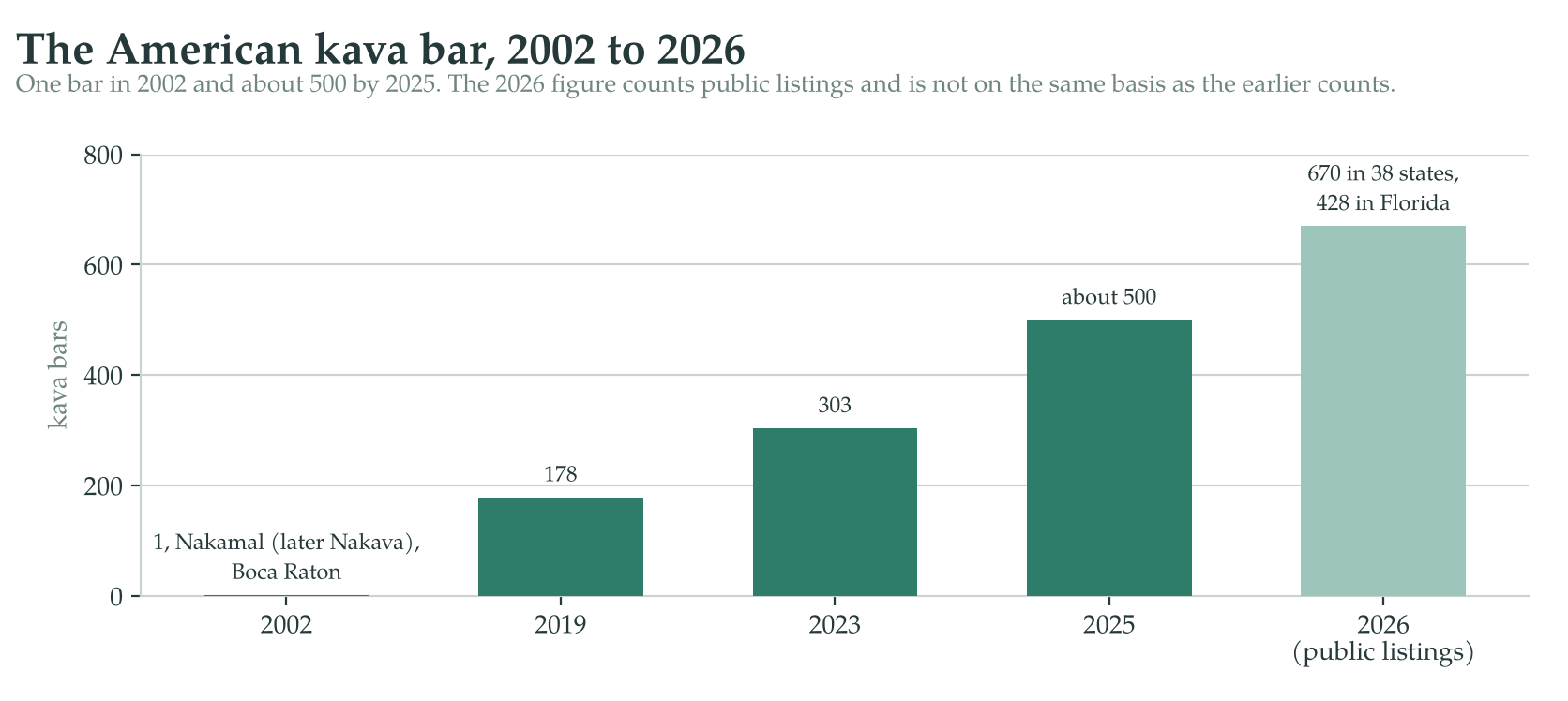
What each house inherited
The houses differ most in how much ritual ancestry they carried into the commercial room. The coffeehouse inherited the Sufi lodge’s night hours and its communal room, but not the shared cup that the jurists condemned, so the gathering survived while the suspect gesture did not. The chocolate house carried over none of Mesoamerica’s ceremonial forms, yet steep import duties and costly preparation reproduced the social exclusivity cacao had held at Maya and Aztec courts, turning London rooms such as White’s and the Cocoa-Tree into aristocratic gathering places that eventually closed into private gentlemen’s clubs (Coe & Coe, 2013; Loveman, 2013). In an American kava bar a customer may still receive a coconut shell filled from a common bowl and hear a round greeted with the Fijian “bula.” The gestures are recognizable, but what brings the drinkers together is different. A group of strangers can buy a round without taking on the roles or obligations of a ceremonial gathering.
Preparation was gendered in all three origins, with kava broken by the virgin, Oromo coffee by the married woman and sacred cacao ground by women set apart. The London coffeehouse was a predominantly male room, although women kept some of the houses (Cowan, 2005), and The Women’s Petition Against Coffee of 1674, whoever actually wrote it, was framed as a complaint from outside the door. The chocolate house became a club for men of rank, and the urban nakamal of Port Vila grew out of the men’s house. The American kava bar, in the authors’ experience, has admitted men and women alike from its founding, the first of the three houses to do so, and its drinkers are now almost evenly divided, 50.3 percent men and 49.6 percent women among past-year users (Mamallapalli et al., 2025, pp. 3–4). Once a drink fills hundreds of urban rooms far from home, however, its history ceases to be local and becomes a question of land, labor and global supply.
Chapter 7. New Grounds: Brazil, Ghana and the American Mainland
Coffee became the world’s drink after planters set it out in Brazil, and chocolate became a mass confection after farmers planted cacao in West Africa. A beverage crop becomes a world commodity only when it leaves home. In both cases the new ground soon outproduced the old, the market grew many times over, and the origin lands had to choose between competing on volume and defending a premium. American-grown kava has begun the same transfer, and this chapter reads the two finished ones for what they tell about the third.
| Crop | Origin | New ground | Lineage moved | Share from new ground |
|---|---|---|---|---|
| Coffee | Ethiopia; first cultivated in Yemen, 15th c. | Java 1696–99; Brazil 1727 | arabica; later robusta | Brazil about 35% (63.0m of 178.8m bags, 2025/26) |
| Cacao | Upper Amazon; Mesoamerica | São Tomé 1824; Ghana c. 1879; Ivory Coast 1905 | forastero | Africa 69.2% (2024/25) |
| Kava | Northern Vanuatu | California and Florida, 2015 on | Kali ISA, Kali Hiwa | small, growing; production confidential |
Note. Data from International Cocoa Organization [ICCO], 2025a; USDA, 2026.
Coffee goes west
Coffee left Africa twice, and the first departure, across the Red Sea, created a monopoly where a world market might have been expected. Coffea arabica grew wild in the forests of south-western Ethiopia, where people gathered its fruit, but Yemeni farmers first cultivated it on terraced mountain farms, and the Sufis of the fifteenth century first made it a prepared drink. The jurist al-Dhabhānī, who died around 1470, is credited with bringing the habit from Ethiopia (Hattox, 1985, pp. 14–22). Ethiopia never commercialized the crop, since coffee there remained a gathered, domestic and largely Muslim drink, forbidden to Christians until the reign of Menelik at the end of the nineteenth century (Ficquet, 2023). After the Ottomans took Yemen in 1538, merchants shipped coffee through Mocha to Cairo, Mecca and Istanbul, and by the early seventeenth century Dutch and English buyers were trading there. For two centuries Yemen was the world’s only commercial source, a single origin with a single port.
The Dutch broke the monopoly, although at first they did not displace the volume. Indian tradition credits the pilgrim Baba Budan with carrying seeds from Mocha to the hills of Mysore, but the East India Company made the decisive move, planting coffee on Java in 1696 and, after a flood destroyed the first planting, again in 1699. Java coffee reached the Amsterdam auctions in the following decade, the first plantation coffee grown outside Arabia, and within five years it had taken the Dutch market: “Whereas 90 percent of Amsterdam’s imports in 1721 were from Mocha, by 1726 90 percent were from Java” (Topik, 2004, p. 12). By 1725 the company shipped about 1,200 metric tons a year from Java and bought almost nothing at Mocha (Marquese, 2023, p. 18). Yet it held Java’s exports below 2,000 tons a year for the rest of the century, so in 1755 Yemen’s 12,000 tons were still 45 percent of the world’s coffee exports (Marquese, 2015, 2023, p. 19).
It was plantation expansion across the Caribbean, rather than Java’s tightly rationed trade, that finally overtook Yemen in volume. Dutch and French colonists carried coffee to Surinam by 1714 and Martinique around 1720, and between 1725 and 1750 the European colonies together came to match Yemen’s output (Allen, 1999; Marquese, 2023, p. 21; Pendergrast, 2010). Saint-Domingue, today’s Haiti, then outgrew them all. Its exports rose from about 3,150 tons in 1755, 12 percent of the world total, to 18,000 tons and 35 percent in 1774, and to 34,650 tons in 1790, half of a world supply of 69,400 tons, while Yemen’s share fell to 17 percent (Marquese, 2015). On the eve of the French Revolution the French colonies supplied two-thirds of the world’s coffee, and more than 80 percent of world production came from the Americas (Topik, 2004, pp. 12, 16). Enslaved Africans grew that coffee, and the revolution they began in 1791 ended the colony’s lead, cutting Haitian production from 40,000 tons in 1789 to 9,000 in 1818 (Topik, 2004, p. 16).
In 1727 the Portuguese officer Francisco de Melo Palheta carried coffee from French Guiana to Pará (Allen, 1999; Pendergrast, 2010), yet the crop stayed small for most of a century. Brazil came last and grew largest. It exported about 1,500 metric tons a year in 1812–16 and 13,560 tons in 1823, less than Haiti’s 16,490 (Marquese, 2023, p. 27). Planters then carried coffee south from Pará to Rio de Janeiro and the Paraíba valley. In 1831 Brazil exported 32,000 tons, as much as Saint-Domingue at its peak, and in 1851–55 it exported 153,000 tons a year, about half of world production (Marquese, 2023, pp. 29, 31). By the 1840s Brazil was the world’s largest producer, and it has never lost that place. Its share of world exports stayed around half until the 1890s and peaked above 80 percent in the 1900s (Abreu & Fernandes, 2005). In 1906 Brazil produced almost five times as much as the rest of the world combined, and about 80 percent of the nineteenth century’s growth in world coffee production took place in Brazil alone (Topik, 2004, p. 19). As in Saint-Domingue, enslaved Africans built this growth until abolition in 1888 (Allen, 1999). In the USDA’s July 2026 tables Brazil grows 63.0 million of the world’s 178.8 million 60-kilogram bags in 2025/26, about 35 percent, and is forecast to grow 71.9 million of 189.7 million in 2026/27 (USDA, 2026), and an earlier USDA forecast put about 24 million of Brazil’s bags as robusta (USDA, as cited in Food Business MEA, 2025).
Coffee leaf rust, Hemileia vastatrix, broke out in Ceylon and southern India in 1869 and 1870 and opened the vacancy that Brazil and its neighbors filled. Between 1870 and 1877 Ceylon’s production fell by almost a third even as the planted area grew, and by the mid-1880s “most of the coffee industry was in ruins,” so its planters turned to tea (McCook, 2006, p. 182). In the lowlands of Java and Sumatra the rust cut production by 30 to 50 percent in a single season, and growers abandoned arabica below 1,000 meters (McCook, 2006, p. 183). Africa, Asia and the Pacific, which had grown about a third of the world’s coffee from the 1830s to the 1870s, grew 5 percent on the eve of the First World War (McCook, 2006, p. 182; Topik, 2004, p. 20).
Brazil’s coffee, meanwhile, had grown “despite depending upon an increasingly aging and expensive slave labor force until abolition in 1888” (Topik, 2004, p. 20), and as abolition approached, planters faced a shortage of hands (Bucciferro, 2021). Brazilian coffee was worth two and a half times as much in 1890 as in 1885, and New York prices in dollars practically doubled between 1882 and 1892 (Bucciferro, 2021; Marquese, 2020). São Paulo paid passage for European families, and immigration into the province rose to 32,000 in 1887 and 92,000 in 1888, with another 1.5 million arriving between 1890 and 1914 (Andrews, 1988). Colombia, Venezuela, Guatemala, Nicaragua, El Salvador and southern Mexico expanded their exports as ocean freight fell (Topik, 2004, p. 22). The rust, McCook concludes, “gave coffee planters in Latin America a decisive comparative advantage in arabica coffee production” that lasted for most of the twentieth century (McCook, 2006, p. 186).
With immigrant labor in hand, Paulista planters doubled the area under coffee to 600,000 hectares, the market could not absorb the surplus, and in 1906 São Paulo began buying the excess crop, the valorization (Dean, 1989). Brazilian output almost tripled between abolition and the first decade of the twentieth century, and within ten years dollar prices fell to a third of their 1893 peak (Marquese, 2020). The authors set the kava case below against this sequence of disease at the old origin, labor crisis at the new, price spike, planting rush and glut, and it fits only in part: kava’s labor drain falls on the origin, not on the new ground, and its prices are led by demand rather than by a collapse of supply. Figure 2 and Appendix Table A1 chart the passing of the lead from Yemen to Saint-Domingue to Brazil.
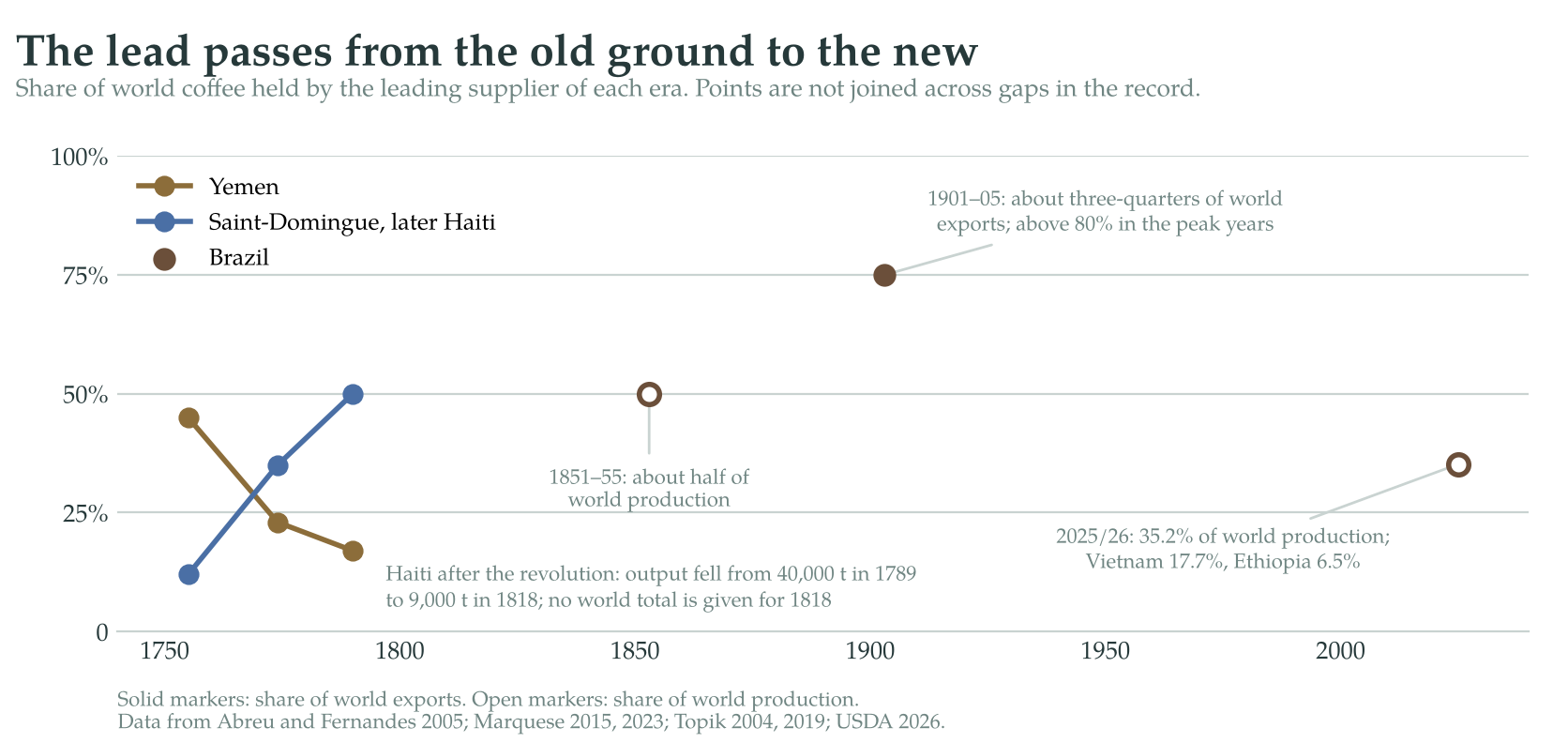
Yemen lost its monopoly and nearly all its share, and its legacy survives mostly as a name, Mocha. Ethiopia, which never depended on exports, kept a vast domestic coffee culture and has become the premium origin of the specialty trade, its regional names (Yirgacheffe, Sidamo, Harar) commanding prices that Brazilian commodity coffee cannot. Hughes (2009) shows that origins that defend their names, as Jamaica’s Blue Mountain and Hawaiʻi’s Kona have done, keep the premium, whereas those that do not see their coffee rebagged under someone else’s. The value that survives a transfer attaches to provenance, and that value holds only where growers keep quality high and defend the name against counterfeiting and adulteration before inferior or mislabeled product dilutes it.
Cacao goes east
One of the present authors, Douglas LaRose, owns some four hundred acres of cacao in Ghana, on ground that grew none until the late nineteenth century, and few facts in this paper show more plainly how fast a crop can move. People in the upper Amazon first used, and probably domesticated, cacao some 5,300 years ago (Zarrillo et al., 2018), and by the second millennium BCE it was in Mesoamerica, where the drink and its name took the form Europeans later met. Its move to Africa reversed an older traffic, which is why the Coes call it “supremely ironic” that West Africa, “from which so many hundreds of thousands had been torn against their will to work as slaves in the white man’s cacao plantations,” became the world’s leading producer (Coe & Coe, 2013, p. 196). In 1824 the Portuguese carried forastero cuttings from Brazil to São Tomé, and around 1850 cacao went to Fernando Po. From there it reached Ghana, then the British colony of the Gold Coast, where tradition credits the blacksmith Tetteh Quarshie with bringing pods home in 1879, then Nigeria, and by 1905 the Ivory Coast (pp. 196–197). By 1911 Ghana was the world’s largest exporter. In a 2012 market report, Africa supplied 70 percent of the world’s cacao and Mexico, “where not only chocolate was born, but the word cacao itself,” supplied 1.5 percent (p. 197). The International Cocoa Organization puts African production at 3.253 million metric tons, 69.2 percent of a world crop of 4.698 million tons, in 2024/25 (ICCO, 2025a).
West Africa’s growers planted forastero, the hardy lineage, and forastero now makes up 80 percent of world production, against 10 to 15 percent for trinitario, the hybrid of the two lineages, and a few percent for criollo (Coe & Coe, 2013, pp. 197, 259). The old ground kept the fine lineage. Mesoamerica’s criollo survived as a premium crop “in luxury confections and in upscale bars of dark chocolate” (Coe & Coe, 2013, pp. 197–198), and the fine-flavor origins of Latin America, Ecuador’s Nacional and Venezuela’s criollos among them, held that tier by controlling what could be planted where (Hughes, 2009).
A century after cacao reached the Gold Coast, researchers have measured its labor problem most carefully in the two countries that grow most of the world’s cocoa. A survey by NORC at the University of Chicago for the US Department of Labor estimated that in the 2018/19 season 1.56 million children were in child labor in cocoa production in Côte d’Ivoire and Ghana, 790,647 in Côte d’Ivoire and 765,754 in Ghana, or 45 percent of the children in agricultural households in the cocoa-growing areas, and that 1.48 million, 43 percent, were in hazardous child labor (NORC at the University of Chicago, 2020). Between 2008/09 and 2018/19 the prevalence held steady in the high-production areas and rose in the medium- and low-production areas (NORC at the University of Chicago, 2020). Communities reached by several interventions in combination were 25 percentage points less likely to have a child in child labor, and 28 points less likely to have one in hazardous work (NORC at the University of Chicago, 2020). Ghana and Côte d’Ivoire built a market that fed the world’s chocolate, and the households least able to bear part of its cost bore it. That record lies behind the demand that cocoa trace every bean to its plot.
Kava comes to the mainland
Hawaiʻi’s ʻawa, nearly lost by 1948, was replanted from its surviving cultivars, which DNA fingerprinting has since shown to be mostly somatic mutants of a single clonal source carried by the first Polynesian settlers (Lebot et al., 1999). Kava’s homeland is wider than coffee’s or cacao’s, and its first new ground was itself a Pacific island. In the mid-1980s Vincent Lebot introduced seven cultivars from Pohnpei, Samoa, Tonga and Papua New Guinea to widen that narrow base, among them Isa and Iwi from Madang. Staff propagated them at the University of Hawaiʻi’s Lyon Arboretum and planted them at the National Tropical Botanical Garden in Hāna (Johnston & Rogers, 2006, p. 58). By 1996 a supermarket on Oʻahu was selling Isa as nursery stock, and in 1997 the Association for Hawaiian ʻAwa took cuttings of Iwi and the Tongan cultivars from Lebot’s collection in Hāna (Winter, 2004, p. 153). Vandenbroucke et al. (2015) record their Isa and Iwi accessions as coming from a nursery in Hilo. Hawaiʻi thus did for kava what Yemen did for coffee, a first new ground beside the homeland where growers kept the crop alive and carried it onward.
Between 2013 and 2019 Tyler Blythe acquired Isa, the Hawaiian cultivar Hiwa and 20 other cultivars from established growers in Hawaiʻi and elsewhere to study how the plant might grow outside the tropics, and in 2015 he began planting them in California, selecting from that year on the single criterion of survival through mainland winters and summers. The most tolerant individuals went to tissue culture. The first generation, grown out in 2017, proved cold-tolerant, and successive generations have been acclimated and re-cultured. A Kali ISA plant in Sarasota has survived several hard freezes, with temperatures down to 29 °F, and has kept growing in the years since; after two years in full sun on unamended sandy soil it assayed 19.9 percent kavalactones in its lateral roots (Blythe, 2026a, Table 6; Kali Kava, n.d.). Lateral roots assay higher than whole root, so the figure is not comparable with whole-root or raw-material values, and the same assay exceeded the Harmonized absolute flavokavain limit (Appendix Table A8). The line now grows on commercial farms in Florida and California, alongside Kali Hiwa, derived from the Hawaiian Hiwa, and four other varieties that were chosen for the Florida climate. The Association has published the propagation methods developed for it, from tissue culture and soft-stem cuttings to outdoor air layering and aeroponic micro-cuttings (Blythe, Bowman, & Masifilo, 2026a, 2026b; Blythe, Bowman, & McDonnell, 2026).
Blythe made the acquisitions when Hawaiian ʻawa was itself at risk, its commercial planting of the late 1990s having collapsed with the European extract market. The University of Hawaiʻi’s kava specialist concluded that “Hawaii, a high cost producer, was not competitive with other Pacific producers” (Bittenbender, 2009, p. 6), and the state’s kava statistics series ended with the 2003 report (U.S. Department of Agriculture, National Agricultural Statistics Service [USDA NASS], 2003). The Pacific cultivars planted in the research collections of the 1980s “were not properly cared for and could not be considered viable” by 2002 (Winter, 2004, p. 19). In the authors’ account, one of the few commercial growers still operating, who is not named here, facing the end of his farm lease, feared no one would carry the planting on, since Hawaiian families were leaving for the mainland and the drinking of ʻawa, let alone its growing, was in decline. He asked that the plants be established in California or Florida and kept for future generations. The census bears him out. Less than half of the Native Hawaiian population, 46.7 percent, lived in Hawaiʻi in 2020, against 55.0 percent in 2010 (Rico et al., 2023), and among the states that received them were California, with 95,165 Native Hawaiians, and Florida, with 13,085, a rise of 63 percent in the decade (Hawaiʻi Department of Business, Economic Development and Tourism, 2023). The authors therefore regard the mainland plantings as both a commercial enterprise and ex situ conservation of Hawaiian and Pacific cultivars, made at a grower’s request.
Any new ground now faces the question of whether its plants moved under agreed terms. Coffee’s and cacao’s did not; the cuttings and seeds that founded the coffee of Java and Brazil and the cacao of São Tomé and the Gold Coast traveled by purchase, gift, colonial order and occasional stealth, and the Pacific’s own coffee arrived the same way, reaching Vanuatu in 1852 and Papua New Guinea from Java, Jamaica and Kenya from the 1880s onward (Commonwealth Scientific and Industrial Research Organisation & Secretariat of the Pacific Regional Environment Programme, 2023; MacWilliam, 2018, pp. 4–5). Modern biodiversity law drew new boundaries without reaching backward. Neither the 1993 Convention on Biological Diversity nor the 2014 Nagoya Protocol is retroactive (European Parliament and Council, 2014, Article 2(1); United Nations Treaty Collection, 2026a, 2026b). Fiji, Samoa, Vanuatu and Tonga belong to the Protocol, whereas Papua New Guinea belongs only to the Convention, the United States has ratified neither, and kava sits outside Annex I of the FAO Plant Treaty (FAO, 2001; Secretariat of the Convention on Biological Diversity, 2011; United Nations Treaty Collection, 2026a, 2026b). Although Vanuatu’s Kava Act forbids exporting planting material (Republic of Vanuatu, 2002, Section 9), the mainland lines fall outside all of those restrictions: Isa entered Hawaiʻi in the mid-1980s before the Convention existed, Hiwa descends from Polynesian settlement, and the authors acquired both domestically in Hawaiʻi without collecting or exporting material from any foreign Pacific state.
In the authors’ view, kava’s movement continues the ordinary traffic of agriculture by which canoe settlers once carried cuttings out of Vanuatu to Fiji, Tonga, Samoa, Pohnpei and Hawaiʻi. Because sterile clones never reproduce in the wild, kava has naturalized nowhere in three millennia under standard botanical criteria (D. M. Richardson et al., 2000, p. 93); it survives only where people tend it. Research on Hawaiian ground has already returned knowledge to the Pacific, showing Papuan Isa to be “perhaps the most productive – kavalactone lb/acre/yr – variety known” and comparing its chemistry directly against Hawaiian Mahakea (Bittenbender, 2009, p. 6; Wang et al., 2015). Standing outside a treaty does not erase obligation, however, and coffee and cacao show what workable reciprocity looks like through two-way institutions such as CATIE in Costa Rica and the cacao genebank and quarantine collections in Trinidad and Reading.
The authors propose three reciprocal commitments of that kind for kava: a public provenance register covering Pacific as well as mainland plantings, joint field trials co-authored across both regions, and mutual exchange of clean stock, propagation methods and dieback research among participating partners. That provenance record matters inside the Pacific as much as outside it, because national cultivar lists codified in recent surveys and regional standards freeze recent, often informal inter-island transfers alongside ancient heirlooms. Comparative studies found Samoan ʻAva Lea morphotypically and chemotypically identical to Hawaiian Nēnē (Lebot et al., 1999, p. 415), and microsatellite genotyping matched Fijian Honolulu, recorded in Fiji’s quality manual and Codex list as Yonolulu alongside another recent Fijian accession called Vanuatu, to Hawaiian Hanakāpīʻai across all 66 scored alleles (Codex Alimentarius Commission, 2020; Lebot et al., 2024, pp. 5–6, 14; PHAMA Plus, n.d., pp. 18–19). In Solomon Islands, where kava arrived from Vanuatu only in 1961 (United Nations Conference on Trade and Development [UNCTAD], 2024, p. 11), the three varieties now listed in Codex, Feo, Temo and Tahu, likewise derive from Vanuatu stock, with Feo and Temo tracing to noble Borogu and Melomelo lines while Tahu clusters genetically with Vanuatu two-day varieties alongside Palisi in a class that on Pentecost includes Laklak (Codex Alimentarius Commission, 2020; Lebot et al., 2024, pp. 6, 14; PHAMA Plus, 2013, p. 40). Understanding that modern standards catalog unrecorded transfers carried without origin permission alongside traditional cultivars gives Pacific governments as much reason as mainland growers to build an open lineage register.
Reciprocity, however, has to run in both directions. The Forum’s regional strategy urges members to restrict outside access to germplasm (Pacific Islands Forum Secretariat [PIFS], 2024, pp. 29, 31), and in the authors’ experience some Pacific institutions extend that caution to agronomic information. Cooperation cannot mean a one-way transfer of research and improved, climate-acclimated lines from America back to the islands simply because mainland growers encountered those cultivars and refined them, particularly in the face of opposition from origin bodies. Naming a parent cultivar to disclose lineage is, in the authors’ view, honest attribution, whereas using a Pacific place or cultivar name to claim an origin a product lacks is misrepresentation. The Nagoya Protocol does not decide the question of naming. Its Article 7 concerns prior informed consent and mutually agreed terms for access to traditional knowledge, and Article 12.1 asks Parties to consider customary laws and community protocols, provisions that point toward seeking the consent of the communities whose cultivar names are used (Secretariat of the Convention on Biological Diversity, 2011).
The parallels with Brazil and Ghana are close. Kava has stepped into a subtropical climate next to its largest consuming market, where growers select for winter cold, summer heat and full sun using a hardy Papuan lineage, much as forastero carried cacao into West Africa and robusta carried coffee into Vietnam. Because Pacific export bans and access rules now bar fresh movement of island planting stock, the few growers who already hold adapted mainland lines, the first author among them, hold most of the material from which cultivation outside the Pacific can spread. That concentration is a risk as well as an opportunity, for if the material moves on without provenance or agreed terms the islands will have no say in where it goes. Kava’s clonal biology favors that role, since most traditional forms arose as somatic mutations governed by relatively few genes (Lebot et al., 1991; Lebot et al., 1999), and in the authors’ experience the cold and heat tolerance of the selected lines has held across successive clonal generations. Because the plants are clones, the authors read this as selection among somatic variants rather than a heritable effect of acclimation, and any carry-over through tissue culture, epigenetic or otherwise, remains a hypothesis to be tested. Any onward distribution from mainland stock should carry full lineage provenance and move only under genuinely two-way agreements in which partner institutions share germplasm, field data and research access in return.
In January 2026 Fiji’s agriculture minister said that about 20 percent of the country’s kava farmers were affected by dieback, which had re-emerged in the previous two to three years (Naimatau, 2026b). Kava’s new ground is opening under pressures that resemble coffee’s, as demand rises at home and abroad (the next section shows how) while disease, a slow crop and labor slow the growth of the origin’s supply, although, as the section also shows, the balance between them differs. Dieback, caused by cucumber mosaic virus and spread by aphids and infected cuttings, is the crop’s “single most important constraint in Fiji and other Pacific islands,” and has “almost destroyed” entire plantings in Fiji, Tonga, Vanuatu and Samoa (R. I. Davis & Brown, 1999, pp. 13, 25; R. I. Davis et al., 1996). Root-knot nematodes are widespread, and growers often see roots “seriously debilitated” by them, although no one has measured their economic effect on kava (R. I. Davis & Brown, 1999, pp. 28–29). Labor is the third pressure and the one closest to Brazil’s. Australia’s and New Zealand’s seasonal schemes, built for fruit picking and horticulture, employ by recent estimates the equivalent of 15 percent of the working-age population of Tonga, 11 percent of Vanuatu’s and 2 percent of Fiji’s (Edwards et al., 2023), and where participation is high, households report local shortages of labor for planting and gardens (Craven, 2015; Petrou & Connell, 2025).
In 2024 Vanuatu’s agriculture minister named the seasonal schemes as a cause of the shortage that by August 2025 had doubled the green price in Luganville (Vanuatu Business Review, 2025). A former chairman of the Vanuatu Kava Industry linked the shortage to farmers joining the schemes, to Cyclone Harold and to demand in Port Vila (RNZ Pacific, 2025). Fiji’s minister cited “decreased labour, simply because there are other options and opportunities for our labourers” (Naimatau, 2026b), and in August 2026 Vanuatu’s agriculture minister said that “Vanuatu does not have enough kava” (Vanuatu Daily Post, 2026). Brazil differs in the direction and the terms of the labor’s movement. São Paulo lost coerced workers and replaced them with subsidized immigrants, whereas the Pacific’s growers are free people choosing better-paid work abroad, and in parts of Vanuatu where kava could be grown and sold, people showed little enthusiasm for guestwork at all (Petrou & Connell, 2025). Prices have risen because demand has outrun a supply that is still growing, not because harvests failed, and Vanuatu’s Treasury attributes high kava prices to demand (Vanuatu Department of Finance and Treasury, 2026b). The shortage is nonetheless acute. Luganville bars closed on some nights in 2025 and some farmers harvested one-year-old plants rather than wait about three years (Vanuatu Business Review, 2025), and in June 2026 deliveries to Port Vila sold out within an hour at VT 1,500 a kilogram of green kava (Vanuatu Business Review, 2026). On a visit to Port Vila in late 2026 the third author found some bars closed for want of kava and others serving two-year-old root and stems.
Fiji’s 2020 census counted 57.3 percent of farmers aged forty or over and 15.4 percent aged sixty or over, and its agriculture ministry warns that “the age of farmers around the world and in Fiji continues to rise” (Fiji Ministry of Agriculture, 2021, 2022, p. 3). Seasonal work is the most visible drain on the origin’s labor, but slower drains are harder to reverse, and the same ministry explains why the young are slow to replace the old. Agriculture, its youth policy says, “brings an image of hard work, long grinding hours, little financial return, low social status and remaining beholden to community needs,” and is “often seen as the default option for those who are unable to succeed elsewhere – the so-called ‘drop-out’ option” (Fiji Ministry of Agriculture, 2022, p. 7).
Schooling pulls the same way. On Lamen island in Vanuatu, Smith (2018, p. 49) found that young people “are increasingly undertaking secondary school, which involves them leaving the island and taking up residence in boarding schools,” where “they do not learn the gardening skills that were once essential to making a living,” and concluded that “rather than work the land, it seems that youths will be more likely to go to town in search of work or opportunities to work overseas.” Lamen households also named school fees among their commonest reasons for seasonal work abroad (Smith, 2018, pp. 35, 46), so one drain pays for the other. Vanuatu’s statistics office identifies the main movement of young people as “from rural to urban areas to take advantage of better education and employment opportunities” (Vanuatu National Statistics Office, 2012, p. 23), and Petrou’s study of Paama islanders in Port Vila finds that they regard moving for schooling, work and health care less as a choice than as a necessity (Petrou, 2020).
Permanent migration then removes part of the cohort altogether. New Zealand’s Pacific Access Category grants residence to up to 250 Fijian and 250 Tongan citizens a year, and its Samoan Quota to up to 1,100 Samoans (Immigration New Zealand, 2026). Since June 2024 Australia’s Pacific Engagement Visa has added up to 3,000 permanent places a year, of which 300 are allocated to Fiji, 150 to Vanuatu and 150 to Tonga for 2026–27 (DFAT, 2026). All three schemes take only applicants aged eighteen to forty-five, the years in which a grower plants, weeds and digs a kava garden. In Tonga, recorded departures exceeded arrivals by 6,950 in 2023 (Tonga Statistics Department, n.d.). None of these pressures is peculiar to kava, but kava feels them more than most crops, because growers propagate it from cuttings, tend it for years before harvest and dig it by hand. Its supply depends on young people who stay on the land long enough to see a planting through.
Where the market stands
In the 1880s coffee’s Old World origins were losing their crop to leaf rust, Brazil’s planters were losing enslaved labor, prices nearly doubled within a decade, and growers across the Americas planted into the gap. The kava market of 2026 resembles that turn only in part. Its evidence points to growth led by demand rather than a collapse of supply. Vanuatu’s production is growing, but its own nakamals absorb the increase, so that its exports have barely moved over twenty-five years while Port Vila’s bars run short (Section 9.4), and the labor drain falls on the origin rather than, as in Brazil, on the new ground. Kava’s origins face viral dieback and root-knot nematodes while seasonal farm work in Australia and New Zealand, secondary schooling in town and permanent migration draw working-age hands away from village gardens, and the green price in Luganville doubled in 2025. The first commercial plantings on new ground show that the crop can be grown on the mainland, but their production has not been disclosed as of yet. American growers are choosing to keep it confidential, although the authors’ plantings already supply their own bars and a select few other bars within their network. A demand-led expansion predicts high prices alongside rising Pacific volumes, which is what the figures for 2024 to 2026 show. Its risk is not coffee’s supply gap but a synchronized planting response to the prices of 2025 and 2026, in the islands and on the mainland, which would bring the harvests of 2028 to 2031 to market together, the mechanism behind coffee’s 1890s surplus and the valorization of 1906.
Kava made up 68.5 percent of Vanuatu’s domestic exports in 2024, when the crop earned VT5.3 billion (about US$43.5 million), up from VT3.3 billion in 2022 and VT4 billion in 2023, according to the director of the country’s statistics office (Pacific Islands News Association, 2025). Fiji’s exports rose from FJD 8.9 million in 2015 to FJD 53.5 million, 730.9 metric tons, in 2024, and to FJD 79.1 million, 1,015.7 tons, in 2025 (Ministry of Agriculture, Waterways and Sugar, 2026). Its government has set a target of FJD 250 million by early 2028 (Fiji Ministry of Agriculture, 2025b). American buyers took FJD 30 million of Fiji’s 2024 exports by value, 56 percent, and 349 of its 730 tons, and one exporter, Lami Kava, ships about 80 percent of its product to the United States (Fiji Ministry of Agriculture, 2025a). Fiji’s agriculture minister has described the American kava market as worth more than one billion US dollars (Fiji Ministry of Agriculture, 2025b).
Solomon Islands received kava from Vanuatu in 1961, first grew it in Santa Isabel province, and for almost forty years had little national market for it (UNCTAD, 2024, p. 11). Exports began only in 2000, and by 2010, without dedicated legislation, the country was shipping up to 50 metric tons a year of dried kava powder to Kiribati, Fiji and the United States (UNCTAD, 2024, p. 11). Its foreign ministry put kava exports at SBD 26 million in 2021 and SBD 4.6 million in 2022, mainly powder and dried chips, and reported a national kava development policy and export strategy in draft (Solomon Islands Government, 2023). The fall between those two years shows how thin a young origin’s trade can be, yet root from Solomon Islands already reaches Florida’s kava bars through Long Beach and Los Angeles (Blythe, 2026b).
Before the first sakau bar opened in Kitti in 1972, no one on Pohnpei bought or sold sakau (Merlin & Raynor, 2005). By 1996 more than a million pounds entered the commercial economy, earning at least US$3 million for growers and business people. Pohnpei is the clearest case of a kava economy that commercialized at home before it exported. About fifty licensed bars, retail stores and many unlicensed temporary bars consumed an estimated 477,000 kilograms a year, exports of pounded and frozen root and liquid extract to Pohnpeians in Guam, Saipan, Hawaiʻi and the American mainland ran at about 40,000 kilograms a year in 1995–2000, and growers harvested another 660,000 kilograms each year for customary use and family consumption (Merlin & Raynor, 2005). The forest paid the cost. Farmers put most of the new planting into the uplands, where sakau grows fast, and intact native forest fell from 42 percent of the island’s land area to 15 percent between 1975 and 1995, a loss of nearly two-thirds of that forest in twenty years, which Merlin and Raynor attribute principally to sakau cultivation and put at more than 70 percent of the native forest remaining in 1975 (Merlin & Raynor, 2005). Conservationists answered with a “Grow Low” campaign to move planting back to the lowlands near the villages, which had distributed more than 600,000 planting bags by 2003, and with a proposal for a certified low-grown sakau that could command a premium (Merlin & Raynor, 2005). In a 2019 survey, 71 percent of adults sampled in Kolonia and 58 percent in rural Mand had drunk sakau, and 52 percent of Kolonia’s drinkers always bought bottled market sakau or drank in bars, against 21 percent in Mand. One family business in Kolonia reported sales of about US$7,000 a month (Sakai & Nakazawa, 2022). Pohnpeians still serve sakau at feasts, marriage proposals and rites of forgiveness (Sakai & Nakazawa, 2022), and the ceremonial drink and the commercial one coexist.
Between 23 September and 4 October 2024 a University of Florida team surveyed an online panel, and the result, published in 2025, is the first national estimate of American kava drinking. Although the title calls the sample nationally representative, a marketing company recruited respondents by non-probability sampling from people who had agreed to take surveys, and the design filled a quota of 1,000 kava users within a final sample of 2,000 (Mamallapalli et al., 2025, pp. 1–2). Of 9,366 adults who began the survey, 1,000 had used kava in the past year (Mamallapalli et al., 2025, p. 2). With a user quota, that ratio of 10.7 percent, about one adult in nine, is a screening rate in an opt-in panel, not a population prevalence, and opt-in panels are known to overstate rare behaviors because some respondents answer falsely (Mercer, Kennedy, & Keeter, 2024). Applied to the 267.0 million Americans aged eighteen and over in July 2024 (U.S. Census Bureau, 2024), the rate would correspond to about 28.6 million adults. The extrapolation is the present authors’, not the study’s, and they read it as an upper-bound indication.
The sample was far from the American adult population. The largest age group was thirty to thirty-nine (32.4 percent of users), men and women were almost evenly divided (50.3 and 49.6 percent), and 71.5 percent held a college degree or higher, 81.6 percent worked full-time and 67.3 percent reported household incomes of US$100,000 or more (Mamallapalli et al., 2025, pp. 3–4). Of past-year users, 59.4 percent usually drink kava at home and 42.3 percent at a kava bar, while 33.7 percent buy it regularly at kava bars, 30.1 percent on the internet and 27.5 percent from brand websites. The traditional beverage remains the form most used, by 50.7 percent of users in the past year and 39.9 percent in the past thirty days (Mamallapalli et al., 2025, p. 6). Social media was the most common first source of information about kava (36.2 percent), ahead of friends or family (34.3 percent) and kava bars (30.3 percent) (p. 6). Users most often rated it effective for relaxation and stress relief (88.1 percent) and described its effects as happy, relaxed and friendly (p. 1). The survey therefore does not show that the bar recruits most new drinkers. It shows the bar as one of three first sources of similar weight, beside social media and friends or family, among users who drink more often at home than at the bar. Kava bars are not yet found in every town, so many users could have met kava first only online or through friends, and the bar’s share as a first source can be expected to change as the public house for kava spreads.
For the origin islands, the older crops show that a new ground can be an opportunity or a threat, and that the origin’s own conduct decides which. The coffee and cacao markets grew so much that origin producers could sell more in absolute terms than before, yet Yemen and Mexico, which did not protect their names and planting material, lost their share, whereas Ethiopia, Kona and the fine-flavor cacao origins kept a premium identity, and Ecuador grew by planting productive material of its own (Section 9.2). Kava has advantages coffee and cacao lacked, because its transfer is happening without slavery or colonial coercion, Vanuatu and Fiji already defend noble standards and national names, and the islands have so far met the American market’s growth overwhelmingly. The model the authors propose for American-grown kava is therefore complement, not substitution, with a fresh, traceable, domestically grown supply alongside a growing Pacific import trade and origin identities protected on both sides. Whether it holds is an empirical question, and Section 9.6 names the indicators that would answer it.
The older crops show both outcomes. A new supply complements the origin when it recruits drinkers who would not otherwise have bought the drink, fills a season or a format the origin cannot, or sells into a distinct tier. It substitutes when it takes the same customer for an undifferentiated product at a lower price, as Brazilian coffee did to Yemen’s trade and West African cacao to Mexico’s. Four variables will decide the outcome for kava. The first is relative price, which depends on the cost of mainland cultivation. No mainland production cost has yet been published, including by the authors, although they expect labor and land to keep it above the islands’. The second is security of supply through the harvest lag and the seasons, the third differentiation by cultivar, freshness and declared origin, and the fourth whether total demand keeps growing faster than either source of supply. If American output stays small and differentiated while the market grows, the record points to complement; if American kava competed on price in the bulk trade in dried root, it would point to substitution.
Names on the cup: Geographical indications and origin fraud
Coffee and cacao origins kept their premiums once bulk production moved elsewhere by turning place-names into enforceable legal rights, whether through European appellation registers or, in markets such as the United States, Canada and Japan, certification and trademark law (Hughes, 2009, p. 5). Formal protection arrived late for both older crops, mostly after Brazil, Vietnam and West Africa had already captured the volume trade: Colombia’s Juan Valdez mark in 1960 and Café de Colombia in 2005–2007, Venezuela’s Chuao in 2000, Ecuador’s Cacao Arriba in 2009 and Modica chocolate in 2018 (Appendix Table A2). Ethiopia won recognition for Harrar, Yirgacheffe and Sidamo only after the U.S. Patent and Trademark Office initially refused two of the names on genericness objections backed by the National Coffee Association and an Oxfam campaign brought Starbucks to sign royalty-free licensing agreements in 2007 (Hughes, 2009, pp. 6–8; Oxfam Australia, 2007; World Intellectual Property Organization [WIPO], 2007). Where growers pair a famous place-name with laboratory proof, even ordinary unfair-competition law has teeth. In Corker v. Costco Wholesale Corp. (2019), Kona farmers sued twenty-one retailers and distributors under the Lanham Act after elemental testing and a simple harvest balance showed more than 20 million pounds of coffee sold annually as “Kona” from a belt harvesting roughly 2.7 million green pounds, recovering more than US$33 million in settlements (Daily Coffee News, 2023; Hughes, 2009).
Kava has the chance to reverse that defensive sequence by protecting its origin names before new grounds scale, and on the mainland the American Kava Association’s certification program, in use since 2023 and the subject of a certification-mark application filed in 2025, already separates domestically grown root from Pacific imports at the outset. Across the islands, the Pacific Islands Forum’s Regional Kava Development Strategy 2024–2028 notes that “there is currently no specific intellectual property (IP) right protecting the denomination ‘KAVA’” and proposes regional geographical-indication protection backed by registries of farmers, exporters and varieties (PIFS, 2024, pp. 21, 33–36). WIPO held stakeholder consultations in Port Vila in October 2024 as Vanuatu drafted national geographical-indication legislation (Tabureguci, 2024; WIPO, 2024), and in 2025 regional producers signed the Pacific Kava Origin and Place Declaration to safeguard “KAVA,” “Pacific KAVA” and “Pacific Islands KAVA” against market misrepresentation (Islands Business, 2025). Published specifications protect buyers as well as island growers against the trade’s four recurring substitutions: Selling one island’s root as another’s, blending two-day or wild root as noble, grinding stems and peelings into root powder, and laundering origin through offshore extraction, as when Vanuatu root is shipped to China for extraction and re-exported to the United States (Tabureguci, 2024).
The first of those four risks is built into the structure of the Pacific trade itself. In March 2026 Fiji’s finance minister remarked that the country “can’t even satisfy the local market” (Naimatau, 2026a). Fiji harvests an estimated 4,000 to 4,500 metric tons of dry kava a year (Mohanty, 2017, p. 10), yet domestic bowls absorb most of it, making Fiji a steady kava importer since 2002 to keep its export packhouses supplied. Imports rose from 124 metric tons in 2017 to 268.0 tons worth FJD 14.5 million in 2022, when Vanuatu supplied 231 tons and Papua New Guinea 36 tons against Fijian exports of 498.1 tons worth FJD 40.7 million (DT Global, 2023; Ministry of Agriculture, Waterways and Sugar, 2026). By 2025 Papua New Guinea had overtaken Vanuatu by weight. Official Fiji Bureau of Statistics returns record 824.9 metric tons of kava imports worth FJD 41.2 million in 2025, valued on arrival, of which 529.1 tons worth FJD 18.7 million came from Papua New Guinea and most of the rest, worth FJD 21.8 million, from Vanuatu, so that imported root equaled four-fifths of the 1,015.7 tons Fiji exported that year (Ministry of Agriculture, Waterways and Sugar, 2026). Pacific Trade Invest now calls Fiji “an unofficial kava import hub for the Pacific” (Pacific Trade Invest Australia [PTI Australia], 2026), and in October 2026 Fiji’s deputy prime minister cited FJD 48 million in kava imports alongside FJD 79 million in exports, figures for which no period was given and which the official annual return does not match (Fijivillage, 2026). The island best known to overseas buyers is increasingly a port of consolidation rather than the field of origin.
Re-export is lawful, but its margins are the ones in which misrepresentation has historically taken root. In 2026 the deputy prime minister also said that some exporters were sourcing kava from Vanuatu and Papua New Guinea for re-export because Fiji had not grown enough to replace the imports (FBC News, 2026b). The Fiji Sun’s investigation of thefts from containers at Suva port quoted the Minister for Agriculture, Tomasi Tunabuna, on kava bought from those two countries at FJ$50 to FJ$80 a kilogram and re-exported to China and India at more than FJ$200 (Fiji Sun, 2026b). A Papua New Guinea exporter told RNZ Pacific that Fiji is his company’s main market, and that Fiji’s biosecurity rules admit Papuan kava only as whole roots or chips, not as powder (RNZ Pacific, 2026). In September 2026 Fiji’s health authorities began requiring a declaration of origin, traceability documents and chemotype testing for every imported consignment, including kava for repacking and export (Kumar, 2026). The minister’s example implies root leaving at two and a half to four times its purchase price. Across all trade in 2025 the margin was smaller, with exports averaging FJD 77.9 a kilogram against imports at FJD 49.9 (FJD 35.3 from Papua New Guinea), a ratio of about 1.6 (Ministry of Agriculture, Waterways and Sugar, 2026). Even at that margin, a trade in which imported root can leave a Fijian port as Fijian is the structure in which the Kona problem arose, because the buyer abroad sees the port of shipment and not the field where it is grown. The Kona farmers’ proof was the balance of 2.7 million pounds grown against more than 20 million pounds sold under the name, and the same balance can be struck for kava by setting a country’s exports under its own name against its exportable harvest once the home market has drunk its share.
Fiji’s kava trade in both directions between 2013 and 2025, tabulated in Appendix Table A3 and charted in Figure 3, shows how much of the trade now passes through the country.
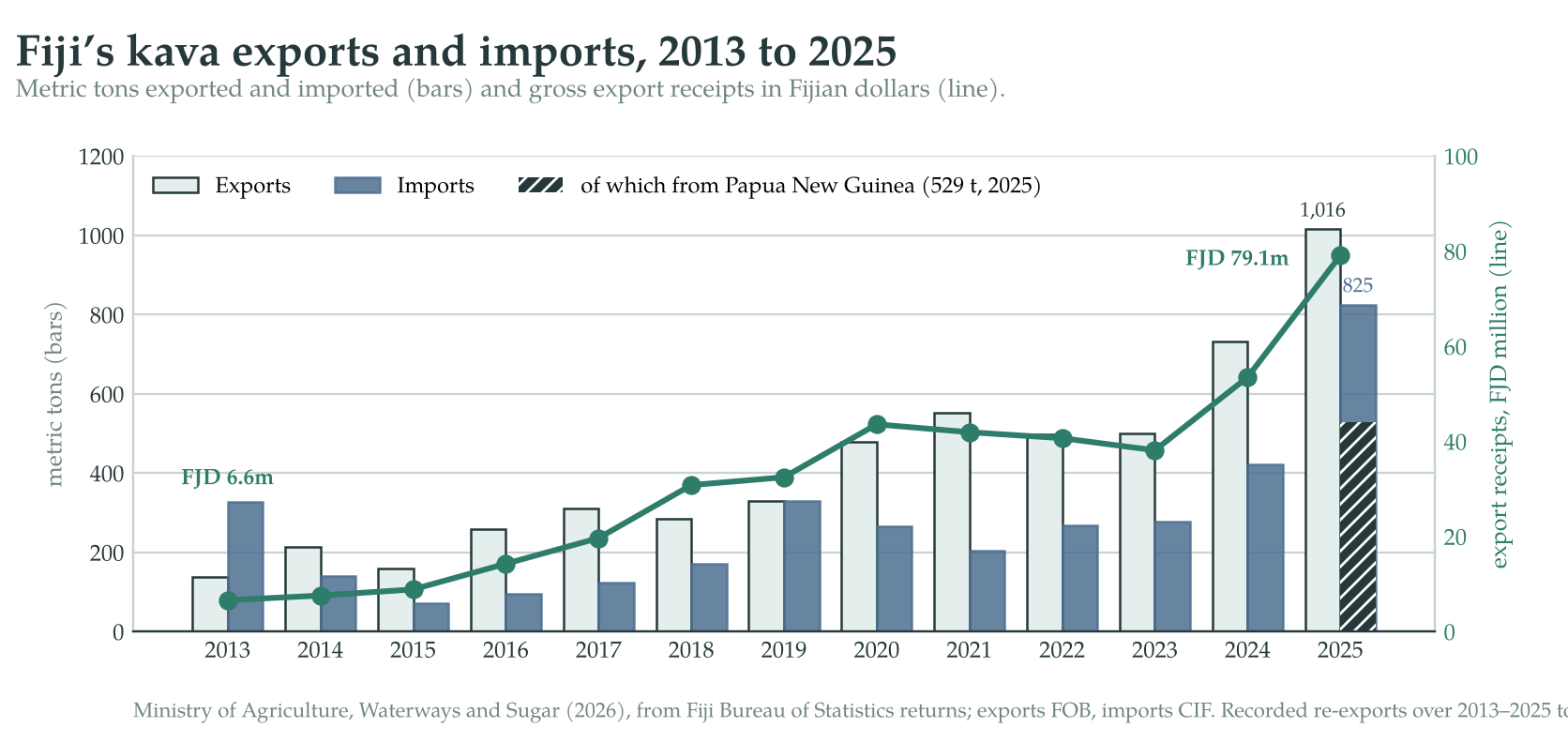
The geographical indication is therefore the decisive legal instrument for the Pacific trade. Once Fiji Yaqona, Vanuatu Kava and the other place-names are registered with a published specification and a register of farmers and exporters, as the Forum’s strategy proposes (PIFS, 2024, pp. 33–36), kava grown in one country and shipped through another can be sold lawfully only under its true origin. A re-exporter who sells Papuan or ni-Vanuatu root as Fijian then infringes a registered right in every market that recognizes the indication, and customs and food authorities gain grounds to detain the consignment at the border, as Fiji’s own authorities already can with imported kava that fails its documentation. The indication protects the growers of the transit country, whose name is at risk, and equally those of the source countries, because Vanuatu and Papua New Guinea would sell their root under their own names and earn the premium those names command, instead of supplying raw material for others to finish. Fiji has begun to write the offense into its own law. The Yaqona (Kava) Bill 2026 before Parliament makes it an offense to represent “any yaqona or yaqona product as originating from Fiji” falsely, with fines of up to FJD 100,000 for a company and FJD 10,000 or two years’ imprisonment for an individual, and it requires a license from the Fiji Yaqona Council to import or export kava (Fiji Sun, 2026a). The Bill protects the name at home, whereas a registered indication would carry the same protection into every market that recognizes it. In the American market, a registered specification combined with the Lanham Act remedy the Kona farmers used would turn “Fijian kava” from a description on a sack into a claim that can be tested and enforced in court.
In the largest consuming market, the legal remedies already exist; what kava lacks is published specifications and forensic reference data. Under American law, certification-mark infringement, false designation of origin under the Lanham Act, federal food-misbranding rules and country-of-origin customs marking already bar passing off imported or blended root under another place’s name. Flavokavain-to-kavalactone assays already separate noble from two-day kava (Lebot et al., 2014), and kavalactone profiles distinguish cultivar groups without proving geographic origin on their own (Blythe, 2026a). Proving which island or state grew a root will require the elemental and isotopic fingerprinting that authenticated Kona coffee, an obvious joint task for Pacific laboratories and trade organizations such as the Kava Coalition and research organizations such as the American Kava Association.
At the same time, the older crops show where a geographical indication stops. No country owns coffee, cacao or chocolate. What is protected is Kona, Blue Mountain, Yirgacheffe and Darjeeling, places and not plants, and there the older crops mark where a GI stops. When the European Union reserved the trade name “sardines” for a single species, the WTO Appellate Body found the regulation inconsistent with the relevant Codex standard (World Trade Organization [WTO], 2002), and Pacific lawyers have noted that the plant’s universal common name complicates any claim to the word itself (Kelly, 2024). Some Pacific voices go further than the declaration’s place-names. Fijian reporting has described it as limiting the name kava to seven growing countries (Biutu, 2025), and a Vanuatu official has disputed the use of the name for American-grown plants of Hawaiian stock (Tabureguci, 2024). That reading would exclude Hawaiʻi, whose ʻawa is as Polynesian as Tonga’s kava, and it would run against the Codex regional standard of 2020, which defines kava beverages by cultivar and plant part, not by country. That definition cuts both ways, since its cultivar list admits Hawaiʻi’s noble ʻawa but not the Isa-type lines grown on the mainland. The coffee and cacao precedent points to a firmer settlement, in which the place-names, Vanuatu Kava, Fiji Yaqona, Tongan Kava, Samoan ʻAva, Hawaiian ʻAwa and Pacific Kava, are protected with registered GIs and certification marks enforced by testing and traceability, the species name is left as the Codex defines it, and every product must state its origin. The same disclosure rule protects Pacific sellers from having American-grown or blended material sold under their names, and American growers and buyers from imported material sold as American-grown. The American Kava Association’s certification mark carries an “American Grown” designation for kava grown and processed in the Americas. In US law this is a geographic certification mark, the tool by which the United States protects origin names such as Idaho potatoes and, for foreign producers, Darjeeling. It certifies where the kava was grown and leaves the word kava free, the settlement this paper proposes for the Pacific names. (The related U.S. trademark and certification-mark applications, their owners and their status are set out in the conflicts statement. The argument is offered as one the older crops have already tested, and readers may weigh the interest accordingly.)
The seven stages can now be placed on a common timeline.
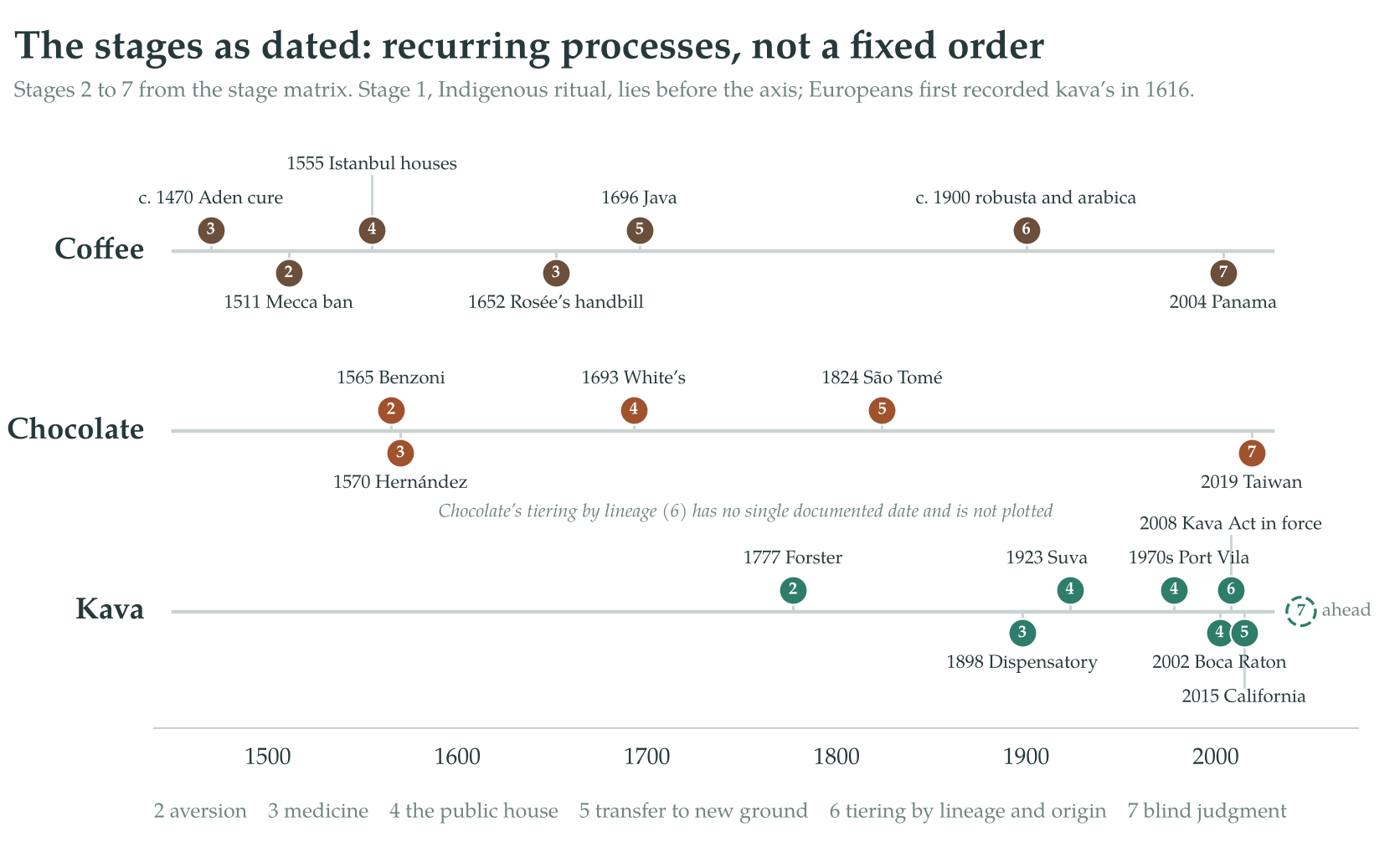
The timeline measures the pace of the transfer. Measured from ritual use, all three transfers took centuries or millennia, kava’s about three thousand years. Measured on the matrix’s own dates from the first public house abroad (stage 4) to the first plantations on foreign ground (stage 5), coffee took about 140 years (Istanbul, 1555, to Java, 1696), chocolate about 130 (White’s, 1693, to São Tomé, 1824) and kava 13 (Boca Raton, 2002, to California, 2015). Its sixth stage began with Vanuatu’s noble-only export rules, passed in 2002 and in force from 2008, and protected origin names are the part still to be built.
Chapter 8. The Judgment: When the New Ground Wins
Every crop that moves to new ground eventually faces a test of reputation. The new region may outproduce the old for generations and still be dismissed as the cheap grade, because the prevailing value regime assigns quality to origin. Then, usually in a blind comparison, it is scored above the origin it supposedly imitated. That moment is the seventh stage, and wine supplies its name.
Napa, 1976 and 1979
On 24 May 1976 the English wine merchant Steven Spurrier held a blind tasting in Paris at which nine French judges, whose scores alone counted, rated California Chardonnays and Cabernets against white Burgundies and classed-growth Bordeaux. France was expected to win easily, and Spurrier himself “hadn’t expected California wines to succeed.” The 1973 Chateau Montelena Chardonnay, made by Miljenko Grgich, and the 1973 Stag’s Leap Wine Cellars Cabernet Sauvignon took both first places (University of California, 2018). Robert Mondavi’s winery at Oakville, opened in 1966, had been the first major new winery built in the Napa Valley since Prohibition, and the Sebastianis, making wine in Sonoma since 1904, and the Fetzers, planting in Mendocino from 1968, made wine Europe did not take seriously. Three years after Paris the French guide Gault-Millau had 62 experts taste some 300 wines from 33 countries, and “the No. 1 chardonnay was the Trefethen 1976,” from Napa (Robards, 1979). In 1981 Napa Valley became one of the first American Viticultural Areas.
The Napa judgment came about fifteen years after serious planting began. It rested on research at the University of California at Davis, which had spent decades matching varieties to sites and training the winemakers who made the winning wines, and whose researchers were, the university notes, perhaps the only people not surprised by the result. It needed a blind format, because the labels carried the old hierarchy, and it turned on quality in the glass, judged on equal terms.
Coffee: Panama, 2004
Coffee’s new grounds won on volume for two centuries before any won on quality. Java gave its name to coffee itself, and Brazil was the world’s largest producer by the 1840s. Jamaica’s Blue Mountain, planted from the same Caribbean stock, became one of the most expensive coffees of the twentieth century, yet the specialty trade still looked to Ethiopia and Yemen for the finest cups.
In 2004 the Peterson family of Hacienda La Esmeralda entered a Geisha in the Best of Panama competition, won, and sold the lot at auction for $21 a pound while other premium beans fetched $1.25 to $2.50 (Strand, 2010). Seeds of a forest coffee were collected in the Gesha region of western Ethiopia around 1936, sent by way of Kenya to the Lyamungu research station in Tanzania, and taken in 1953 to CATIE in Costa Rica. In the mid-1960s the variety, called Geisha, was planted from CATIE’s stock on a few farms in Boquete, Panama (Medrano et al., 2025). Esmeralda’s Geisha fetched $130 a pound in 2007 and $170 in 2010 (Strand, 2010), an Esmeralda natural Geisha sold for $601 a pound at Best of Panama in 2017, and in 2019 the Elida Estate’s Geisha Green Tip Natural sold there for $1,029 a pound unroasted (Specialty Coffee Association of Panama, 2017, 2019), and by early 2025 a Panamanian Geisha had sold for US$10,000 a kilogram at auction in Dubai (Emirates News Agency, 2025). An Ethiopian plant grown in a Panamanian valley under new selection and processing now commands prices that no coffee from Ethiopia does. Genetic origin and growing place had come apart as sources of value, and the Cup of Excellence, founded in Brazil in 1999, carried the same blind, scored, auction-backed format to producing countries generally and made the judgment repeatable.
Chocolate: Taiwan, 2019
Cacao’s new ground in West Africa never won the judgment. It took the volume and kept the forastero reputation, the premium stayed with the fine-flavor origins of Latin America, and the judgment came from a newer ground still. Cacao reached Taiwan in the twentieth century and has been farmed commercially in Pingtung County only recently, partly to replace betel nut. At the World Final of the International Chocolate Awards, judged in Florence in October 2019 and announced at Antigua, Guatemala, in November, Taiwanese makers won seven gold, twenty-six silver and five bronze medals, and Fu Wan Chocolate of Pingtung, founded in 2017, took Best in Competition for plain and origin dark bars with its Taiwan #1 62% Ping Tung (International Chocolate Awards, 2019; Taiwan News, 2019). The prize went, in Mesoamerica, where the chocolate drink took its classic form, to a bar from an island with no cacao tradition at all. Because the competition judged finished bars, however, it measured the maker’s craft with the bean and was no controlled comparison of origins.
Kava: the judgment ahead
Kava’s equivalent of the 1976 Judgment of Paris would put Pacific and mainland American roots before the same tasters without telling them which was which. No such international verdict is documented here. The grounds for a fair comparison are already taking shape. Before a shell is poured, the Kava Coalition’s voluntary harmonized standard gives laboratories a way to check the identity and composition of a lot and screen it for contaminants (Kava Coalition, 2025). That tells a judge what is on the table, not which cup is better.
Once the shells are poured, The Organoleptic Spectrum of Kava gives the tasters a different tool. Its three wheels distinguish flavor and aroma from mouthfeel and oral sensations, and both from possible defects. A taster can record how strong a peppery note is, how long the mouth tingles and, separately, whether the cup is one they would choose again (Blythe, LaRose, & Bowman, 2026). The vocabulary is published; the proposed panel has not yet tested how reliably different tasters use it. As at Paris, the result would have to come from the tasting, not from the pedigree on the label.
The older judgments were not all of one kind. Paris in 1976 set the same judges to taste new ground and old blind against one another, Best of Panama in 2004 ranked Panamanian coffees against each other and left the verdict on the old ground to auction prices, and the International Chocolate Awards measure the maker as much as the bean. Kava’s test can be designed in advance, and it needs two experiments that answer different questions.
The first test is a commercial judgment, a blind panel scoring representative kavas from the Pacific islands and the American mainland as sold, prepared to one serving concentration and evaluated with the companion paper’s sensory vocabulary. It would show how finished American and Pacific products compare in the cup, though not which stage of production explains the score, since cultivar mix, plant age, root fraction, drying and storage vary across commercial lots. The second is a controlled origin trial comparing Pacific-grown and American-grown kavas when post-harvest handling is held constant. Harvests of comparable maturity from Pacific and mainland farms, spanning each region’s principal commercial plantings alongside shared lineages where available, would be separated into matching lateral-root and peeled-stump fractions, dried, milled, stored and extracted under one protocol to a single kavalactone concentration, then scored blind alongside kavalactone and flavokavain assays. Together the two experiments separate market performance from agronomy, showing first how American and Pacific kavas stand against one another as drinkers buy them and second how much of any difference belongs to growing conditions rather than processing and transit.
Neither experiment can be run by one party and believed by the other. Best of Panama ranked lots from one country and left the verdict to the auction, while the International Chocolate Awards set finished bars from every origin against one another under rules entrants accepted in advance. A credible kava judgment likewise requires that neither Pacific export boards nor mainland farms control the result. The authors propose that the event be facilitated by a trade organization whose membership spans both sides of the market, such as the Kava Coalition, or by a research institution such as the American Kava Association, with judging handed off to independent third-party panelists, seasoned industry stakeholders from both sides of the Pacific, kava bar owners, importers, exporters and experienced regular drinkers, who are the most practiced cuppers of kava. The facilitating body would organize the event but take no part in the judging. The samples would be coded and served blind.
Coffee and chocolate also show how to judge distinct botanical classes such as Kali ISA fairly. Specialty coffee created a separate Fine Robusta grading protocol so Coffea canephora would not be scored on an arabica sheet before adopting its broader Coffee Value Assessment to record sensory description and preference apart from extrinsic identity (Coffee Quality Institute, 2019; Specialty Coffee Association, 2024), whereas the International Chocolate Awards judge plain origin dark bars across forastero, trinitario and criollo lineages in shared product tiers while requiring full declaration of cacao genetics and origin (International Chocolate Awards, 2026).
The authors propose separate technical divisions for noble and Isa-type roots, with each judged against the characteristics of its own class. The harmonized standard is written for noble cultivars. Admitting an Isa-type entry under specified contaminant and flavokavain limits would be a competition rule, not certification of that root as noble (Kava Coalition, 2025). A separate consumer tasting would compare eligible cups from both regions blind, with cultivar class and place of origin disclosed only after scoring. Publishing the protocol, serving concentration, scorecard, analytical methods and raw scores together would allow anyone who doubted the verdict to check it.
What the judgment changes
In each case the judgment left the origin in place and displaced the assumption that quality belonged to place by birthright. France remains France, Ethiopia remains the source of coffee’s genetic diversity and much of its finest coffee, and Venezuela and Ecuador still define fine-flavor cacao. After Paris, Esmeralda and Pingtung, however, quality had to be shown in the cup, and every producer, old ground or new, could compete for it. The origin countries that answered with protected names and competitions of their own (Burgundy’s appellations, Ethiopia’s trademarks, Venezuela’s Chuao) kept their premiums. For kava, therefore, the geographical indication and the judgment are complementary, the GI protecting a place’s name from borrowing and the blind tasting showing which places, old or new, earn a premium for what is in the cup.
The leaf that stayed home
Khat, the leaf of Catha edulis, is offered here as a counterexample from coffee’s own homeland, a social stimulant that never became a world commodity. Khat is chewed habitually in Yemen and the Horn of Africa and taken in social gatherings, and when the WHO Expert Committee on Drug Dependence reviewed it in 2006 it found the potential for abuse and dependence low, identified no confirmed therapeutic use and did not recommend international control (World Health Organization, 2006, Section 2.2.4). In Harerge, in eastern Ethiopia, it displaced coffee as the leading cash crop over the twentieth century (Gebissa, 2004). It has nonetheless stopped at the border that coffee crossed. The leaf is chewed, not infused, and its principal alkaloid degrades within days of harvest, so the trade depends on fresh consignments flown from Kenya, Ethiopia and Yemen, and consumption abroad has stayed almost entirely within the Ethiopian, Somali, Yemeni and Kenyan diaspora (Anderson & Carrier, 2011, pp. 2, 5, 10). It crossed no border as a medicine, since no therapeutic use has been confirmed for it, and the receiving states chose prohibition over the tax that coffee eventually paid. Finland, Germany and New Zealand legislated against it in 1981, the Netherlands in 2013, and the United Kingdom, against the advice of its own Advisory Council, made it a Class C drug from 24 June 2014 (Anderson & Carrier, 2011, pp. 2, 22; Home Office, 2014; United Kingdom, 2014). A plant stimulant from coffee’s own region, which could not be stored, carried no medical passport and met prohibition without a compensating revenue, reached no public house beyond its own people. Without the conditions that carried coffee and cacao outward, khat stayed a regional habit.
Chapter 9. The Global Tanoa: Where the Kava Industry Is Headed
When an American kava bar buys root from a mainland farm, does the next order from the Pacific grow or shrink? A bar that introduces new drinkers to both roots may bring an island grower customers. A bar that serves the same customers and changes suppliers has taken a sale away. Coffee and cacao offer examples of both outcomes. The trade figures show how much kava now changes hands; the harder question for the decade through 2035 is how much of a growing trade will reach the people who grow the root.
9.1 Three movements: Commodification, proliferation, innovation
Figure 5 traces how three overlapping movements turned coffee and cacao from localized ritual drinks into global staples. Commodification first gave a domestic harvest an export price, as Yemen’s Mocha trade did for coffee and colonial American ports did for cacao (Braudeau, 1979; Marquese, 2015; Topik, 2004). Geographic proliferation then shifted bulk supply to new tropical grounds with land and labor to spare, carrying coffee across Brazil and cacao into West Africa (Poelmans & Swinnen, 2016; Topik, 2004; Varon, 1950). Innovation in plant and product completed the expansion: hardy robusta turned Vietnam from a minor grower in the 1980s into the world’s second coffee producer, while West African smallholder forastero paired with Dutch pressing and solid eating bars built mass chocolate consumption (ICCO, 2001, 2025a, 2026; International Coffee Organization [ICO], 2008, 2019, 2026; USDA, 2026). Together those movements multiplied world coffee harvests more than seven hundredfold beyond Yemen’s eighteenth-century monopoly and world cacao output about 470-fold since 1830. Two new grounds, Brazil and Vietnam, now grow just over half of the world’s coffee and Africa grows nearly seven-tenths of its cacao, yet the total market expanded so far that Ethiopia and the Americas still harvest vastly more today than the entire world produced when origins held a monopoly.
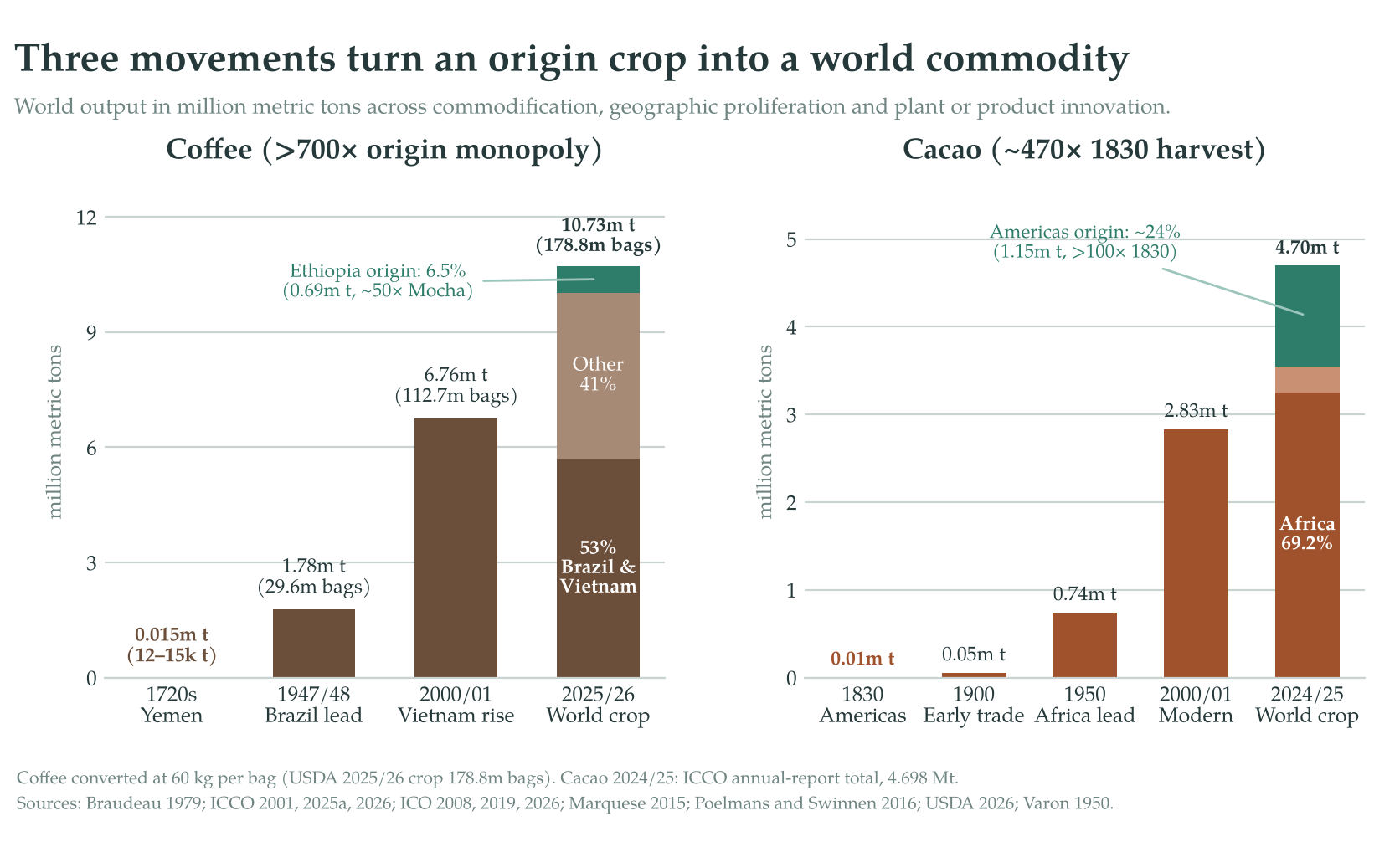
Figure 6 sets out the price and value-chain consequences that accompany global scale. Once a handful of large producing regions set one world benchmark, weather shocks in the new grounds swing prices for every grower at once, yet headline nominal records can mislead if inflation is ignored. Coffee set a nominal monthly record in February 2025 and cocoa futures spiked sharply in London and New York in April 2024 before both markets eased over the following year (ICCO, 2024, 2025b; ICO, 2025, 2026). Expressed in constant U.S. consumer prices, however, both recent surges remained well below the real commodity peaks of 1977, which stood more than four times higher for coffee and more than twice as high for monthly cocoa averages (U.S. Bureau of Labor Statistics, 2026; World Bank, 2026).
The right-hand panel of Figure 6 illustrates the deeper structural cost of commodification: most of the final consumer dollar is captured where crops are roasted, ground, branded and served rather than where they are grown (FAO, 2026; FAO & BASIC, 2024; ICO, 2022). As roasting and soluble coffee manufacture concentrated in importing countries after 1991, producing nations saw their share of total coffee export value fall from four-fifths to under three-fifths and kept roughly a tenth or less of global retail coffee spending (ICO, 2022). French supermarket audits tell the same story for chocolate, with cocoa farmers receiving barely a tenth of a bar’s retail price and all actors in producing countries under a fifth combined (FAO & BASIC, 2024). World scale enlarges total revenue at origin, but downstream processors and retailers capture the bulk of the margin unless origins defend differentiated quality, protected names and value-added standards of their own.
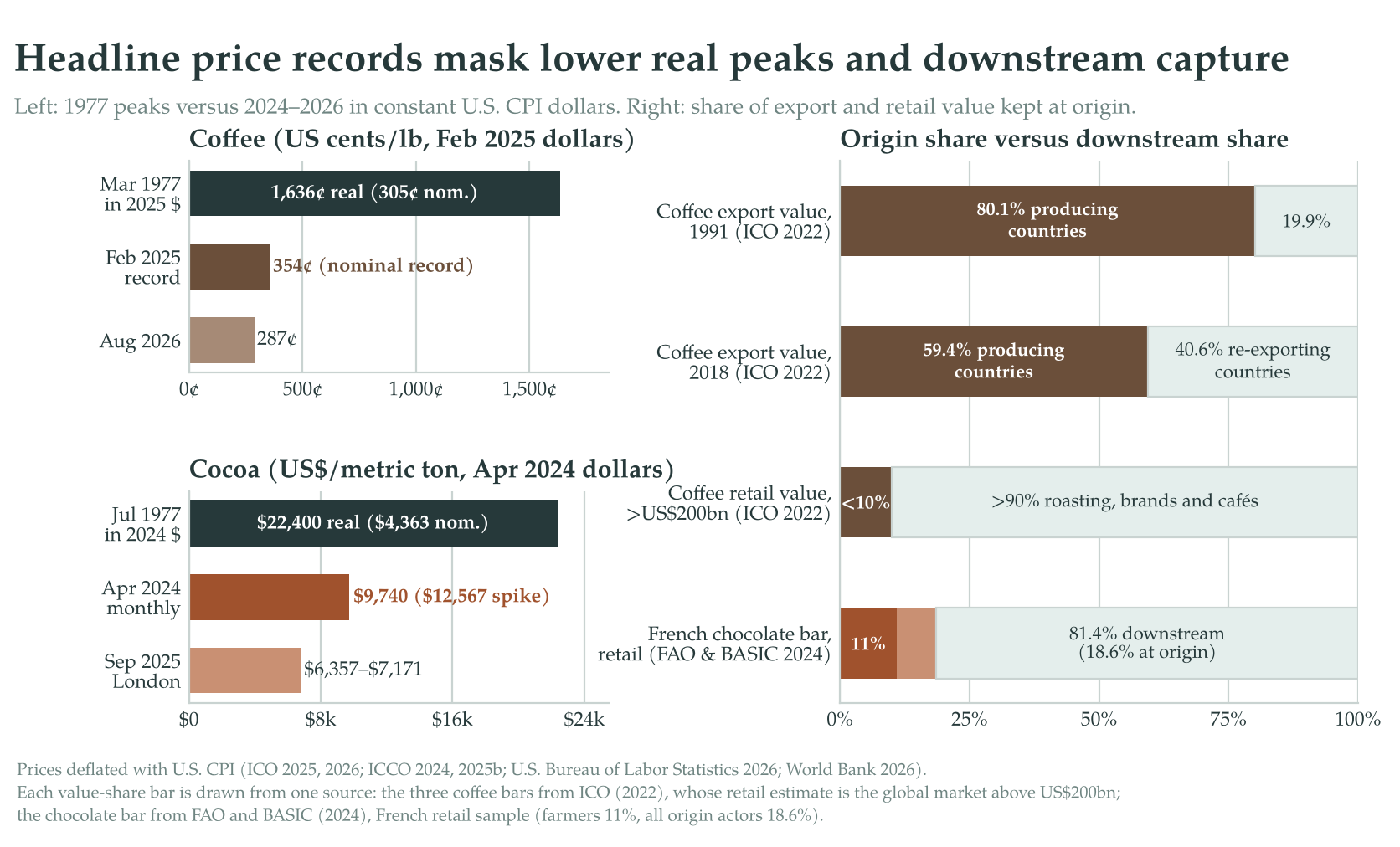
9.2 The origin dividend and its conditions
A country can lose its share of a market and still sell more of its crop. Ethiopia’s coffee and Ecuador’s cacao illustrate why that distinction matters for the Pacific. A falling percentage alone does not show that island growers are losing customers, any more than a rising export total shows what those growers were paid.
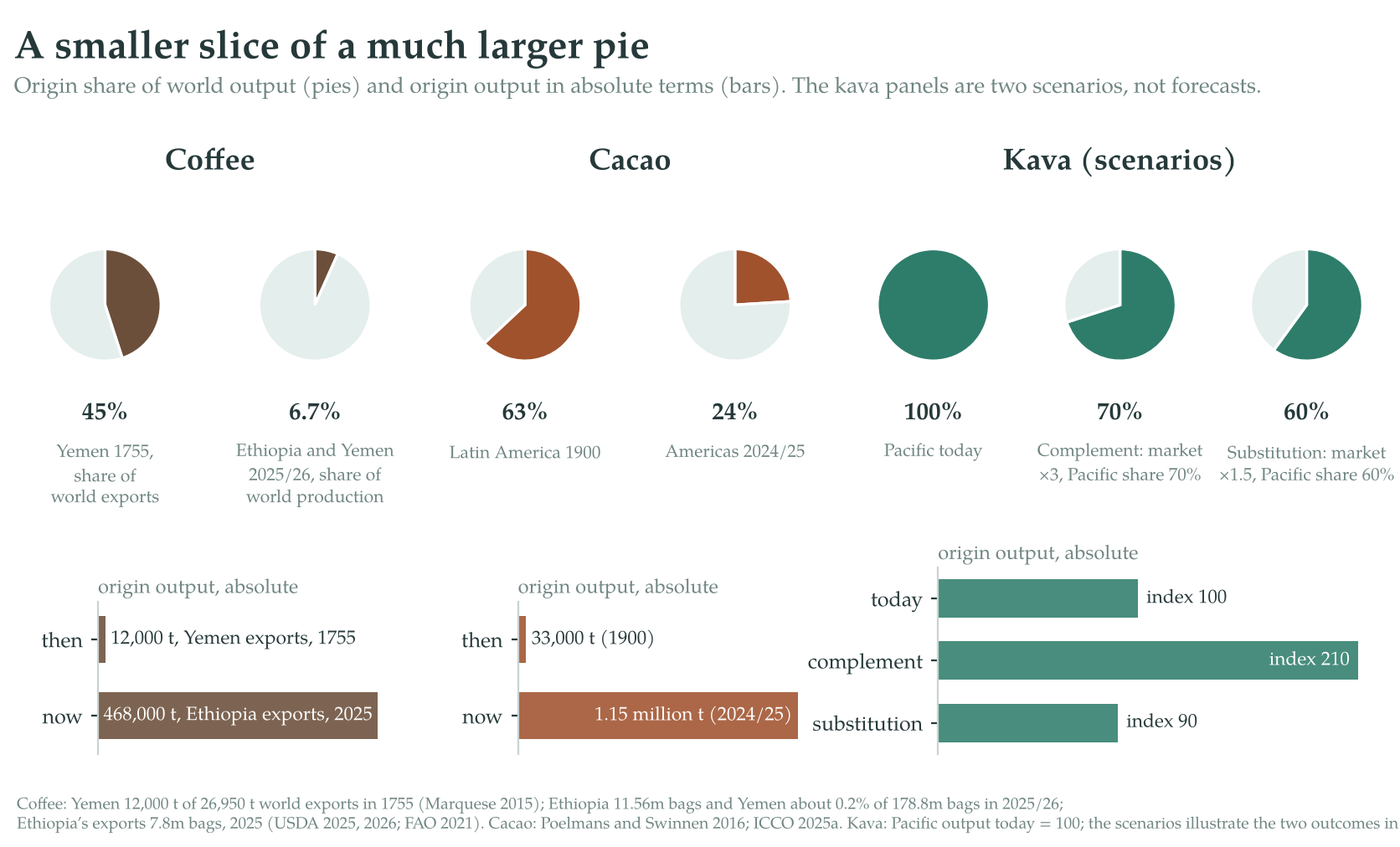
In the USDA’s 2025 tables Ethiopia produces 11.56 million bags, exports a record 7.8 million and consumes 3.7 million at home, so that the buna ceremony remains the destination of a third of its coffee (USDA, 2025). Ethiopia is the strongest case because record and ceremony have grown together. Export receipts rose from US$1.4 billion in 2023 to US$1.43 billion in 2024 and US$2.65 billion in 2025, and in July 2026 the government reported a record US$3 billion for the 2025/26 fiscal year, earned by more than four million smallholders (Ethiopian News Agency, 2026). Ethiopia’s share of world production is 6.5 percent (USDA, 2026), and the price set by a world market of 180 million bags, with the premium its regional names command within it, pays Ethiopia more than a Yemeni-sized monopoly trade ever could.
The world exported about 69,400 metric tons of coffee in 1790 (Marquese, 2015). In 2025/26 it grew 178.8 million bags, about 10.7 million tons, more than 150 times that volume, and the USDA expects consumption to reach a record 179.7 million bags in 2026/27 (USDA, 2026). Brazil’s 63.0 million bags and Vietnam’s 31.7 million were more than half of world production in 2025/26, and other new grounds, from Colombia and Indonesia to India and Honduras, much of the rest (USDA, 2026). No origin could have met such demand alone, for Ethiopia’s whole crop is about one bag in fifteen of the world’s coffee, yet the origin grew inside the larger market, which the new grounds enlarged instead of taking. Ethiopia produced 1.69 million bags in 1960 and 11.56 million in 2025/26, nearly seven times as much (IndexMundi, n.d.; USDA, 2025). The ICO’s fifty-year review found Ethiopia’s output growing 2.6 percent a year from the early 1960s and 3.6 percent a year after 1990, the most dynamic growth of any African producer (ICO, 2014). Its share rose from 4.35 percent in 2010/11 to 4.52 percent in 2020/21 and 6.5 percent in 2025/26 (USDA, 2014, 2023, 2026). Ethiopia alone now grows more than forty times the coffee the whole world drank when Yemen held the trade.
In February 2025 a lot called Gesha Village Oma Natural sold for US$1,100 a kilogram at the Dubai Coffee Auction, a record for Ethiopian coffee (Emirates News Agency, 2025). Gesha Village, the estate that grew it, covers 471 hectares some 20 kilometers from the Gori Gesha forest and was planted with seed from its own expedition into the forest in 2011 (Gesha Village, n.d.). Gesha had left that forest as a research collection, was kept at CATIE in Costa Rica under the germplasm spelling Geisha and made its name in Panama (World Coffee Research, n.d.-b), and its fame there brought buyers back to its birthplace. A new ground had taught the market what the origin’s plants were worth, and the premium it created is now collected at the origin.
Latin America’s share of world cacao production fell from 63 percent in 1900 to 12 percent in 2010, but because the world crop grew eighty-fold, the region’s output, calculated from the same series, rose from about 33,000 metric tons to about 504,000, fifteen times over (Poelmans & Swinnen, 2016). The ICCO’s Americas figure for 2024/25 is 1.15 million tons, up 17 percent in a year (ICCO, 2025a). Ecuador, home of the Nacional fine-flavor lineage, grew 89,000 tons in 2000/01 (ICCO, 2001) and 570,000 tons in 2024/25, 6.4 times as much, third in the world behind Côte d’Ivoire and Ghana (ICCO, 2025a). The ICCO’s panel recognizes three-quarters of its bean exports as fine or flavor, a category that makes up about 12 percent of world bean exports, about 90 percent of it from Latin America (ICCO, n.d.). That is a country designation, not a measure of which clones the beans came from, and it sits uneasily beside the planted area of CCN-51, a high-yielding clone that by 2018 covered about 70 percent of Ecuador’s cacao (Jaimez et al., 2022; Section 9.3); the authors have found no measurement that reconciles the two. The ICCO credits Ecuador’s growth to a market-linked producer price that let farmers capture the 2024 spike and reinvest it, whereas the administered farmgate prices of Côte d’Ivoire, CFA 2,800 a kilogram, and Ghana, GHS 58,000 a ton, passed on less (ICCO, 2025b). Ecuador grew faster than the new grounds themselves, and on the ICCO’s account the price signal mattered; its lineage is a different story.
Yemen, which held the first commercial monopoly, produced 20,812 metric tons in 2019 on 34,981 hectares, little different from its eighteenth-century output and about 0.2 percent of the world’s, with export receipts of about US$20 million (FAO, 2021). Haiti, the largest producer of the 1780s at 40,000 tons in 1789, grew 9,000 tons in 1818 after revolution and the collapse of the plantation system (Topik, 2004). Mexico, where the word cacao was coined, grew 34,000 tons in 2000/01, 1.2 percent of the world crop, and is absent from the ICCO’s current country tables (ICCO, 2001, 2025a), not because it stopped growing cacao but because its output is small; Tabasco alone, its leading state, produced 17,319 tons on 34,260 hectares in the latest official tally (Servicio de Información Agroalimentaria y Pesquera [SIAP], 2023). In each instance the market grew around an origin that did not grow with it, and these failures, set beside the successes, define the conditions.
What separated Ethiopia and Ecuador from Yemen, Haiti and Mexico is the authors’ inference from five cases, not the finding of any single study, and Appendix Table A10 sets the cases, with Fiji and Vanuatu for comparison, against the candidate conditions. Two conditions the authors first proposed do not sort them. A large domestic culture of the drink is shared by Ethiopia and by Mexico, whose living cacao-drink traditions Chapters 3 and 4 document, while Ecuador’s growth was exported as beans. Keeping the flavor lineage does not explain Ecuador either, whose growth rested largely on CCN-51, a clone bred for yield and disease resistance rather than from the Nacional lineage (Jaimez et al., 2022). Three conditions fit the cases better: productive planting material backed by research, a price mechanism that passed world prices to growers, and escape from, or recovery after, the wars, revolutions and blights that undid Haiti and Yemen. Protected names fit the premium tier of each trade, as Ethiopia’s regional names and Ecuador’s Arriba show, but they arrived after the volume growth began and cannot by themselves explain it.
On this reading the origin dividend is real but conditional, and five cases support its conditions only as hypotheses. New grounds and new products enlarge the market enough for an origin to grow while its share falls, but whether a particular origin does so depends on productivity, the grower’s share of the price and resilience to shocks, with quality, differentiation and market access deciding the premium, none of which commodification supplies by itself. The prescriptions in Section 9.6 therefore rest on more than these cases: lot testing on American food law and the collapse of 2001–02, honest names on the re-export structure documented in Chapter 7 and on the Lanham Act, under which a false designation of origin can be sued on in American courts by the producers it injures, as Kona’s coffee growers did (Daily Coffee News, 2023), and a premium shared with growers on the one condition the cases support most clearly. Appendix Table A4 sets out the figures for each origin, then and now.
9.3 Innovation and the exchange of plants
The market did not grow by planting more of the same drink in more places. It grew because the drink took forms that reached people whom neither the public market nor the public house ever would, and because planting material and techniques moved between regions as freely as the beans.
Once Van Houten’s 1828 press and Fry’s 1847 chocolate bar moved cacao out of the cup (BBC News, 2023; Coe & Coe, 2013), Daniel Peter’s 1875 milk chocolate with Henri Nestlé’s condensed milk and Rodolphe Lindt’s 1879 conche completed its transformation from a bitter court drink into a smooth counter confection, changing the scale of the world market with the product’s form (Lindt & Sprüngli, n.d.; Nestlé, 2022). Coffee’s innovations were in the machine and the package. Angelo Moriondo patented a steam brewing machine in 1884, Desiderio Pavoni bought Luigi Bezzera’s single-cup patents in 1903 and presented “caffè espresso” at the Milan fair of 1906, and Achille Gaggia filed Italian patent No. 365726 for his Lampo extraction mechanism on 5 September 1938 (Gaggia, 2018). Gaggia’s postwar lever machine raised the pressure from under two bars to eight to ten and produced crema, and the Faema E61 of 1961 replaced the barista’s arm with a pump (Stamp, 2012). Nestlé launched Nescafé in 1938, after years of work on Brazil’s unsold surplus, and Nespresso in 1986 (Nestlé, 2022). Each moved coffee into a new place, the bar counter, the office, the kitchen or the pocket, and American surveys measure the latest wave. Ready-to-drink coffee was consumed by 9 percent of past-day coffee drinkers in 2021 and 19 percent in 2025, instant rose from 6 to 11 percent and cold brew reached 17 percent. Specialty coffee, by the National Coffee Association’s definition, was drunk by 48 percent of American adults on a given day in late 2025, up from 37 percent in 2021 (National Coffee Association of U.S.A., 2025). The United States has 45,227 branded coffee-shop outlets in a market the trade puts at US$58.5 billion (World Coffee Portal, 2025).
Canned ready-to-drink kava appeared in American grocery and liquor channels after 2021, and kava now has a recent equivalent for nearly every item on this list. Instant kava and water-soluble CO₂ extract reconstitute without strainer or bowl, and fresh-frozen root carries the flavor of the green plant to a public house on another continent. Kava’s counterpart to the cocoa press and the espresso machine is the CO₂ extract formulated to mix with water, which the companion paper describes as separating the kavalactone fraction from the bulk root fiber so that a manufacturer can control what reaches the cup (Blythe, LaRose, & Bowman, 2026, Section 4.6). Water-soluble extracts of this kind, one of which Root of Happiness has sold since 2012, are now used in many canned kava beverages and shots. In the 2024 national survey, 43.9 percent of past-year kava users had drunk a ready-to-drink or prepared kava such as a seltzer, 34.2 percent micronized or instant kava and 33.0 percent ground root powder, beside the 50.7 percent who drank the traditional beverage, while capsules, tea bags, gummies, shots and tinctures were each used by between 30 and 47 percent (Mamallapalli et al., 2025, p. 6). Measured against the coffee timeline, in which the London coffeehouse of 1652 preceded the packaged roast by 219 years and the soluble format by 286 (Nestlé, 2022; Pendergrast, 2010), kava has moved from its first mainland bar to canned and instant formats in about twenty years.
Planting innovations and the exchange of germplasm reshaped cultivation just as thoroughly. The Timor Hybrid, a natural cross of arabica and robusta found in the 1920s, was sent to Portugal’s rust research center in 1958–59, crossed with Caturra from 1967 to produce the Catimor group, tested in Brazil by the Campinas and Viçosa institutes, and sent in 1978 to CATIE in Costa Rica as the population T8667, from which the PROMECAFE program selected Costa Rica 95, Lempira and Catisic for different national conditions (World Coffee Research, n.d.-a). Plants moved as freely as products and in every direction, so that no producing region now grows material wholly its own. Gesha, recorded in early germplasm banks and Panamanian auctions as Geisha though specialty coffee increasingly restores the Ethiopian spelling, traveled from the Gori Gesha forest to Tanzania, to CATIE in 1953 as accession T2722, and to Panama in the 1960s (World Coffee Research, n.d.-b). The first F1 hybrids were sold commercially in Central America in 2010. World Coffee Research made 43 crosses in 2015, planted trials in Costa Rica, El Salvador and Rwanda in 2017, selected four finalists in 2022 that yielded 28 percent above the check varieties with three scoring above 84 points, and has them in pre-commercial evaluation until 2031 (World Coffee Research, n.d.-c). A hybrid takes ten to twenty years to breed against twenty-five to thirty for a pure line, and because the F1 plants’ own offspring do not breed true, F1 seed must be produced by repeated crossing, so the hybrids are propagated clonally, so that nursery capacity, not breeding, is the bottleneck to adoption (World Coffee Research, n.d.-c).
Cacao has the same architecture. Trinidad’s ICS selections of 1930–35 and the Upper Amazon collections of 1937–42 fed every later breeding program. The International Cocoa Genebank there was founded in 1982, held more than 2,000 types by 1994 and about 2,400 accessions today, and the quarantine center at Reading, founded in 1985, moves about 350 of its 450 accessions for exchange (CacaoNet, n.d.; UWI Cocoa Research Centre, n.d.). CCN-51, selected by Homero Castro and first planted at Naranjal in 1965, was in commercial cultivation by 1985, covered about 70 percent of Ecuador’s 573,000 hectares of cacao by 2018 at yields of 1,300 to 1,800 kilograms a hectare attainable on managed plantings, not national averages, and has spread to Colombia, Peru, Brazil, Guatemala and Panama (Jaimez et al., 2022). An origin’s clone became the new grounds’ workhorse, as Ethiopia’s Gesha became Panama’s prize. Ecuador’s case carries an implication for kava, for an origin can prosper by adopting hardy, productive material itself. Fiji’s imports of Papua New Guinea root suggest that Pacific producers already face that choice with Isa-type kava, between grading it openly under its own name and blending it unseen.
In 2017 a team from the Royal Botanic Gardens, Kew, and Ethiopia’s Environment and Coffee Forest Forum, working under the Strategic Climate Institutions Programme, projected that 39 to 59 percent of Ethiopia’s current coffee-growing area could become unsuitable by the end of the century, and that moving coffee uphill, with forest conservation and re-establishment, could increase the suitable area at least fourfold (Moat et al., 2017). Research stations in the new grounds and consuming countries have repaid the origins when disease and climate struck, and Ethiopia’s forests are the first of three current cases. The Yemeni case concerns genetics. A survey led by World Coffee Research, Italy’s Istituto di Genomica Applicata and France’s CIRAD, using 648 accessions from the CATIE collection and 88 from Sana’a University, confirmed Yemen as arabica’s secondary center of dispersal, and a 2021 study with the Yemeni exporter Qima Coffee found a “New-Yemen” genetic cluster that belongs to no cultivated variety elsewhere (Montagnon et al., 2021; World Coffee Research, 2020). Qima has marketed coffee from that group as Yemenia, giving one of the poorest coffee origins a distinction no new ground can copy (Daily Coffee News, 2020). The Sierra Leonean case concerns climate. Kew researchers and their partners there found Coffea stenophylla, a West African species that had fallen out of cultivation by the 1920s, again in the wild. Tasting panels rated its flavor as analogous to high-quality arabica, and it grows and crops at a mean annual temperature 6.2 to 6.8 °C higher than arabica (A. P. Davis et al., 2021). Kew’s project to revive it as a crop is based in Sierra Leone (Royal Botanic Gardens, Kew, n.d.). In each case the collection, the laboratory or the funding sat outside the origin, while the benefit went to the origin’s growers.
In 1942, searching the Peruvian Amazon for trees that resisted witches’ broom, Trinidad’s F. J. Pound collected seed from two symptom-free trees he named Scavina 6 and Scavina 12 (Lima et al., 2013). Cacao’s record of such repayment is longer and was tested by catastrophe. Bred in Trinidad with another clone from his collection, IMC 67, Pound’s trees produced the Trinidad Selected Hybrids, widely planted there from the late 1950s (CABI, 2021). When witches’ broom devastated Ecuador’s plantations around 1960, Homero Castro crossed IMC-67 with the Trinidad selection ICS-95 and an Amazonian Canelo tree to make CCN-51 (Jaimez et al., 2022). When the disease reached Bahia in 1989 it consumed about 300,000 hectares in three years, and Brazil’s production fell from about 450,000 metric tons to less than 100,000, turning an exporter into an importer of cocoa beans (National Research Council, 2010). Brazil’s Cacao Research Center answered with Theobahia, a Scavina 6 cross released in 1995, and in 1997 with five clonal varieties, three of them Trinidad Selected Hybrids, all with Scavina 6 as their main source of resistance (Lima et al., 2013). By 2020 Brazil’s crop was back to about 250,000 tons, with Pará now ahead of Bahia (Arantes, 2021). Within a few years the fungus broke down Scavina resistance in Bahia, and breeders have since found resistance in Brazilian Amazon accessions, CAB 208 and CAB 214, that are genetically distinct from Scavina 6 (Pires et al., 2022; Royaert et al., 2016). A single source of resistance held in a single collection buys years instead of decades, and the only durable remedy is a collection broad enough to supply the next one.
For kava the implication, stated as inference, is direct. A sterile clone with about thirty distinct genotypes has less room than cacao to find its next source of resistance, and the Pacific holds almost all of it. A second, quarantined collection of cultivars in a different climate would do for Vanuatu and Fiji what Trinidad did for Ecuador and Brazil. It would hold a copy of the origin’s material where a cyclone, a pathogen or a drought at home cannot reach it, decontaminate and multiply it with modern tissue culture methods, and return it under agreed rules when the origin needs it. In the coffee and cacao records, exchange of that kind returned its largest benefits to the origins when it was governed. The Pacific already has the institution to govern it. The Pacific Community’s Centre for Pacific Crops and Trees (CePaCT) in Suva, the region’s genebank, conserves crops in tissue culture, tests germplasm for pathogens before distribution and distributes it under material transfer agreements (Pacific Community, n.d.). Its collections center on aroids, yams, banana, sweet potato, breadfruit and coconut, and its 2017 external review does not list kava (Dulloo & Adkins, 2017). A mainland collection should therefore serve as a duplicate in a second climate that deposits with CePaCT and draws from it under its agreements, not as a rival to it.
On the planting side, kava’s key propagation innovations are tissue culture, used to establish clean American-grown lines, and aeroponic micro-cutting, which in three independent runs between August 2025 and July 2026 rooted 277 of 288 cuttings, 96.2 percent, and 274 of 288 in a second generation (Blythe, Bowman, & Masifilo, 2026b). That result addresses nursery throughput, the same bottleneck World Coffee Research identifies for clonal F1 coffee hybrids, though not the three years a kava root still needs in the ground. Cultivars moved from the Pacific to Hawaiʻi in the mid-1980s, from Hawaiʻi to California in 2015, and onward to Florida, Latin America and the Caribbean. Within the Pacific, where the region holds about 118 named cultivars, the Forum’s regional strategy calls for safe movement of healthy planting material among member islands, notes that earlier mass-propagation attempts fell short, and urges members to restrict outside access to germplasm, while Fiji’s ministry is zoning thirteen noble varieties to specific agro-ecological regions (Fiji Ministry of Agriculture, 2025b; PIFS, 2024, pp. 29, 31). CATIE, the Trinidad genebank and the Reading quarantine center resolved that tension between sharing within and protecting without by institutionalizing exchange under agreed rules, and in the authors’ view kava will need the same institutions.
Brazil’s coffee had the Campinas and Viçosa institutes and cacao had the Trinidad genebank, whereas on the American mainland that early technical work has so far rested with a grower- and operator-led body, the American Kava Association, founded in 2014 (American Kava Association, n.d.). Its published work documents subtropical cultivar performance across USDA zones 9b to 10b alongside near-infrared field identification in Hawaiʻi, California and Florida, develops high-throughput propagation from soft-stem cuttings and air layering to aeroponic micro-cuttings, and shares agronomic and sensory findings openly while setting baseline standards for the new ground (Blythe, 2026c; Blythe, Bowman, & Masifilo, 2026a, 2026b; Blythe, Bowman, & McDonnell, 2026; Blythe, LaRose, & Bowman, 2026; Blythe & Lowin, 2026). Built on AOAC International’s analytical performance requirements for kavalactones and flavokavains, co-authored by Tyler Blythe (Dentali et al., 2018), and the Kava Coalition’s 2025 harmonized product standards, the Association’s certification and “American Grown” marks pair lot-by-lot chemotype and flavokavain testing with heavy-metal and mycotoxin screening and posted serving guidance (American Kava Association, n.d.; Kava Coalition, 2025a). Chemotype testing records the code of each lot and does not establish its cultivar, and the Association treats Isa-type lots such as Kali ISA, which are not noble under the Harmonized Standard, as a class of their own, reported honestly by cultivar name and by chemistry so that the market can judge them rather than excluding them wholesale. Because those studies come from practitioners with a declared commercial stake rather than state stations, the test of the program, as of Davis’s work at Napa, will be whether independent laboratories and growers repeat its methods and reproduce its numbers.
9.4 Kava’s milestones, measured
Appendix Table A5 sets the newer U.S. bars and mainland farms beside the Pacific trade that supplies them. Bar counts show how many places sell the drink. Export volumes and receipts tell a different part of the story: whether more root is leaving the islands, and what it earns when it does. Neither measure alone shows what American buyers would have bought in the absence of a mainland crop.
Four features of those counts bear on the forward question. The first is that kava has already survived a crash of the kind cocoa suffered in 2024 and coffee in 1977. Between the last quarter of 2001 and the first of 2002, as the European bans took effect, Fiji’s exports fell by three-quarters and Vanuatu’s by three-quarters, and between 2001 and 2002 Hawaiʻi’s annual farm sales fell by 88 percent, from US$585,000 to US$69,000. Hawaiʻi’s fresh-equivalent volume fell from 450,000 to 60,000 pounds and its kava farms from 65 to 55 (USDA NASS, 2003). Fiji’s exports, FJD 35 million in the boom year of 1998, were about FJD 2 million in 2004 and under FJD 4 million in 2008 (Mohanty, 2017; PHAMA Plus, 2026). Recovery took a decade. The FJD 19.7 million of 2017 was the first figure to approach the 1998 peak, and by 2024 the trade was half as large again as that peak in nominal terms (Ministry of Agriculture, Waterways and Sugar, 2026; Mohanty, 2017). Deflated by Fiji’s consumer price index, the 1998 peak equals about FJD 77 million at 2024 prices, so 2024 receipts were about 69 percent of it in real terms and 2025 receipts about 104 percent (World Bank, n.d.). The FJD 79.1 million of 2025 is therefore a second boom, built on a social beverage instead of a supplement, with a resilience Yemen and Haiti lacked.
The second is that growth is in volume as well as value, the mark of an expanding market and not a failed harvest. Fiji shipped 137 metric tons in 2013, 311 in 2017, 498 in 2022, 731 in 2024 and 1,015.7 in 2025, and Fiji’s official damped-trend baseline model projects exports reaching 1,704.1 metric tons worth FJD 160.0 million by 2030, alongside imports rising from 824.9 tons in 2025 toward 1,165.7 tons worth FJD 55.9 million unless domestic farm output expands (Ministry of Agriculture, Waterways and Sugar, 2026; PIFS, 2024, p. 16). The 2013 base follows the post-crash years, and the sources consulted publish no comparable export volume for the boom before 2002, when Fiji’s production peaked at 4,575 tons (Mohanty, 2017, p. 10). Vanuatu’s exports rose 64 percent between 2021 and 2025, from 762 to 1,253 tons, yet over twenty-five years they have barely moved, averaging 897 tons a year in 2000–2009 and 916 in 2016–2025 (Vanuatu Kava Industry Association [VKIA], 2026, from VBoS data). Fiji, Kiribati and New Caledonia take six of every ten tons, and Kiribati was the largest market by value, with 31 percent of 2025 earnings. The United States bought 158 tons direct in the first half of 2026, more than in all of 2025, while China fell from 326 tons in 2023 to 20 in the first half of 2026 as extraction shifts to the United States and Vanuatu, and Australia took 55 tons, 4 percent, in 2025. India’s 2025 shipments were declared at about US$18 a kilogram against a farm-gate price above US$40 (VKIA, 2026). Production is growing while exports stay flat because Vanuatu’s own nakamals absorb it, with Port Vila alone estimated to drink 120 tons of green kava a week (VKIA, 2026), and the result at home is the shortage described in Chapter 7. Vanuatu’s quarterly tonnage rose from 234 tons in the March 2025 quarter to 358 in the June 2026 quarter (VBoS, 2026), and Australia’s imports rose 45 percent between the first and last quarters of 2025 (PTI Australia, 2026). Reviewing the first half of 2026, Vanuatu’s Treasury attributed high prices to international and domestic demand (Vanuatu Department of Finance and Treasury, 2026b). Prices have risen too. Vanuatu’s export price was VT 1,108 a kilogram in 2017 and VT 5,086 in the last quarter of 2025, and the green price in Luganville rose from VT 500 a kilogram in January 2025 to VT 1,000 by August (VBoS, n.d.; Vanuatu Business Review, 2025; Vanuatu Department of Finance and Treasury, 2026a). High prices alongside rising volumes are the marks of growth led by demand. The ministers’ reports of shortage in Chapter 7, and the closed bars of Port Vila, describe demand at home and abroad outrunning a supply that is still growing, not a supply that has fallen.
Gross receipts are not growers’ income. In 2025 Fiji’s imports equaled 81 percent of its export weight, and the returns’ re-export category, 87 tons over 2013–2025, counts only goods leaving in the state they arrived, so imported root that is repacked or blended leaves as domestic exports that the returns cannot separate from Fijian-grown kava. On the mass balance alone, Fijian-grown root made up somewhere between a fifth and all of the 1,015.7 tons exported in 2025. Farm-gate prices are the better measure of the growers’ share. Fiji’s average farm-gate price, in the Pacific Community’s kava indicators, rose from FJD 71 a kilogram in 2017 to FJD 95 in 2019 and fell to FJD 64 in 2023, while export receipts held between FJD 32 million and FJD 44 million a year (Pacific Community, 2025; Ministry of Agriculture, Waterways and Sugar, 2026), and the series does not yet cover 2024 or 2025. In Vanuatu the green price doubled in 2025. The evidence for an origin dividend at the farm gate is therefore, so far, Vanuatu’s, and the Fijian case awaits a price series for the boom years.
The third is that demand has widened geographically while supply remains Pacific. Australia’s 170 metric tons of 2025 came from Fiji (96 tons, 56 percent), Vanuatu (51 tons, 30 percent), Tonga (18 tons) and Papua New Guinea (4 tons) (PTI Australia, 2026). The American kava bars, one in 2002 and about five hundred by the Coalition’s 2025 estimate (670 directory listings in 2026, a count not on the same basis), draw overwhelmingly on the islands, and American-grown kava appears in no trade statistic yet. Mainland production has not been disclosed. Multiple mainland farms and backyard growers hold plantings of varying size, but American growers, the authors among them, are for now keeping their locations and production figures confidential, so no planted area, harvest or production cost has been published. The authors’ plantings already supply their own bars and a select few other bars within their network, and the authors expect significant harvests by 2035, the horizon of this paper. Until production figures are disclosed, the relative price of the two supplies, the first of the four variables in Chapter 7, cannot be weighed. The new ground can grow the crop, but the judgment that would make it an origin lies ahead.
The fourth is the size of the whole, where the record is least certain. Fiji’s agriculture minister puts the American market above a billion US dollars, and a Fijian cabinet discussion in October 2026 put domestic consumption at FJD 230 million against exports of FJD 79 million (Fiji Ministry of Agriculture, 2025b; Fijivillage, 2026). Neither figure has a published method. The official figures show that kava now earns two-thirds of Vanuatu’s domestic exports and 42.3 percent of Fiji’s agricultural export earnings (FBC News, 2026a; VBoS, 2026), and that a third consuming country has opened and grown for four consecutive years. An opt-in panel suggests, as an upper bound, that up to one American adult in nine drank kava in the past year.
9.5 Constraints and risks for the decade ahead
A new bar creates an opportunity for a Pacific grower, not a standing order. An exporter can lose that order through a failed lot, a missed harvest or a change in the rules of the importing country. Even when the shipment sells, the price may not reach the farm. Appendix Table A6 sets out eight such risks, their precedents in the older crops and the remedies proposed here.
The first, and in the authors’ judgment the largest and most persistent, is the quality of the kava that leaves the islands. Kava has the rules. The Codex regional standard limits moisture and excludes mold, Vanuatu’s Kava Act restricts what may be exported, and the Vanuatu Bureau of Standards requires exported dried kava to be “free from microbial contaminants” (Codex Alimentarius Commission, 2020; Republic of Vanuatu, 2002; Vanuatu Bureau of Standards, 2025). What the islands lack is the capacity to show that each lot meets them. An assessment prepared for the Australian Government in 2023 found that Vanuatu tests every export consignment for nobility but samples it at the exporter’s packhouse and not at the wharf, so that untested batches can be shipped, that Fiji and Tonga had no such control at the point of export, and that Tonga had no access to testing kava for microbial contamination or heavy metals, although many of its processors used iron machinery (DT Global, 2023, pp. 16, 18). The well-financed exporters of Fiji and Vanuatu run their own laboratories, but the same report found “large gaps” among farmers and smaller exporters (DT Global, 2023, pp. 10, 18). In Suva the University of the South Pacific’s Institute of Applied Sciences holds accredited food microbiology tests, yet the kava tests it lists for export are for kavalactones and moisture (Institute of Applied Sciences, n.d.). The consequence reaches the American border. The FDA has placed two Fijian kava processors on its import alert for Salmonella, subjecting the listed products to detention without physical examination unless evidence supports their release (FDA, 2026). In the authors’ experience as importers, the FDA now samples incoming Pacific kava regularly and continues to find microbial contamination.
HACCP certification does not establish compliance with the FDA’s current good manufacturing practice requirements. For conventional foods, those requirements address the condition of premises and equipment, sanitation throughout processing and storage, and testing where needed to identify contamination, with preventive controls verified as effective (Current Good Manufacturing Practice, 2026). In the authors’ experience as importers, HACCP-certified suppliers have delivered kava that failed microbiological specifications. A certificate cannot replace control of the process or evidence of the quality of the lot being shipped. The Coalition’s successive retail surveys recorded microbial action-limit pass rates of 49 percent, 73 percent and 68 percent (95 percent confidence intervals 34–64, 57–84 and 52–80 percent), with 11 of 40 products exceeding two million CFU/g on aerobic plate count in the latest round (La Rose, 2025, pp. 9–11; La Rose, 2026a, pp. 11–12; La Rose, 2026b, pp. 9–10). The persistence of these failures shows that the products on American retail shelves do not yet consistently meet the microbial quality the industry’s own standard requires. Because the surveys do not trace products to their origin, they cannot by themselves place the failures at the point of export rather than in later milling, packing or storage.
In the authors’ experience, few Pacific exporters can supply lot after lot that passes the microbial and heavy-metal specifications an American food buyer applies, and few laboratories in the islands can test a lot and return the result to the farmer and processor in time to correct the next one. The older crops built institutions at the origin to establish consistent quality. Ghana’s cocoa board grades and seals every consignment before export, and its reputation for consistency earns a premium (Kolavalli et al., 2012), while the Ethiopia Commodity Exchange grades the coffee traded through it (Rashid, 2015). Kava needs comparable investment in processing facilities and accessible accredited laboratories. The authors propose representative testing of every export lot, traceable from the sample to the consignment, with results returned to growers and processors, failed lots withheld and corrective actions verified before release. Testing must support clean water, sanitary milling, controlled drying and protected storage, not substitute for them. The collapse of 2001–02 showed how quickly a safety scare closes markets and how slowly they reopen, and a contamination outbreak traced to kava would test the new American acceptance in the same way.
The second is the harvest lag, which in a tree or root crop turns price into supply only after a delay. The Forum’s strategy plans on a three-year minimum from planting to harvest, and Vanuatu’s export rules require five years for noble kava (PIFS, 2024, p. 24; Republic of Vanuatu, 2002, Section 6). Coffee and cocoa trees take a similar time to bear, so a shortage raises prices long enough to provoke planting that arrives after it has passed. Cocoa’s 2024 spike to US$12,567 a metric ton and its fall to under US$6,400 within eighteen months is the most recent example (ICCO, 2024, 2025b). Kava’s propagation research shortens the nursery stage but not the years in the ground. The plantings prompted by the prices of 2025 and 2026, in the Pacific and on the mainland, will reach the market around 2028 to 2031, and growers on both sides should plan for them to arrive together.
The third is weather. Cyclone Pam cut Vanuatu’s kava exports from an average of VT 766 million a year in 2011–14 to VT 180 million in 2015, a fall of three-quarters, and Cyclone Winston damaged Fiji’s plantations in 2016 (Judge, 2022; Mohanty, 2017). Exports then averaged VT 2,112 million a year in 2016–20, nearly three times the pre-Pam level, partly because replanting after the storm came to harvest into a rising market (Judge, 2022). A crop grown on a few islands in a cyclone belt carries a supply risk that one grown in several climates does not, the strongest economic argument for a diversified geography of production.
The fourth is concentration. Two countries grow 48.6 percent of the world’s cocoa (ICCO, 2025a). In 2024 Ghana’s cocoa board estimated that swollen shoot virus had infected 500,000 hectares, 25.7 percent of the country’s 1.94 million hectares, and 81 percent of the Western North region. Infected trees must be uprooted, and replacements take two to four years to bear (Reuters, 2024). Coffee faces a slower threat. The ICO’s climate review cites Bunn and colleagues’ projection of roughly a 50 percent loss of currently suitable area for both arabica and robusta by 2050, with some gains at higher elevations, including parts of Ethiopia’s northern highlands (ICO, 2017). Kava is a sterile clone with, by Vandenbroucke’s count, only thirty distinct genotypes among 103 accessions, so a pathogen that found the noble cultivars would find them everywhere they are grown. The older crops’ remedy, described in Section 9.3, was genebanks, quarantine exchange and breeding programs in several countries.
The fifth is the capture of value downstream. Coffee’s producing countries hold 59 percent of export value and perhaps a tenth of retail value, and cocoa’s farmers hold 11 percent of a chocolate bar’s price in the one chain that has been measured (FAO & BASIC, 2024; ICO, 2022). As kava moves into cans, capsules and instant powders, the same arithmetic will apply unless the origin moves with it. Processing is already migrating in both directions, as the Fijian exporter that sells 80 percent of its product to the United States, the Fijian processors who take Vanuatu’s root for re-export, and the Pacific extracts that Vanuatu’s working group has traced through China to the American market all show (Fiji Ministry of Agriculture, 2025a; Tabureguci, 2024). Fiji’s own figures show the alternative, a domestic market worth, on the minister’s estimate, three times the export trade, the home base that saved Ethiopia (Fijivillage, 2026). On the authors’ reading, the downstream capture is the peacetime form of the colonial division of labor, in which the plantation grew the crop and the metropolis roasted, refined, branded and priced it, and the export and retail shares above show how long that division has outlasted the empires that set it up.
The older crops have tried two remedies. Certification has been limited less by its terms than by its reach. From 1 August 2023 Fairtrade International raised its minimum price for washed arabica, more than 80 percent of the Fairtrade coffee sold, from US$1.40 to US$1.80 a pound, with a premium of US$0.20 a pound on top and an organic differential raised from US$0.30 to US$0.40 (Fairtrade International, 2023). Its cocoa minimum is US$2,400 a metric ton free on board, with a premium of US$240 a ton (Fairtrade International, 2024). The labels do not move together, and Fair Trade USA held its own coffee minimum at US$1.40 through 2023 (World Coffee Portal, 2023). Fair Trade-certified coffee was 1.8 percent of world coffee exports in 2009, and the economists who reviewed the system for the Journal of Economic Perspectives did not find it a general solution (Dragusanu et al., 2014). A premium on a small share of a crop helps the farmers who receive it without changing how the trade divides value.
The second remedy is action by the origin states. In July 2019 Côte d’Ivoire and Ghana agreed a Living Income Differential of US$400 a metric ton, added to the free-on-board price of cocoa sold from the 2020/21 season, within a floor export price of US$2,600 a ton. Farmers were to receive 70 percent of that floor, a farm-gate price of at least US$1,820 a ton, and a stabilization fund was to pay the shortfall when prices fell below the floor and hold back the excess above US$2,900 (Boysen et al., 2021; Reuters, 2019). On 24 September 2020 Ghana raised its producer price by 28 percent, from GH₵515 to GH₵660 a bag (Ghana Cocoa Board, 2020). Kava already has the beginnings of both. The noble-only export rules are an origin-set standard as the differential is an origin-set price, and the domestic markets of Fiji and Vanuatu are the base from which a premium can be defended. A Pacific premium for traceable noble root would need what the differential needed, a common position among the largest exporters.
The sixth is regulation, for kava the decisive risk before. The 2001–02 collapse was regulatory, not agronomic, and its sequels are unfinished. Germany’s medicinal authorizations were restored by the courts in 2014 and 2015, revoked again in December 2019 and restored by the Administrative Court of Cologne in June 2024 in a judgment now on appeal (Bundesinstitut für Arzneimittel und Medizinprodukte, n.d.; FratiniVergano – European Lawyers, 2024; Oberverwaltungsgericht für das Land Nordrhein-Westfalen, 2015; Chapter 5), the United Kingdom’s restriction stands, and Australia, which stopped commercial imports in 2007, allowed them again only in December 2021 (Australian High Commission, 2007; PTI Australia, 2026).
The American position differs by product. For the single-ingredient beverage prepared with water, the FDA’s July 2024 letter to Congress, as California’s Department of Public Health reports it, places kava steeped only in water and consumed as a single-ingredient conventional food generally outside regulation as a food additive (FDA, 2024b; California Department of Public Health, n.d.). In January 2024 Hawaiʻi’s Department of Health found noble ʻawa prepared with water or coconut water generally recognized as safe on the strength of its pre-1958 common use (State of Hawaiʻi Department of Health, 2024). Kava added to conventional foods is another matter. In an August 2020 memorandum the FDA’s Office of Food Additive Safety concluded that there is no basis to treat kava as generally recognized as safe for use as an ingredient in conventional foods, and that “indiscriminate use of kava either as a ‘recreational’ or ‘relaxation’ beverage is not safe for human consumption” (FDA, 2020). That conclusion bears directly on the canned and extract-based beverages described in Section 9.3. Dietary supplements remain lawful under the 1994 Act (U.S. Congress, 1994), and the industry’s view that CO₂ extracts are substantially equivalent to the traditional beverage is a trade position, not a regulatory finding. Local practice is less settled, and in California operators have often paid for legal advice to explain the beverage to each locality and keep their doors open (Blythe, 2026b).
The nearest regulatory risk to the American public house may be kratom. U.S. poison centers recorded 203 kava exposures in 2025, 61 of them (30 percent) involving kratom, and serious outcomes rose to 32 percent of reports from 12 percent in 2000; the report notes that kava bars are often promoted as alcohol-free social venues (Towers et al., 2026). Kratom is sold in many of the same bars (Bisnow, 2026), and a regulator who meets the two together has no reason to separate them. The Codex regional standard of 2020 and the noble-only export rules give the industry a definition to defend. Kava’s medical passport was revoked once, and its social passport depends on the market selling products whose safety rests on evidence, the traditional preparation first, and keeping kratom out of kava products and apart from the bowl.
The seventh is traceability. Regulation (EU) 2023/1115 admits cattle, cocoa, coffee, palm oil, rubber, soy and wood, and their products, to the European market only if they were not produced on land deforested after 31 December 2020 and were produced lawfully in the producing country, with a due-diligence statement and plot geolocation behind each consignment (European Parliament and Council, 2023). Postponed twice, it now applies from 30 December 2026 to large and medium operators and from 30 June 2027 to micro and small ones, and in July 2026 the Commission added soluble coffee to its scope from 30 December 2027 (European Commission, 2026; European Parliament, n.d.). Kava is not covered, but the inference is close to hand. Pohnpei’s sakau cleared most of its island’s intact forest within a generation, and a kava trade that grows into new land in Vanuatu, Fiji, Solomon Islands or Papua New Guinea will be asked cocoa’s question by the same buyers. Coffee’s record carries the same warning, since the coffee frontier of the nineteenth century advanced through Brazil’s Atlantic forest (Dean, 1995), and kava has a reason of its own to avoid the planted block, because the dieback that has almost destroyed plantings in Fiji, Tonga, Vanuatu and Samoa travels by aphid and by infected cutting (R. I. Davis et al., 1996), a route that in the authors’ growing experience favors the mixed garden over a stand of one clone. Cocoa’s labor record is the other half, because a buyer who must map the plot will also be asked who worked it. The noble-only inspections Vanuatu and Fiji already run, and the lot testing begun in the American market, start a traceable chain, and records of plot, grower and drying would complete it.
The eighth is land, where the contrast with the older crops is sharpest. Coffee and cacao moved to new grounds on land that could be bought, granted or seized, whereas kava’s homeland is held under custom. Vanuatu’s Constitution provides that “all land in the Republic of Vanuatu belongs to the indigenous custom owners and their descendants,” that custom governs ownership and use, and that ownership is perpetual (Republic of Vanuatu, 1980, Articles 73–75). About 91 percent of Fiji’s land is iTaukei land, administered by the iTaukei Land Trust Board under the iTaukei Land Trust Act of 1940, and about 6 percent is freehold (FBC News, 2026c; iTaukei Land Trust Board [TLTB], n.d.). In Samoa 81 percent of land is customary, 15 percent government and 4 percent freehold, and customary land may be leased but not sold (World Bank, 2022). The tenure that protects the islands from alienation also shapes their supply, although from this point the argument is inference. Many households grow kava on family and clan land, in plots that cannot be consolidated by purchase, and it takes years to mature. The islands’ supply therefore grows as more families plant, never as estates are assembled, and outside investment enters through leases, processing and purchase contracts instead of land. That keeps the origin dividend widely spread and limits how fast the islands can answer a sudden rise in demand. For the same reason the mainland’s new ground adds supply without asking any island family to give up its land, although whether it complements the islands’ trade depends on customers and price, as Chapter 7 defines it, not on tenure.
9.6 Conditions and scenarios
Fiji’s trade projections give the outlook a starting point. The six conditions that follow ask when growth in the wider market would bring Pacific growers repeat orders at a price worth planting for. The alternative is not necessarily a smaller kava industry. It is a larger one in which island growers sell no more root, or receive less for it.
The first condition is a second source of supply that complements the first. Coffee and cacao spread in part because colonial buyers wanted substitutes for the original crops. For kava, there is a practical difference between filling a shortage and replacing a supplier. If a bar serves mainland root while an island farmer replants after a cyclone, it can keep its customers until the Pacific harvest returns. If it keeps buying the cheaper root after shipments resume, the island farmer has lost the account. Both outcomes would register as growth in mainland production.
The second is a tiered market with honest names. Coffee tiers by species and origin, cocoa by lineage and the fine-or-flavor list, and both reward the origins that protect a name. Kava has the noble standard, the Codex definition and the geographical indications in preparation, but it lacks the reference chemistry that would let a buyer test a claim of origin as the Kona growers did. Fiji’s re-export of Vanuatu and Papuan root shows why the Pacific has the first interest in that test and in a registered indication. In this scenario Vanuatu Kava, Fiji Yaqona and the Polynesian names command the premium that Yirgacheffe and Nacional do, American Grown is certified as Kona is, and the heavier Papuan and American Isa-type kavas are sold as what they are, as fine robusta now is.
An honest name tells the buyer two things, what the plant is and where it grew, and claims nothing it cannot show. The wine trade reached that rule by law. American wineries long sold “California Burgundy” and “California Chablis,” borrowing a French place to describe a style, and federal rules allowed it only if the true origin stood beside the borrowed name (U.S. Code of Federal Regulations, 2025). From December 2006 Congress restricted those names on new labels to wine from the European Community (Alcohol and Tobacco Tax and Trade Bureau, n.d.), and the form that won the market instead was the grape and the place, California Chardonnay and Napa Cabernet. Coffee shows the same form working in the origin’s favor. Gesha, marketed from Panama as Geisha, took its name from the Gesha region of western Ethiopia, kept that link through Kenya, Tanzania, Costa Rica and Panama, and made its reputation under the names of Esmeralda and Panama (Medrano et al., 2025; World Coffee Research, n.d.-b). The fame it won there brought buyers back to the Gori Gesha forest, where an Ethiopian lot set a record in 2025 (Emirates News Agency, 2025).
Kali Kava named its lines on the same principle. Kali ISA and Kali Hiwa join a contraction of California to the names of the cultivars from which the lines descend, ISA from Papua New Guinea by way of Hawaiʻi and Hiwa from Hawaiʻi, so that each name discloses both the new place and the Pacific parent. The alternatives would each have hidden something. A name invented for the lines would have concealed their Pacific lineage, and a Pacific place name would have claimed an origin the plants do not have.
The naming of American-grown kava has drawn objections in the Pacific. A Vanuatu official has disputed the use of the name kava for American-grown plants of Hawaiian stock (Tabureguci, 2024), and Fijian reporting has described the regional declaration as limiting the name to seven growing countries (Biutu, 2025), objections that bear on the Kali names as on any American-grown kava. The strongest form of the objection is that a cultivar name carries the knowledge of the community that selected and named the cultivar, and that its use abroad without that community’s consent takes something that is theirs; the traditional-knowledge provisions of the Nagoya Protocol point the same way (Chapter 7). The authors, one of whom owns Kali Kava and so has a direct interest in the names, accept the force of that objection. The history of the material, set out in Chapter 7, settles its legal position but not the ethical question of the names. Their answer is disclosure: a name that states the parent cultivar and the place the line now grows hides neither, and they would welcome a naming convention agreed with Pacific producers. The rule they propose binds both sides. It forbids an American grower to sell mainland kava as Vanuatu’s, and it forbids a re-exporter to sell Papuan root as Fijian, which is the misrepresentation the Pacific’s own origin declaration and its geographical indications are written to stop (Islands Business, 2025).
The third is convenience without loss of the ceremony. Chocolate’s bar and coffee’s espresso, instant and can each reached a public the house never saw, and kava’s instant, frozen and canned formats are doing the same. The value-chain figures argue that the origin should own some of that processing, and the ceremonial record that the formats should leave room for the bowl. The two are compatible, since in the 2024 panel a third of American users bought at bars and three-fifths drank at home, and both numbers can grow (Mamallapalli et al., 2025).
The fourth is research and exchange. Davis made Napa, CATIE made Gesha’s second home, and the Trinidad genebank made CCN-51 possible. Kava’s equivalents are the Pacific agricultural services, the university laboratories and the American Kava Association’s technical program. The question for the decade is whether they will exchange material and method under agreed rules, as the coffee and cocoa institutions do, or hold them apart. The strategy’s own text contains both impulses. The authors, arguing for names and plants alike, hold that exchange should be institutionalized and names protected, the settlement the older crops reached.
The fifth is a market that grades, stores and prices the crop in public. Coffee and cocoa met price swings and adulteration less with exhortation than with institutions that graded every lot, warehoused it and published the price at which it changed hands. Ghana’s cocoa board grades and seals each consignment before export. Its reputation for consistent quality is estimated to earn a premium of 4 to 6 percent and has been “the single most important factor enabling the country to forward-sell up to 70 percent of its crop” (Kolavalli et al., 2012, pp. 21, 23). Forward sales give farmers a known price for the season, although holding that price when the market fell left the board with unsecured debt of more than GH₵6 billion by early 2019 (Tröster et al., 2019, p. 22). The Ethiopia Commodity Exchange, opened in 2008, set coffee grades and standards, a warehouse receipt system, public price tickers and payment within a day of the trade (Rashid, 2015, pp. 17–18), and its warehouses narrowed the price gaps between Ethiopia’s regions (Andersson et al., 2017). Its record carries two warnings. It did little to pass world coffee prices through to Ethiopian ones (Hernandez et al., 2017), and by blending lots in its warehouses it removed traceability from about 80 percent of Ethiopia’s coffee exports. Buyers “do not trust the grading done by the ECX when traceability is not present,” and in 2017 the rules were changed so that coffee sold on the exchange could be traced to the washing station where it was first processed (Mbakop et al., 2023).
Kava has no such institution. Its root is sold by private arrangement between farmer, middleman and exporter, and the green price in Luganville doubled between January and August 2025 (Vanuatu Business Review, 2025). The substitutions the noble standard exists to prevent, of two-day and wild kava for noble and of stems and peelings for root, are discovered, if at all, after the kava has left the islands. The Kava Coalition has now commissioned three rounds of retail-product testing, reported as Q1 2025, Q4 2025 and H1 2026 (La Rose, 2025, 2026a, 2026b). The components of an answer exist in the Codex regional standard, the national noble lists, the HPLC and acetone tests Fiji has put to the Codex committee, and the lot-testing requirements of the harmonized product standards (Government of Fiji, 2025; Kava Coalition, 2025a). The authors propose, and will set out in a companion economic paper, a Pacific-hosted kava exchange joining them, a graded spot auction in which every lot is tested for chemotype and contaminants before sale and keeps its cultivar and island of origin, with bonded warehouses whose receipts can serve farmers as collateral, a published reference price and forward contracts for the season. Coffee supplies the design rule, that grading must preserve identity instead of blending it away, since identity is what adulteration attacks. The smaller exchanges supply the caution. Most agricultural exchanges set up in Africa’s developing countries have failed or survive only on government or donor support, and Uganda’s estimated in 2008 that it would need twenty-two warehouses of 5,000 metric tons each to break even (Rashid, 2015, pp. 4, 10). Fiji exported 1,015.7 tons of kava in 2025 (Fijivillage, 2026). A crop of that size fits a graded spot market, not a futures contract, and whether even that can pay its way is the first question the economic paper must answer.
The sixth condition is a credible blind tasting. Kava has the beginnings of one in its published product standard and sensory vocabulary (Blythe, LaRose, & Bowman, 2026; Kava Coalition, 2025). What it still needs is a panel whose judgment growers on both sides of the Pacific will trust. The judgment turns a new ground from a supplier of volume into an origin with a name, and the origin countries that answered Napa, Esmeralda and Pingtung with their own appellations and competitions kept their premiums. On the evidence of the older crops, kava’s market grows most where the judgment is held, the Pacific enters it as the standard to beat, and both sides leave with a name worth protecting.
Fiji’s official baseline projects roughly 1,700 metric tons of kava exports worth FJD 160 million in 2030, alongside more than 1,100 metric tons of imports (Ministry of Agriculture, Waterways and Sugar, 2026). That is a projection for trade through Fiji, not a forecast of what Fijian farmers will earn. The authors expect mainland cultivation to complement Pacific supply through 2035 where it keeps bars supplied between harvests and introduces new drinkers who go on to buy island kava. The signs to watch are repeat U.S. orders for Pacific-grown root, the volumes shipped under verifiable origin names and the prices growers receive. If bars multiply while buyers replace island lots with cheaper mainland root, the public house will have prospered without the Pacific grower sharing in its gains.
Each of the four variables set out in Chapter 7 can be followed by an indicator. Relative price can be followed by the landed price of Pacific root in the United States against the farm-gate price and production cost of mainland root, once the latter is disclosed. Security of supply can be followed by the variance of U.S. imports of Pacific kava from quarter to quarter and the share of bars and brands that buy from more than one origin. Differentiation can be followed by the volume sold under verifiable origin and cultivar names, Pacific and American, and the premium each commands. Demand growth can be followed by repeat U.S. orders for Pacific root and Pacific export volumes to the United States, set against mainland output. Complement would show as rising Pacific volumes and grower prices alongside mainland growth, and substitution as falling Pacific orders or grower prices as mainland output rises.
Conclusion: Kava as The Third Cup
Kava, chocolate and coffee share strikingly similar trajectories. All three reached English under borrowed names that preserve their early histories, with kava drawn from an Oceanic word for a potent or bitter root, cacao from the ancient Olmec name kakawa, and coffee from qahwa, an Arabic word for wine transferred to a drink that banished sleep. Each contains two main lineages, one bred for flavor and one for strength, and DNA and chemometrics have confirmed what traditional knowledge long dictated. All three began as a sacrament, drunk from one vessel passed in a fixed order with a spoken formula, so that precedence and commensality were built into the act of drinking. They crossed their first cultural border largely as medicine. Many outsiders recoiled at first, though the Spaniards of 1519 found chocolate refreshing and Forster recoiled from kava’s preparation without tasting it, and the authorities who tried to suppress them objected variously to the gathering, the fast and, for kava in 2002, the reports of liver injury. All three acquired a public house, and coffee and chocolate became the world’s drinks only after being planted on new ground.
Kava followed this sequence slowly at first but is now accelerating through the last stages of joining coffee and cacao in becoming a world commodity. Its ritual history begins with the Lapita settlement of Papua and Vanuatu some three thousand years ago. It entered the European record in 1616, its aversion ran from Forster’s account of 1777 to the 1990s, and its Western medical career ran from the dispensatories of the nineteenth century to the extract bans of 2002. Then, in less than a quarter of a century, it acquired a public house on a new continent and was planted on new ground. The American kava bar now stands where the London coffeehouse stood in the 1670s, established, multiplying, indispensable to its patrons and still viewed with cautious regulatory uncertainty by the authorities. American-grown kava stands where Java coffee stood in the first years of the eighteenth century, Brazilian coffee in the 1730s and Ghanaian cacao in the 1880s, a small supply, its production not yet disclosed, beside the largest market in the world.
For the seventh stage, a blind judgment like Napa’s in Paris in 1976, the groundwork is already in print. The harmonized standard sets out what to test in the root and a newly proposed organoleptic criteria describes what to look for in the cup and neither can say which cup the panel will prefer.
The sixth stage, tiering the market by lineage and origin, requires work that the industry has begun but not finished. Coffee and cacao reached mass markets by tiering their lineages (arabica and robusta, criollo and forastero), and their origin countries kept their premiums where they protected their names and planting material. Kava has begun the process of quality controls with noble standards the Codex regional standard, and Harmonized Standard and private industry is performing retail surveys to assist the industry with meeting those standards. The first task for the coming decades is therefore to show that each lot leaving the islands is clean, with accredited laboratories beside the packhouse and the result returned to the farmer who dried the root, because registrations and certificates attest to a facility or a plan and not to a shipment.
The tasks that follow are to make the tiers honest, defining kava grades by chemistry and organoleptic qualities rather than handling and valuing them by cultivar name or plant part alone, to protect the origin identities of Vanuatu, Fiji, Tonga, Samoa, Hawaiʻi and Papua New Guinea, to give the crop a market that grades, stores and prices it in public, as the cocoa boards and the coffee exchanges did, and to see that an American-grown supply complements the islands’ trade rather than replacing it. Complement has a testable meaning. It holds where the new supply recruits new drinkers, fills seasons and formats the islands cannot, and sells on quality and freshness, and it fails where it takes island customers on price.
In twenty-five years the world coffee crop grew by about three-fifths on the ICO’s series (ICO, 2026) and the cocoa crop from 2.8 million to 4.7 million metric tons, and origin countries (Ethiopia with a record US$3 billion in coffee exports, Ecuador with a cocoa crop six times its size of 2000) now earn more from the enlarged market than ever before. Kava’s export figures for 2024 to 2026 resemble the early part of that curve, with two cautions: Fiji’s include re-exported Melanesian root, and no Fijian grower price has yet been shown to rise with them. Fiji’s exports rose by half in a year to FJD 79.1 million, kava supplies two-thirds of Vanuatu’s domestic exports, Australia is open and growing, and about five hundred kava bars operate in the United States by the Coalition’s estimate. In the older crops the dividend went to origins with productive planting material, a price that reached the grower and the fortune to survive war and blight, and it passed Yemen, Haiti and Mexico by. The decade ahead turns on whether the Pacific and the new grounds build those conditions together, testing every lot before it ships, exchanging plants and method under agreed rules, protecting place-names on both sides, owning some of the processing that convenience formats require, and holding the blind judgment that makes a new ground an origin.
Linnaeus called cacao the food of the gods, but by the time he named it chocolate’s gods had long since lost their offerings. Kava’s are still served, in Pohnpei’s churches and Fiji’s villages, while kava bars in Florida and California pour the same plant from a common bowl. The ceremonies of the other two cups survive at home, in the Ethiopian buna and in Yukatek Maya healing rites, yet their commercial houses abroad did not carry those ceremonial practices with them. The common bowl, the shell and the round crossed the ocean by way of another public house. Pacific islanders had already found ways to serve a paying stranger while keeping a place for the ceremonial cup. As kava bars proliferate in new lands, Pacific and mainland growers supply the same trade. Kava still awaits its 1976 Napa moment, when the judges set down their scores before anyone tells them where the roots were grown.
Conflicts of Interest
The authors are commercially engaged in the kava sector and affiliated with the American Kava Association, which publishes this paper, and several of the paper’s judgments bear on their interests, as the text notes where they occur.
Tyler Blythe is a co-founder of Root of Happiness Kava, which sells kava, operates kava bars and has served kava from its own farms since 2019, and which in 2023 announced itself a founding member of the Kava Coalition (Root of Happiness, 2023). He also owns Kali Kava, which since 2015 has selected the Kali ISA and Kali Hiwa lines for the American mainland, so the paper’s treatment of Isa-type kava, of mainland cultivation, of the Kali names and of the spread of adapted lines bears directly on his commercial interests. No plant variety protection or patent is held or pending on the Kali lines. Root of Happiness paid for the Kali ISA analyses reported from Blythe (2026a), except the Boca Raton lot, which Nakava LLC submitted, and supplied the Solomon Islands assays from its routine quality-control program (Supplementary File S2).
Douglas LaRose is the executive director of the Kava Coalition, an American kava trade association whose figures and standards are cited here, operates LaRose Agroforestry (Consulting) and owns cacao plantations in Ghana. The Coalition’s market surveys (La Rose, 2025, 2026a, 2026b) are his.
Jeffrey Bowman owns Nakava LLC, which has operated a kava bar in Boca Raton since 2002, Nakamal at Home, a kava brand, and The Nak, a kava bar that serves American-grown kava alongside Pacific kava. Bowman and Blythe own American Kava Farms. Neither Bowman nor LaRose has any interest in the Kali lines, which are Blythe’s alone through Kali Kava. Products of Root of Happiness and of Nakamal at Home were among those tested in the Coalition’s H1 2026 survey (La Rose, 2026a, p. 14).
Trademarks. Public USPTO records list AMERICAN KAVA (Serial No. 98738045; Class 31, fresh edible rootstocks) and AMERICAN KAVA CULTURE (Serial No. 98738075) as applications filed on September 6, 2024 by AT Noland Farms Inc., which Tyler Blythe owns, and AMERICAN KAVA CERTIFIED (Serial No. 99233487) as a certification-mark application filed on June 13, 2025 by American Kava Association LLC. The Association’s certification program operates under its certification-mark application, not under the product marks, as Version 1.0 of this paper stated.
Testing. Tyler Blythe is a partner in KavaLytics, a kava testing business, and the authors are affiliated with the American Kava Association, which operates the certification program described in Chapter 7. Because the paper’s first remedy is to test every export lot, these interests bear on it.
Provenance. The Kali lines descend from Isa and Hiwa, acquired within the United States between 2013 and 2019 (Chapter 7). Blythe acquired them, with other varieties, from material that Lebot and others had brought to Hawaiʻi to widen the islands’ genetic diversity, as Technical White Paper No. 26 documents (Blythe, 2026a).
Practitioner observations drawn from this experience are identified as such and kept separate from measured data and cited literature. Technical White Paper No. 26 (Blythe, 2026a) and the companion paper (Blythe, LaRose, & Bowman, 2026) are association publications by the authors.
Funding
No external funding was received for the preparation of this paper.
Editorial process
Tyler Blythe is Editor-in-Chief of The Journal of American Kava, and Jeffrey Bowman is one of its editors. This manuscript was handled by Travis Lowin, an editor of the journal who is not an author of this paper and who is the first author’s business partner at Root of Happiness (Blythe, 2026a). Neither Blythe nor Bowman took part in its handling. Before acceptance the manuscript underwent Computational Manuscript Review (CMR; see editorial policies) of version 1.0, was revised by the authors, and was accepted on the editor’s decision. Corrections, if any, are issued as dated notices linked from this page; the version of record is not amended silently.
Institutional Review Board Statement
No research with human participants was conducted for this paper. Practitioner observations, including the third author’s in Port Vila, are the authors’ own, and the request of a Hawaiian ʻawa grower reported in Chapter 7 is relayed as a personal communication, without naming the grower, and was not collected under institutional review.
Informed Consent Statement
The request of the Hawaiian ʻawa grower in Chapter 7 is reported without identifying the grower. The third author’s observations in Port Vila are his own. No other personal communications are reported.
Data Availability Statement
No new experiments, assays or tasting panels were conducted for this paper. Chemotype, kavalactone and flavokavain figures for Kali ISA and the Madang cultivars are taken from Technical White Paper No. 26 (Blythe, 2026a), whose Supplementary Data reproduce the Flora Research Laboratories certificate for every assay in Appendix Table A8 (https://doi.org/10.5281/zenodo.24330977). Fijian kava trade series are from the Ministry of Agriculture, Waterways and Sugar’s trade performance report (2026), an unpublished report compiled from Fiji Bureau of Statistics returns, a copy of which is available from the corresponding author; Blythe (2026b) is available from the American Kava Association on request. The derived calculations, including unit values, deflated and converted values, mirror ratios, survey intervals and tests, and the Kali ISA ratios, are deposited as Supplementary File S1. The Flora Research Laboratories certificates for the Solomon Islands assays cited in Chapter 2, with a consolidated data table, are deposited as Supplementary File S2. Every historical quotation is attributed to the edition consulted, with a retrieval location where a digitized text was used.
Supplementary Materials
Supplementary File S1 (workbook): derived calculations for Appendix Tables A3, A5, A8 and A10, the Fijian deflation and currency conversions, and the retail-survey intervals and tests. Supplementary File S2 (PDF): Flora Research Laboratories certificates and a consolidated data table for thirteen assays of Solomon Islands Tahu, Feo and Temotu purple and two of a commercial Solomon mix, 2019–2022 (items 1–15), reproduced from the Supplementary Data of AKA Technical White Paper No. 29. Supplementary File S2 can be downloaded here: Supplementary File S2, Solomon Islands certificates (PDF, 2.7 MB). The accepted manuscript and Supplementary File S2 are also deposited on Zenodo: https://doi.org/10.5281/zenodo.24413577.
Use of Generative Artificial Intelligence
An AI assistant was used to check figures against their sources, compute the derived values reported here, redraw the figures, and draft and revise text in response to Computational Manuscript Review and the authors’ own revisions. Every derived figure was computed from the source values rather than estimated. The sources, data and conclusions are the authors’, and the authors reviewed every change.
Version and Identifiers
This is Version 1.1 (November 2026), revised in response to Computational Manuscript Review of Version 1.0 (October 2026) at The Journal of American Kava and accepted for publication on 20 November 2026. Its DOI is https://doi.org/10.5281/zenodo.24413577. Author identifiers are given in the front matter; the second author holds no ORCID identifier at the time of acceptance. References follow APA style, seventh edition.
Author Contributions
Conceptualization, T.B.; methodology, T.B.; investigation, T.B. (kava history, cultivar genetics, American kava cultivation and markets), D.L. (cacao and coffeehouse history, West African cacao cultivation, agricultural development) and J.B. (kava-bar history and practice); formal analysis, T.B. and D.L.; writing, original draft, T.B.; writing, review and editing, T.B., D.L. and J.B.
Acknowledgments
The authors acknowledge the Pacific Island communities whose cultivation, preparation and social practice constitute the knowledge on which this paper depends, and the growers of Ethiopia, Yemen, Mesoamerica and West Africa whose coffee and cacao histories it draws on.
Appendix A. Statistical Tables
The tables below carry the trade statistics on which Chapters 7 and 9 rest. Each is followed by its sources. Figures in the chapters are drawn from these tables. Tables A7 to A10 set out the chemotype records for Isa and Isa-type kava, the Kali ISA lots, the standards against which kava is judged and the origin-dividend cases.
| Date | Leading supplier | Volume and share of world coffee | Source |
|---|---|---|---|
| 1721 | Yemen (Mocha) | 90% of Amsterdam’s imports | Topik, 2004 |
| 1726 | Java | 90% of Amsterdam’s imports; Java about 1,200 t a year (1725) | Marquese, 2023; Topik, 2004 |
| 1755 | Yemen | 12,000 t, 45% of 26,950 t; Saint-Domingue 3,150 t, 12% | Marquese, 2015 |
| 1774 | Saint-Domingue | 18,000 t, 35% of 51,600 t; Yemen 23% | Marquese, 2015 |
| 1790 | Saint-Domingue | 34,650 t, 50% of 69,400 t; Yemen 17%; French colonies about two-thirds | Marquese, 2015; Topik, 2004 |
| 1818 | Haiti, after the revolution | 9,000 t, down from 40,000 t in 1789 | Topik, 2004 |
| 1851–55 | Brazil | 153,000 t a year, about 50% | Marquese, 2023 |
| 1901–05 | Brazil | about three-quarters of world exports; above 80% at the 1900s peak | Abreu & Fernandes, 2005; Topik, 2019 |
| 2025/26 | Brazil | 63.0 million of 178.8 million bags, 35.2% | USDA, 2026 |
Note. Sources as listed in the table. Eighteenth-century figures are export estimates in metric tons from Marquese (2015, Table 1), drawing on Samper K. and Fernando (2003) and Trouillot (1982). Amsterdam shares are of Dutch imports, not world supply, and 1901–05 is Brazil’s share of world exports.
| Year | Product | Instrument |
|---|---|---|
| 1960 | Juan Valdez (Colombian coffee) | US trademark registration |
| 2000 | Chuao cacao, Venezuela | appellation of origin |
| 2005 | Café de Colombia | national geographical indication |
| 2005–07 | Harrar, Sidamo, Yirgacheffe (Ethiopia) | trademarks in key markets, licensed royalty-free |
| 2007 | Café de Colombia | EU Protected Geographical Indication, the first for a non-European product |
| 2009 | Cacao Arriba, Ecuador | denomination of origin |
| 2018 | Cioccolato di Modica, Italy | first chocolate PGI in the EU |
| 2024 | Vanuatu Kava | GI in preparation; WIPO producer consultations |
Note. Data from Hughes, 2009; Primicias, 2024; WIPO, n.d.-a, n.d.-b, 2024; Official Journal of the European Union, L 257, 15 October 2018.
| Year | Fiji exports, metric tons | Fiji exports, FJD million (FOB) | Fiji imports, metric tons | Fiji imports, FJD million (CIF) | Vanuatu’s recorded exports to Fiji, metric tons (VT million) | Mirror ratio: Vanuatu’s record ÷ Fiji’s imports from all origins |
|---|---|---|---|---|---|---|
| 2013 | 137.5 | 6.6 | 328.0 | 6.7 | — | — |
| 2014 | 214.0 | 7.6 | 139.6 | 3.4 | — | — |
| 2015 | 160.2 | 8.9 | 72.6 | 2.3 | — | — |
| 2016 | 258.7 | 14.3 | 94.3 | 3.7 | — | — |
| 2017 | 311.3 | 19.7 | 124.0 | 8.7 | 246 (307) | 198% |
| 2018 | 285.0 | 30.8 | 169.9 | 15.2 | 185 (616) | 109% |
| 2019 | 328.4 | 32.5 | 328.4 | 20.7 | 303 (963) | 92% |
| 2020 | 478.4 | 43.6 | 266.3 | 18.2 | 305 (787) | 115% |
| 2021 | 552.4 | 41.9 | 205.0 | 15.2 | 295 (691) | 144% |
| 2022 | 498.1 | 40.7 | 268.0 | 14.5 | 167 (413) | 62% |
| 2023 | 501.0 | 38.1 | 277.4 | 14.0 | 133 (332) | 48% |
| 2024 | 730.9 | 53.5 | 420.9 | 19.8 | 846 (615) | 201% |
| 2025 | 1,015.7 | 79.1 | 824.9 | 41.2 | — | — |
Note. Fiji series: Ministry of Agriculture, Waterways and Sugar (2026), compiled from Fiji Bureau of Statistics International Merchandise Trade Statistics; exports valued free on board (FOB), imports at cost, insurance and freight (CIF). Recorded re-exports, goods leaving in the state they arrived, total 86.9 t (FJD 1.3 million) over 2013–2025; repacked or blended imported root is recorded as domestic exports. Fiji’s returns give import origins only for 2022 (231 t from Vanuatu and 36 t from Papua New Guinea; DT Global, 2023) and 2025 (529.1 t, FJD 18.7 million, from Papua New Guinea and FJD 21.8 million from Vanuatu). Vanuatu series: VBoS (n.d.). The mirror ratio sets Vanuatu’s recorded exports to Fiji against Fiji’s recorded imports from every origin, so it should not exceed 100 percent if both records are complete and timed alike. Ratios above 100 percent in 2017, 2018, 2020, 2021 and 2024 point to differences between the two customs systems in timing (shipment against arrival), valuation and classification. The 2024 Vanuatu entry, 846 t at an implied VT 727/kg against VT 1,248–3,330/kg in 2017–2023, is most likely a unit or classification error and is not used in the text. Unit values in 2025: exports FJD 77.9/kg, imports FJD 49.9/kg, imports from Papua New Guinea FJD 35.3/kg.
| Crop | Origin | Origin then | Origin now | Principal new grounds now |
|---|---|---|---|---|
| Coffee | Yemen; Ethiopia | Yemen 12,000–15,000 t/yr, 18th c. (world monopoly) | Yemen 20,812 t (2019); Ethiopia 11.56m bags, 6.5% of world, exports US$3bn (2025/26) | Brazil 63.0m bags, 35.2%; Vietnam 31.7m, 17.7% (2025/26) |
| Cacao | Latin America; Ecuador | Latin America 63% of 53,000 t (1900), c. 33,000 t; Ecuador 89,000 t (2000/01) | Americas 1.15m t, c. 24% (2024/25); Ecuador 570,000 t, 12.1%, third in world | Côte d’Ivoire 1.681m t, 35.8%; Ghana 600,000 t, 12.8%; Africa 69.2% (2024/25) |
| Kava | Vanuatu; Fiji; Polynesia | Fiji FJD 35m (1998), about FJD 2m (2004), FJD 6.6m, 137 t (2013); Vanuatu VT 766m/yr (2011–14 avg) | Vanuatu VT 4.10bn (2023), VT 5.35bn (2024), VT 1.84bn in the June 2026 quarter alone, 68% of domestic exports; Fiji FJD 79.1m, 1,015.7 t (2025) | Hawaiʻi since the 1990s; Florida and California since 2015: small, not yet measured in trade statistics |
Note. Data from Ethiopian News Agency, 2026; FBC News, 2026a; Fijivillage, 2026; FAO, 2021; ICCO, 2001, 2025a; Judge, 2022; Mohanty, 2017; Poelmans & Swinnen, 2016; Topik, 2004; USDA, 2025, 2026; VBoS, 2026; WTO, 2025. “Then” gives the earliest comparable figure available for each origin, and “now” the latest. Coffee shares are calculated against the USDA world total of 178.830 million bags for 2025/26, and cocoa shares against the ICCO annual-report total of 4.698 million metric tons for 2024/25.
| Measure | Then | Now | Source |
|---|---|---|---|
| Fiji kava export receipts | FJD 6m (1997) and FJD 35m (1998) in the ministry series, FJD 2.2m and 31.3m on Singh’s US$ figures; about FJD 2m (2004); FJD 6.6m, 137 t (2013) | FJD 53.5m, 730.9 t (2024); FJD 79.1m, 1,015.7 t (2025), 42.3% of agricultural export earnings; gross receipts, including exported imported root | FBC News, 2026a; Ministry of Agriculture, Waterways and Sugar, 2026; Mohanty, 2017; Singh, 2004; World Bank, n.d. |
| Fiji kava imports | FJD 6.7m, 328 t (2013) | FJD 41.2m, 824.9 t (2025), 529.1 t of it from Papua New Guinea; 81% of export weight | Ministry of Agriculture, Waterways and Sugar, 2026 |
| Fiji farm-gate price | FJD 80/kg (2016); FJD 95/kg (2019) | FJD 63.75/kg (2023); no series yet for 2024–25 | Pacific Community, 2025 |
| Fiji exports to the United States | — | FJD 30m of 53.51m (56%); 349 of 730 t (2024) | Fiji Ministry of Agriculture, 2025a |
| Vanuatu kava exports | VT 766m/yr average, about 15% of merchandise exports (2011–14); VT 180m (2015, Cyclone Pam) | VT 4,097m (2023); VT 5,353m (2024); VT 1,497m, 336 t, 62% of domestic exports (June 2025 quarter); VT 1,844m, 358 t, 68% (June 2026 quarter) | Judge, 2022; VBoS, 2026; WTO, 2025 |
| Vanuatu export unit value | VT 1,108/kg (2017) | VT 5,086/kg (Q4 2025) | VBoS, n.d.; Vanuatu Department of Finance and Treasury, 2026a |
| The 2001–02 shock | Fiji FJD 1.313m (Q4 2001); Vanuatu VT 174m (Q4 2001); Hawaiʻi ʻawa sales US$585,000 (2001) | Fiji FJD 0.323m, −75%; Vanuatu VT 42m, −76% (Q1 2002); Hawaiʻi US$69,000, −88% (2002) | USDA NASS, 2003 |
| Australia commercial imports | Pilot opened 1 December 2021 | 170,308.8 kg (2025), Q1 34,548 kg to Q4 50,161 kg; 635,055.8 kg cumulative, 360 suppliers | PTI Australia, 2026 |
| United States kava bars | 1 (Boca Raton, 2002); 178 (2019); 303 (2023) | about 500 (2025); 670 public listings in 38 states, 428 of them in Florida (July 2026) | BestKavaBar, 2026; Bisnow, 2026; Fiji Times, 2025 |
| United States adult use | — | 10.7% of adults screened in an opt-in quota panel reported past-year use (Sept–Oct 2024), an upper bound of about 28.6 million adults on the authors’ extrapolation; 59.4% of users drink at home, 42.3% at kava bars; 43.9% used ready-to-drink kava in the past year | Mamallapalli et al., 2025; U.S. Census Bureau, 2024 |
Note. Sources as listed in the table. Fiji figures are gross export receipts in Fijian dollars, nominal; deflated by Fiji’s consumer price index, the 1998 peak equals about FJD 77m at 2024 prices (World Bank, n.d.). Vanuatu quarterly figures are from the Bureau of Statistics’ quarterly indicators and are not annual totals. The US bar figures come from an industry estimate, an app’s historical counts and a directory snapshot, not from a census.
| Risk | Precedent in coffee and cacao | Kava’s exposure | Remedy proposed in the text |
|---|---|---|---|
| 1. Quality at the point of export | Ghana’s cocoa board grades and seals every consignment before export and earns a premium for consistency (Kolavalli et al., 2012); the Ethiopia Commodity Exchange grades every coffee lot it trades (Rashid, 2015). | Gaps in export verification and affordable testing (DT Global, 2023). In H1 2026, 13 of 40 retail products failed microbial action limits (La Rose, 2026a). HACCP certification does not establish cGMP compliance. Two Fijian processors are on the FDA’s Salmonella import alert (FDA, 2026). | Accessible accredited laboratories and sanitary processing facilities. Representative export-lot tests linked to consignments, results returned to growers and processors, failed lots withheld and corrective actions verified. |
| 2. Harvest lag | Trees bear after three to five years, so shortages provoke planting that arrives after the price has passed. Cocoa reached US$12,567 a metric ton in 2024 and fell below US$6,400 within eighteen months (ICCO, 2024, 2025b). | Three years minimum from planting to harvest, five for noble export (PIFS, 2024; Republic of Vanuatu, 2002). Plantings prompted by the prices of 2025–26 reach the market around 2028–31. | Growers on both sides of the Pacific plan for those plantings to arrive together. Propagation research shortens the nursery stage, not the years in the ground. |
| 3. Weather | A crop grown in one climate belt carries a supply risk that one grown in several does not. | Cyclone Pam cut Vanuatu’s exports from VT 766m a year (2011–14) to VT 180m (2015); Cyclone Winston struck Fiji in 2016 (Judge, 2022; Mohanty, 2017). | A diversified geography of production, with the Pacific as principal origin and the new grounds as a complement. |
| 4. Concentration and disease | Two countries grow 48.6% of cocoa; swollen shoot infected 500,000 ha in Ghana (ICCO, 2025a; Reuters, 2024). About half of suitable coffee area projected lost by 2050 (ICO, 2017). | A sterile clone with 30 genotypes among 103 accessions (Vandenbroucke et al., 2015); dieback already the crop’s main constraint (R. I. Davis et al., 1996). | Genebanks, quarantine exchange and breeding programs in several countries; exchange of clean stock, protocols and selection data between mainland and Pacific programs. |
| 5. Capture of value downstream | Producing countries hold 59% of coffee export value and perhaps a tenth of retail value; cocoa farmers hold 11% of a bar’s price (FAO & BASIC, 2024; ICO, 2022). | Cans, capsules and instant powders; processing already migrating through Fiji and through China (Fiji Ministry of Agriculture, 2025a; Tabureguci, 2024). | The origin moves downstream with the product; the domestic market as home base; an origin-set standard and a common Pacific position on a premium, on the model of the Living Income Differential. Certification helps those it reaches without changing the division. |
| 6. Regulation | Coffee’s early prohibitions gave way to taxation. Kava’s own collapse of 2001–02 was regulatory, not agronomic. | German authorizations revoked again in 2019 and restored in 2024, under appeal; the United Kingdom’s restriction stands; Australia closed 2007–21. The FDA treats the water-prepared beverage as a conventional food (FDA, 2024b) but finds no basis to treat kava as GRAS in conventional foods (FDA, 2020). Poison-center reports of kratom-containing kava products are rising, and kratom is sold in kava bars (Bisnow, 2026; Towers et al., 2026). Local practice unsettled. | Defend the Codex definition and the noble-only export rules; keep the market selling the traditional preparation; keep kratom out of kava products and apart from the bowl; base extract-based products on evidence of equivalence. |
| 7. Traceability and land use | Regulation (EU) 2023/1115 admits cocoa and coffee only from land not deforested after 2020, with plot geolocation (European Parliament and Council, 2023). Brazil’s coffee frontier advanced through the Atlantic forest (Dean, 1995). | Kava is not covered, but Pohnpei’s sakau degraded most of its island’s intact forest (Merlin & Raynor, 2005), and new land in Vanuatu, Fiji, Solomon Islands and Papua New Guinea will draw the same question. | Noble-only inspections and lot testing extended into records of plot, grower and drying; mixed gardens over single-clone blocks. |
| 8. Land tenure | New grounds were taken on land that could be bought, granted or seized. | Customary tenure in Vanuatu, Fiji and Samoa (TLTB, n.d.; Republic of Vanuatu, 1980; World Bank, 2022) prevents consolidation and slows the supply response to a price rise. | Supply grows as more families plant; outside investment enters through leases, processing and purchase contracts; mainland supply is added without alienating island land. |
Note. Data from Chapter 9, Sections 9.5 and 9.6, with the citations given there. The table assigns no probability or impact scores. Three cases give no basis for estimating how often a risk occurs, and a ranked matrix would claim a precision the evidence does not hold. The order follows the text, and the remedies are the authors’ proposals, not measured outcomes.
| Survey | Material | Codes reported | Codes new to this list |
|---|---|---|---|
| Lebot and Lévesque (1989), Papua New Guinea survey of 1987 | Isa, Usino, Madang Province; roots | 254631 | 1 |
| Lebot et al. (1999) | Isa, Hawaiʻi Island; lateral roots | 246531 | 1 |
| Johnston and Rogers (2006) | Isa, Hawaiʻi; one-year root and stump | 245631; 254631 | 1 |
| Bittenbender (2011), as cited in Blythe (2026a) | Isa, University of Hawaiʻi trial | 245613 | 1 |
| FratiniVergano (2015), Annex 6 | Isa accessions Ha-26, Ha-11, GS-132 and Ha-27, Oʻahu and Hawaiʻi Island; roots, powders and chips | 243651; 256431; 253641 | 3 |
| Wang et al. (2015) | Isa, Waimānalo, Oʻahu; beverages and acetone extract | 254631; 245631 | 0 |
| Dom (2007), national survey | Madang Short and Madang Tall at Madang, Keravat and Lae; roots | 425613; 425163; 421563; 245163 | 4 |
| Kali ISA, seven assays (Blythe, 2026a) | Sarasota, Boca Raton and Sacramento lots and lot KI-R; lateral roots and raw material | 254631 (all seven) | 0 |
Note. Each code lists the six major kavalactones in descending order of content: 1 desmethoxyyangonin, 2 dihydrokavain, 3 yangonin, 4 kavain, 5 dihydromethysticin, 6 methysticin. The records are compiled in Blythe (2026a, Section 4.1 and Table 5), which also reports codes for Madang material assayed since 2019 that are not counted here. The eight surveys give thirteen code listings, counting the five Hawaiian studies’ seven distinct codes once, and eleven distinct codes, because 254631 recurs in the 1987, Hawaiian and Kali ISA records. Plant part, site and laboratory differ across the surveys, which is one reason the codes vary.
| Lot and harvest | Plant part | Flora Research job | Code | KL (%) | FKs (% w/w) | FKs ÷ KL (%) | K ÷ FKB | Both limits met |
|---|---|---|---|---|---|---|---|---|
| Sarasota, Oct 2023 | Lateral roots | J23-0926-B | 254631 | 19.9 | 0.697 | 3.50 | 6.22 | No (absolute limit exceeded) |
| Boca Raton, Oct 2023 | Lateral roots and chips | J23-1011-I | 254631 | 8.95 | 0.320 | 3.58 | 6.69 | Yes |
| Sacramento, Jan 2024 | Lateral roots | J24-0129-E | 254631 | 7.00 | 0.170 | 2.43 | 8.98 | Yes |
| Sacramento, May 2024 | Lateral roots | J24-0520-E | 254631 | 8.10 | 0.138 | 1.70 | 12.86 | Yes |
| Sacramento, Jul 2024 | Lateral roots | J24-0805-E | 254631 | 6.38 | 0.141 | 2.21 | 10.29 | Yes |
| Lot KI-R, bag 1, Oct 2025 | Raw material | J25-0930-I | 254631 | 14.2 | 0.253 | 1.78 | 18.06 | Yes |
| Lot KI-R, bag 2, Jul 2026 | Raw material | J26-0616-A | 254631 | 14.3 | 0.354 | 2.48 | 11.65 | Yes |
| Sacramento, Jan 2024 | Peeled chips | J24-0129-E | 254631 | 2.37 | 0.0624 | 2.63 | 8.95 | Yes |
| Sacramento, May 2024 | Peeled chips | J24-0520-E | 256431 | 3.35 | 0.0850 | 2.54 | 9.60 | Yes |
| Sacramento, Jul 2024 | Peeled chips | J24-0805-E | 256431 | 2.34 | 0.0876 | 3.74 | 5.56 | Yes |
Note. KL, total kavalactones; FKs, flavokavains A, B and C; K ÷ FKB, kavain ÷ flavokavain B. All assays by Flora Research Laboratories, Grants Pass, Oregon; values as reported on the certificates, which state no dry-weight basis, and methods as given in Blythe (2026a, Section 2.2). Harmonized limits: flavokavains A, B and C below 0.4 percent of dried weight and below 5 percent of total kavalactones (Kava Coalition, 2025a). The first seven rows are the seven root and raw-material assays of six lots, lot KI-R having been assayed twice; six of the seven assays and five of the six lots met both limits. The last three rows are peeled chips from the Sacramento harvests. Lateral roots assay higher than whole root, so their totals are not comparable with whole-root or raw-material values. Certificates: Blythe (2026a), Supplementary Data; derived values: Supplementary File S1.
| Reference | Kind | What it governs | Criterion relevant here | Kali ISA against it |
|---|---|---|---|---|
| Lebot, Michalet and Legendre (2019) | Peer-reviewed survey | Describes cultivar groups | Mean flavokavains ÷ kavalactones 0.13 (noble) and 0.36 (two-day); kavain ÷ flavokavain B 7.31 and 1.50; acetone extracts, HPTLC and UHPLC | Not comparable without cross-calibration |
| FratiniVergano (2015), Annex 6 | Variety screening for the Codex standard | Describes Vanuatu noble and two-day roots | Flavokavains ÷ kavalactones 0.50–2.70% in 46 noble roots (median 1.10%), median 12.3% in 5 two-day roots; kavain ÷ flavokavain B 15.7–83.3 (noble), median 2.24 (two-day) | 1.70–3.58% overlaps the top of the noble range; 6.2–18.1 lies mostly below it; different laboratories |
| Codex Alimentarius Commission (2020), CXS 336R-2020 | Codex regional standard | International trade in kava products for the beverage | Noble varieties listed in section 3.1; specified plant parts; moisture | Not a listed variety |
| FSANZ (2022) | Food law, Australia and New Zealand | Legal status of kava as a food | Kava root defined by the Codex noble list | Outside the definition |
| FAO and WHO (2016) | Technical review, advisory | Safety of the traditional and recreational beverage | Noble varieties only; peeled roots and rhizomes only | Outside the recommendation |
| Kava Coalition (2025a), Harmonized Multinational Kava Standards | Voluntary industry standard | Product quality limits | Flavokavains below 0.4% w/w and below 5% of kavalactones; noble chemotype criterion | Both limits met in 6 of 7 assays (5 of 6 lots); not noble by its chemotype criterion (Blythe, 2026a) |
| La Rose (2026a), Kava Coalition retail survey | Market survey of commercial products | Describes kava on American retail shelves | Flavokavains ÷ kavalactones against the 5% action limit; 8 of 40 H1 2026 products above it | All seven assays below 5%; different laboratory |
| FDA (2020, 2024b) | U.S. federal food law | Legal status in the United States | Water-prepared single-ingredient beverage a conventional food; kava as an ingredient in conventional foods not GRAS | Does not address cultivar |
Note. Compliance with the Harmonized flavokavain limits shows that a lot meets a voluntary product limit. It establishes neither noble status, which the Codex, FSANZ and FAO and WHO texts tie to named cultivars, nor safety.
| Case | Home consumption | Lineage behind the growth | Protected name | Price reaching growers | Shocks | Outcome |
|---|---|---|---|---|---|---|
| Ethiopia, coffee | About a third of output | Native arabica landraces | Harrar, Sidamo, Yirgacheffe trademarks, 2005–07 | Weak: the commodity exchange passed little of world prices through | — | Output ×6.8 since 1960; exports US$3bn (2025/26) |
| Ecuador, cacao | Growth exported as beans | CCN-51 clone, about 70% of area by 2018, beside Nacional | Cacao Arriba, 2009 | Yes: market-linked producer price | Witches’ broom, c. 1960, answered with CCN-51 | Output ×6.4 since 2000/01; third in world |
| Yemen, coffee | — | Native arabica | None | — | Lost its monopoly to plantation colonies, 18th c. | About 21,000 t, 0.2% of world (2019) |
| Haiti, coffee | — | Plantation arabica | None | Enslaved labor | Revolution, 1791–1804 | 40,000 t (1789) to 9,000 t (1818) |
| Mexico, cacao | Living cacao-drink traditions (Chapters 3–4) | Criollo and mixed lines | None in Table A2 | — | — | 1.2% of world (2000/01); Tabasco 17,319 t (2023) |
| Fiji, kava | Most of a 4,000–4,500 t harvest | Noble cultivars; imported Isa-type root (authors’ reading) | Yaqona Bill 2026 pending; GI proposed | Not shown: farm-gate FJD 95/kg (2019) to 63.75/kg (2023) | Cyclone Winston, 2016; dieback | Exports ×7.4 by volume, 2013–2025; imports 81% of export weight (2025) |
| Vanuatu, kava | Urban nakamals | Noble cultivars (Kava Act) | GI in preparation | Yes in 2025: green price doubled at Luganville | Cyclone Pam, 2015 (−76%); recovered | VT 766m a year (2011–14) to VT 5.35bn (2024) |
Note. Sources as in Section 9.2, Section 9.4 and Appendix Tables A2, A4 and A5, with Hernandez et al. (2017), ICCO (2025b), Jaimez et al. (2022), Mohanty (2017), Pacific Community (2025), SIAP (2023), USDA (2025) and Vanuatu Business Review (2025). A dash marks a condition the sources cited do not establish. Home consumption and the flavor lineage do not separate the cases that gained (Ethiopia, Ecuador) from those that did not (Yemen, Haiti, Mexico); productive material, price transmission and recovery from shocks fit them better, and protected names arrived after growth began. Five cases support these conditions only as hypotheses.
References
- Abreu, M. de P., & Fernandes, F. T. (2005). Market power and commodity prices: Brazil, Chile and the United States, 1820s–1930 (Texto para Discussão No. 511). Departamento de Economia, PUC-Rio. https://www.econ.puc-rio.br/uploads/adm/trabalhos/files/td511.pdf
- Alcohol and Tobacco Tax and Trade Bureau. (n.d.). Advertising, labeling and formulation FAQs. Retrieved October 26, 2026, from https://www.ttb.gov/faqs/alcohol-labeling-and-formulation
- Allen, S. L. (1999). The devil’s cup: A history of the world according to coffee. Soho Press.
- Ambrose, W. R. (1991). Manus, mortars and the kava concoction. In A. Pawley (Ed.), Man and a half: Essays in Pacific anthropology and ethnobiology in honour of Ralph Bulmer (pp. 461–469). Polynesian Society.
- American Kava Association. (n.d.). American Kava Association: Rooted in research. Retrieved October 10, 2026, from https://www.americankavaassociation.org
- Amos, R. (n.d.). Kava bar standard survey: The current situation [Data collected May 2016]. Food Technology Development Centre and Analytical Unit, Ministry of Tourism, Trade, Commerce and Ni-Vanuatu Business, Government of Vanuatu. http://vila.vsolutions.vu/wp-content/uploads/2019/02/Kava-Bar-Standard-Survey-the-current-situation.pdf
- Anderson, D. M., & Carrier, N. C. M. (2011). Khat: Social harms and legislation. A literature review (Home Office Occasional Paper No. 95). Home Office. https://assets.publishing.service.gov.uk/media/5a7ab058ed915d670dd7de76/occ95.pdf
- Andersson, C., Bezabih, M., & Mannberg, A. (2017). The Ethiopian Commodity Exchange and spatial price dispersion. Food Policy, 66, 1–11. https://doi.org/10.1016/j.foodpol.2016.11.003
- Andrews, G. R. (1988). Black and white workers: São Paulo, Brazil, 1888–1928. Hispanic American Historical Review, 68(3), 491–524. https://doi.org/10.1215/00182168-68.3.491
- Arantes, J. T. (2021, September 15). Study advances understanding of witch’s broom, the disease that devastated Brazil’s cocoa crop. Agência FAPESP. https://agencia.fapesp.br/study-advances-understanding-of-witchs-broom-the-disease-that-devastated-brazils-cocoa-crop/36824
- Argout, X., Salse, J., Aury, J.-M., Guiltinan, M. J., Droc, G., Gouzy, J., Allegre, M., Chaparro, C., Legavre, T., Maximova, S. N., Abrouk, M., Murat, F., Fouet, O., Poulain, J., Ruiz, M., Roguet, Y., Rodier-Goud, M., Barbosa-Neto, J. F., Sabot, F., . . . Lanaud, C. (2011). The genome of Theobroma cacao. Nature Genetics, 43(2), 101–108. https://doi.org/10.1038/ng.736
- As You Sow. (2018, February 15). Court establishes guidelines for chocolate sold in California [Press release]. https://www.asyousow.org/press-releases/2018/2/14/court-establishes-guidelines-for-chocolate-sold-in-california
- Australian High Commission, Port Moresby. (2007, June 28). Kava [Media release MR070628]. https://png.embassy.gov.au/pmsb/MR070628.html
- Ayvazoğlu, B. (2022). Mehmed Âkif ve kahve kültürü. In Kabulünün 100. yılında İstiklal Marşı ve Mehmet Akif (Chapter 15). Istanbul University Press. https://doi.org/10.26650/B/AA07.2022.011.15
- Bacha, A., Kuto, L., Fufa, D., & Mohammed, K. (2018). Buna qalaa ritual of the Boorana Oromo. Üniversitepark Bülten, 7(1), 26–39. https://doi.org/10.22521/unibulletin.2018.71.3
- BBC News. (2023). The chocolate houses that were London’s hottest hangouts. https://www.bbc.co.uk/news/uk-england-london-67405059
- Bedford, S., Spriggs, M., & Regenvanu, R. (2006). The Teouma Lapita site and the early human settlement of the Pacific Islands. Antiquity, 80(310), 812–828. https://doi.org/10.1017/S0003598X00094448
- Benzoni, G. (1857). History of the New World (W. H. Smyth, Trans. & Ed.). Hakluyt Society. (Original work published 1565)
- BestKavaBar. (2026, July 26). American kava bar census. https://bestkavabar.com/american-kava-bar-census/
- Bisnow. (2026, September 30). Kava bars and kratom fuel a retail boom. https://www.bisnow.com/news/national/retail/kava-bars-kratom-retail-boom
- Bittenbender, H. C. (2009, July–August). Enjoying the fruits of his labors. CTAHR Research News, 3–6. https://www.ctahr.hawaii.edu/site/downloads/crn/CTAHR_Research_News_July_August_09.pdf
- Biutu, I. (2025, September 14). Kava declaration sparks concerns among Vanuatu exporters. Fijivillage. https://www.fijivillage.com/news/Kava-Declaration-sparks-concerns-among-Vanuatu-exporters-485frx/
- Blythe, T. (2026a). From Madang to the mainland: Papuan kava chemotypes, the Hawaiian Isa record, and the development of Kali ISA (AKA Technical White Paper No. 26, Version 2.0). The Journal of American Kava, American Kava Association. https://doi.org/10.5281/zenodo.24330977
- Blythe, T. (2026b). A documented history of kava in California: From the Pacific to the Pacific Coast (3rd ed.). American Kava Association. Available from the Association on request.
- Blythe, T. (2026c). American kava growers manual (2nd ed., with contributions from J. Bowman & M. Masifilo). American Kava Association. https://www.americankavaassociation.org/study/growers-manual-second-edition
- Blythe, T., Bowman, J., & Masifilo, M. (2026a). Soft-stem propagation of Piper methysticum using peat-based media and aeroponic cloning systems (AKA Technical White Paper No. 1, Version 1.0). American Kava Association. https://www.americankavaassociation.org/study/aeroponic-cloning-peat
- Blythe, T., Bowman, J., & Masifilo, M. (2026b). High efficiency aeroponic rooting and root architecture engineering of soft-stem kava micro-cuttings derived from tissue-cultured plants [Preprint, Version 1.0]. American Kava Association. https://www.americankavaassociation.org/study/aeroponic-micro-cuttings
- Blythe, T., Bowman, J., & McDonnell, B. (2026). Outdoor nursery propagation of kava (Piper methysticum) by air layering (AKA Technical White Paper No. 4, Version 1.1). American Kava Association. https://www.americankavaassociation.org/study/air-layering-florida
- Blythe, T., LaRose, D., & Bowman, J. (2026). The organoleptic spectrum of kava: From aversion to appreciation in comparative beverage history. The Journal of American Kava, 2, Article 009. https://www.journalofamericankava.org/articles/organoleptic-spectrum
- Blythe, T., & Lowin, T. (2026). Rapid in-field discrimination of kava cultivars using a handheld near-infrared spectrometer: A short multi-site field study in the Hawaiian Islands (AKA Field Report). American Kava Association. https://www.americankavaassociation.org/study/handheld-nirs
- Bott, E. (1972). The significance of kava in Tongan myth and ritual. In J. S. La Fontaine (Ed.), The interpretation of ritual. Tavistock.
- Boysen, O., Ferrari, E., Nechifor, V., & Tillie, P. (2021). Impacts of the cocoa living income differential policy in Ghana and Côte d’Ivoire (JRC125754). European Commission Joint Research Centre. https://publications.jrc.ec.europa.eu/repository/bitstream/JRC125754/lid_paper_sfpr_final.pdf
- Brancaccio, F. M. (1664). De chocolatis potu diatribe. Zacharias Dominicus Acsamitek à Kronenfeld.
- Braudeau, J. (1979). Le cacaoyer. Journal d’agriculture traditionnelle et de botanique appliquée, 26(3). https://www.persee.fr/doc/jatba_0183-5173_1979_num_26_3_3802
- Bucciferro, J. R. (2021). A lucrative end: Abolition, immigration, and the new occupational hierarchy in southeast Brazil. Cliometrica, 15, 391–418. https://doi.org/10.1007/s11698-020-00211-4
- Bundesinstitut für Arzneimittel und Medizinprodukte. (n.d.). Kava-kava: Risk information and regulatory chronology. https://www.bfarm.de/SharedDocs/Risikoinformationen/Pharmakovigilanz/EN/RV_STP/g-l/kavakava.html
- CABI. (2021). Moniliophthora perniciosa (witches’ broom disease of cacao) [Datasheet]. In PlantwisePlus Knowledge Bank. https://doi.org/10.1079/PWKB.Species.16054
- CacaoNet. (n.d.). Partners and networks in the global strategy. https://www.cacaonet.org/partners-and-networks-in-the-global-strategy
- California Department of Public Health. (n.d.). Consumer facts: Kava. https://www.cdph.ca.gov/Programs/CEH/DFDCS/Pages/FDBPrograms/FoodSafetyProgram/ConsumerFactsKava.aspx
- California Office of Environmental Health Hazard Assessment. (2024). Final statement of reasons: Safe harbor warning for acrylamide exposures from food. https://oehha.ca.gov/sites/default/files/media/downloads/crnr/fsoracrylamide101524.pdf
- Chase, L. D. (2000). The Hawaiian mission crisis of 1874: The ʻawa rebellion story. In G. Underwood (Ed.), Voyages of faith: Explorations in Mormon Pacific history (pp. 59–70). Brigham Young University Press. https://byustudies.byu.edu/online-book/voyages-of-faith/the-hawaiian-mission-crisis-of-1874-the-awa-rebellion-story
- Church of Jesus Christ of Latter-day Saints. (2002). Section 89, the Word of Wisdom. In Doctrine and Covenants student manual (pp. 206–211). Church Educational System. https://www.churchofjesuschrist.org/study/manual/doctrine-and-covenants-student-manual/section-89-the-word-of-wisdom
- Codex Alimentarius Commission. (2020). Regional standard for kava products for use as a beverage when mixed with water (CXS 336R-2020). FAO/WHO. https://www.fao.org/fao-who-codexalimentarius/committees/codex-regions/ccnaswp/reg-stan/en/
- Codex Committee on Contaminants in Food. (n.d.). Webinar on cadmium in chocolate and cocoa-derived products [Presentation]. FAO/WHO Codex Alimentarius. https://www.fao.org/fileadmin/user_upload/codexalimentarius/doc/Webinar/CdWEBINAR-clean.pdf
- Coe, S. D., & Coe, M. D. (2013). The true history of chocolate (3rd ed.). Thames & Hudson.
- Coffee Quality Institute. (2019). Fine Robusta standards and protocols. https://www.scith.coffee/wp-content/uploads/2021/03/Fine-Robusta-Standards-Protocols.pdf
- Commonwealth Scientific and Industrial Research Organisation & Secretariat of the Pacific Regional Environment Programme. (2023). Climate change impacts on coffee in Vanuatu [Van-KIRAP information sheet]. Vanuatu Meteorology and Geo-Hazards Department. https://vanclimatefutures.gov.vu/assets/docs/Coffee%20Infobyte.pdf
- Compton, C. W. (2007). Plantation life and labor in Lāʻie. Mormon Pacific Historical Society Proceedings, 28(1). https://scholarsarchive.byu.edu/mphs/vol28/iss1/8/
- Corker v. Costco Wholesale Corp., No. 2:19-cv-00290 (W.D. Wash. filed Feb. 27, 2019).
- Cowan, B. (2005). The social life of coffee: The emergence of the British coffeehouse. Yale University Press.
- Craven, L. K. (2015). Migration-affected change and vulnerability in rural Vanuatu. Asia Pacific Viewpoint, 56(2), 223–236. https://doi.org/10.1111/apv.12066
- Current Good Manufacturing Practice, Hazard Analysis, and Risk-Based Preventive Controls for Human Food, 21 C.F.R. pt. 117 (2026). https://www.ecfr.gov/current/title-21/chapter-I/subchapter-B/part-117
- Daily Coffee News. (2020, August 24). Newly discovered arabica genetic group Yemenia enters the global market. https://dailycoffeenews.com/2020/08/24/newly-discovered-arabica-genetic-group-yemenia-enters-the-global-market/
- Daily Coffee News. (2023, April 26). Judge approves $12 million settlement in Kona-led class action case. https://dailycoffeenews.com/2023/04/26/judge-approves-12-million-settlement-in-kona-led-class-action-case
- Dakin, K., & Wichmann, S. (2000). Cacao and chocolate: A Uto-Aztecan perspective. Ancient Mesoamerica, 11(1), 55–75. https://doi.org/10.1017/S0956536100111058
- Davis, A. P., Chadburn, H., Moat, J., O’Sullivan, R., Hargreaves, S., & Nic Lughadha, E. (2019). High extinction risk for wild coffee species and implications for coffee sector sustainability. Science Advances, 5(1), Article eaav3473. https://doi.org/10.1126/sciadv.aav3473
- Davis, A. P., Mieulet, D., Moat, J., Sarmu, D., & Haggar, J. (2021). Arabica-like flavour in a heat-tolerant wild coffee species. Nature Plants, 7, 413–418. https://doi.org/10.1038/s41477-021-00891-4
- Davis, R. I., & Brown, J. F. (1999). Kava (Piper methysticum) in the South Pacific: Its importance, methods of cultivation, cultivars, diseases and pests (ACIAR Technical Reports No. 46). Australian Centre for International Agricultural Research. https://www.aciar.gov.au/publication/technical-publications/kava-piper-methysticum-south-pacific
- Davis, R. I., Brown, J. F., & Pone, S. P. (1996). Causal relationship between cucumber mosaic cucumovirus and kava dieback in the South Pacific. Plant Disease, 80(2), 194–198. https://doi.org/10.1094/PD-80-0194
- Dean, W. (1989). The green wave of coffee: Beginnings of tropical agricultural research in Brazil (1885–1900). Hispanic American Historical Review, 69(1), 91–115. https://doi.org/10.1215/00182168-69.1.91
- Dean, W. (1995). With broadax and firebrand: The destruction of the Brazilian Atlantic forest. University of California Press.
- Dentali, S. J., Amarillas, C., Blythe, T., Brown, P. N., Bzhelyansky, A., Fields, C., Johnson, H. E., Krepich, S., Kuszak, A., Metcalfe, C., Monagas, M., Mudge, E., Parisi, S., Reif, K., Rimmer, C. A., Sasser, M., Solyom, A. M., Stewart, J., Szpylka, J., . . . Coates, S. G. (2018). Standard method performance requirements (SMPRs®) 2018.005: Determination of kavalactones and/or flavokavains from kava (Piper methysticum). Journal of AOAC International, 101(4), 1256–1260. https://doi.org/10.5740/jaoacint.SMPR2018.005
- Department of Foreign Affairs and Trade. (n.d.). Australia’s kava pilot. Australian Government. Retrieved October 26, 2026, from https://www.dfat.gov.au/geo/pacific/economic-prosperity-in-the-pacific/australia-kava-pilot
- Department of Foreign Affairs and Trade. (2026). Pacific Engagement Visa. Australian Government. https://www.dfat.gov.au/geo/pacific/people-connections/people-connections-in-the-pacific/pacific-engagement-visa
- Devi, D. D., & Pasinszki, T. (2025). Kavalactone content and profile of kava cultivated on Taveuni, Qamea, and Rabi Islands of Fiji. Agriculture, 15(5), Article 478. https://doi.org/10.3390/agriculture15050478
- Deutschlandfunk Kultur. (n.d.). Bier statt Kaffee. https://www.deutschlandfunkkultur.de/bier-statt-kaffee-102.html
- DLA Piper. (2018, April). California court’s narrow Prop 65 coffee ruling should not be misinterpreted. https://www.dlapiper.com/en/insights/publications/2018/04/california-courts-narrow-prop-65-coffee-ruling-should-not-be-misinterpreted
- Dom, M. (2007). Assessment of kavalactones in kava, Piper methysticum Forst. f., cultivars of Papua New Guinea. The Papua New Guinea Journal of Agriculture, Forestry and Fisheries, 50(1–2), 9–14. https://doi.org/10.67387/pngjaff.v50i1-2.1425
- Dragusanu, R., Giovannucci, D., & Nunn, N. (2014). The economics of fair trade. Journal of Economic Perspectives, 28(3), 217–236. https://doi.org/10.1257/jep.28.3.217
- DT Global. (2023). Australia’s commercial kava pilot: An assessment of systemic change in the Pacific kava industry. DT Global Australia for the Australian Government. https://static1.squarespace.com/static/64a844ee6e7f244358d775ff/t/651efcea2ae2d52efb7001a4/1717013372550/Australias-Kava-Pilot_Systemic-Change-Assessment_FINAL_Sep-2023-e-copy-minimized.pdf
- Dulloo, E., & Adkins, S. (2017). Review of the SPC Centre for Pacific Crops and Trees (CePaCT) long term collections [Genebank review]. Global Crop Diversity Trust. https://www.croptrust.org/fileadmin/uploads/croptrust/Documents/Technical_reports/Genebank_Platform/SPC_CePaCT_Genebank_Review_2017.pdf
- Edwards, R., Bedford, C., Liu, H., Walker, T., Doan, D., Luu, T., & Kingston, R. (2023, November 18). Making the triple win of Pacific labour mobility sustainable. Devpolicy Blog. Development Policy Centre, Australian National University. https://devpolicy.org/making-the-triple-win-of-pacific-labour-mobility-sustainable/
- Eliaçık, M. (2020). Bostanzade Muhammed Efendi’nin manzum kahve fetvası: Tenkidli metin. Uluslararası Türkçe Edebiyat Kültür Eğitim Dergisi, 9(4), 1442–1453.
- Ellis, M. (2004). The coffee house: A cultural history. Weidenfeld & Nicolson.
- Emirates News Agency. (2025, February 12). Dubai coffee auction sets new record prices with Panamanian Geisha sold for $10,000 per kilo. https://www.wam.ae/en/article/bi5yvej-dubai-coffee-auction-sets-new-record-prices-with
- Encyclopaedia Britannica. (n.d.). Christopher Columbus: The fourth voyage and final years. In Encyclopaedia Britannica. https://www.britannica.com/biography/Christopher-Columbus/The-fourth-voyage-and-final-years
- Encyclopedia of Latin American History and Culture. (2008). Durán, Diego (1537–1588). Encyclopedia.com. https://www.encyclopedia.com/humanities/encyclopedias-almanacs-transcripts-and-maps/duran-diego-1537-1588
- Ethiopian News Agency. (2026, July 3). Ethiopia earns record three billion USD from coffee exports. https://www.ena.et/web/eng/w/eng_9151027
- European Commission. (2014). Commission Regulation (EU) No 488/2014 of 12 May 2014 amending Regulation (EC) No 1881/2006 as regards maximum levels of cadmium in foodstuffs. https://www.legislation.gov.uk/eur/2014/488
- European Commission. (2023). Commission Regulation (EU) 2023/915 of 25 April 2023 on maximum levels for certain contaminants in food. https://eur-lex.europa.eu/eli/reg/2023/915/oj/eng
- European Commission. (2026, July 13). Commission updates product scope and tools to support EUDR implementation. https://environment.ec.europa.eu/news/commission-updates-product-scope-and-tools-support-eudr-2026-07-13_en
- European Parliament. (n.d.). Targeted amendments to the EU Deforestation Regulation (EUDR). Legislative Train Schedule. https://www.europarl.europa.eu/legislative-train/theme-sustaining-our-quality-of-life-food-security-water-and-nature/file-targeted-amendments-to-the-eu-deforestation-regulation-(eudr)
- European Parliament and Council. (2000). Directive 2000/36/EC of 23 June 2000 relating to cocoa and chocolate products intended for human consumption. https://eur-lex.europa.eu/eli/dir/2000/36/oj/eng
- European Parliament and Council. (2014). Regulation (EU) No 511/2014 of 16 April 2014 on compliance measures for users from the Nagoya Protocol on Access to Genetic Resources and the Fair and Equitable Sharing of Benefits Arising from their Utilization in the Union. Official Journal of the European Union, L 150, 59–71. https://eur-lex.europa.eu/eli/reg/2014/511/oj
- European Parliament and Council. (2023). Regulation (EU) 2023/1115 of 31 May 2023 on the making available on the Union market and the export from the Union of certain commodities and products associated with deforestation and forest degradation. https://eur-lex.europa.eu/eli/reg/2023/1115/oj/eng
- Fairtrade International. (2023, March 30). Fairtrade coffee minimum price and premium announcement. https://www.fairtrade.net/content/dam/fairtrade/fairtrade-international/standards/2023-03-30_Coffee-Price-Announcement_EN.pdf
- Fairtrade International. (2024, October 2). Fairtrade cocoa minimum price and differential announcement. https://www.fairtrade.net/content/dam/fairtrade/fairtrade-international/standards-spo-cocoa/2024-10-02_Cocoa_FMPdifferential_Announcement_EN.pdf
- Faust, B. B., & Hirose López, J. (2006). Cacao in the Yukatek Maya healing ceremonies of Don Pedro Ucán Itza. In C. L. McNeil (Ed.), Chocolate in Mesoamerica: A cultural history of cacao (pp. 408–428). University Press of Florida.
- FBC News. (2026a, June 21). Agricultural export earnings climb to $187.2m. https://www.fbcnews.com.fj/news/agricultural-export-earnings-climb-to-187-2m/
- FBC News. (2026b). Kava exports stalled by high local consumption. https://www.fbcnews.com.fj/news/kava-export-faces-challenges/
- FBC News. (2026c, May 17). TLTB clears confusion over land and mineral ownership. https://www.fbcnews.com.fj/news/tltb-clears-confusion-over-land-and-mineral-ownership/
- FBC News. (2026d, May 27). Fake kava fears spark market outrage. https://www.fbcnews.com.fj/news/fake-kava-fears-spark-market-outrage/
- Felter, H. W., & Lloyd, J. U. (1898). King’s American dispensatory (18th ed., 3rd rev.). Ohio Valley Company. Entries “Caffea.—Coffee,” “Caffeina Citrata,” “Theobroma.—Cacao” and “Piper Methysticum.—Kava-Kava,” transcribed at Henriette’s Herbal. https://www.henriettes-herb.com/eclectic/kings/caffea.html; https://www.henriettes-herb.com/eclectic/kings/caffea_caffeine-citr.html; https://www.henriettes-herb.com/eclectic/kings/theobroma.html; https://www.henriettes-herb.com/eclectic/kings/piper-meth.html
- Ferry, R. J. (2005, May 17). Don’t drink the chocolate: Domestic slavery and the exigencies of fasting for crypto-Jews in seventeenth-century Mexico. Nuevo Mundo Mundos Nuevos. https://doi.org/10.4000/nuevomundo.934
- Few, M. (2005). Chocolate, sex, and disorderly women in late-seventeenth- and early-eighteenth-century Guatemala. Ethnohistory, 52(4), 673–687. https://doi.org/10.1215/00141801-52-4-673
- Ficquet, É. (2023, March 22). Ethiopia, the home of coffee. UNESCO Courier. https://courier.unesco.org/en/articles/ethiopia-home-coffee
- Field, J. H., Summerhayes, G. R., Luu, S., Coster, A. C. F., Ford, A., Mandui, H., Fullagar, R., Hayes, E., Leavesley, M., Lovave, M., & Kealhofer, L. (2020). Functional studies of flaked and ground stone artefacts reveal starchy tree nut and root exploitation in mid-Holocene highland New Guinea. The Holocene, 30(9), 1360–1374. https://doi.org/10.1177/0959683620919983
- Fiji Ministry of Agriculture. (2021). Fiji agriculture census 2020: Key findings. https://www.agriculture.gov.fj/documents/census/2020FACINFOGRAPHICSOFMAJORFINDINGS.pdf
- Fiji Ministry of Agriculture. (2022). Youth in agriculture policy 2022–2027. https://www.agriculture.gov.fj/documents/policies/Youth%20Book%202022%20for%20Web.pdf
- Fiji Ministry of Agriculture. (2025a). Press release no. 863 [Kava exports 2024: 730 metric tons, FJD 53.51 million; U.S. destination figures; Lami Kava]. Ministry of Agriculture and Waterways. https://www.agriculture.gov.fj/pressdetail.php?id=863
- Fiji Ministry of Agriculture. (2025b). Press release no. 855 [FJD 250 million target by early 2028; thirteen noble varieties; U.S. market estimate]. Ministry of Agriculture and Waterways. https://www.agriculture.gov.fj/pressdetail.php?id=855
- Fiji Sun. (2026a, August 27). $100k fine proposed for falsely labelling kava as Fijian. Fiji Sun. https://fijisun.com.fj/news/nation/100k-fine-proposed-for-falsely-labelling-kava-as-fijian
- Fiji Sun. (2026b, September 12). Port security faces inside threat. Fiji Sun. https://fijisun.com.fj/news/investigations/port-security-faces-inside-threat
- Fiji Times. (2015, March 21). The great Suva fire of 1923. The Fiji Times. https://www.fijitimes.com.fj/the-great-suva-fire-of-1923/
- Fiji Times. (2025, April 22). Kava trumps tariff: 21m kava drinkers in the US won’t mind paying more. Fiji Times. https://www.fijitimes.com.fj/kava-trumps-tariff-21m-kava-drinkers-in-the-us-wont-mind-paying-more/
- Fijivillage. (2026, October 1). Yaqona farmers and stakeholders get another opportunity to make submissions on Kava Bill. https://www.fijivillage.com/indepth/yaqona-farmers-and-stakeholders-get-another-opportunity-to-make-submissions-on-kava-bill-724c81/
- Food and Agriculture Organization of the United Nations. (2001). International Treaty on Plant Genetic Resources for Food and Agriculture, Annex I: List of crops covered under the multilateral system. https://www.fao.org/plant-treaty/areas-of-work/the-multilateral-system/annex1/en
- Food and Agriculture Organization of the United Nations. (2021). Yemen assessment report: Coffee value chain in Yemen, export potential and investment [Executive summary]. https://yemen.un.org/en/290202-fao-yemen-assessment-report-coffee-value-chain-yemen-export-potential-and-investment
- Food and Agriculture Organization of the United Nations. (2026). Coffee: Facts, data and global perspectives. Retrieved October 26, 2026, from https://www.fao.org/coffee/en
- Food and Agriculture Organization of the United Nations & BASIC. (2024). The chocolate value chain in Europe: Distribution of value and margins [Executive summary]. FAO. https://openknowledge.fao.org/server/api/core/bitstreams/c6a02e3a-d25e-4d66-abbf-50509e88413f/content
- Food and Agriculture Organization of the United Nations & World Health Organization. (2016). Kava: A review of the safety of traditional and recreational beverage consumption (Technical report). https://www.fao.org/3/i5770e/i5770e.pdf
- Food Business MEA. (2025). Global coffee output to hit record 10.7M tonnes in 2025/26: USDA. https://www.foodbusinessmea.com/global-coffee-output-to-hit-record-10-7m-tonnes-in-2025-26-usda/
- Food Standards Australia New Zealand. (2021, December 10). Risk and technical assessment: Urgent proposal P1057. Kava (Piper methysticum) beverage for traditional and recreational use (Supporting Document 1). https://www.foodstandards.gov.au/sites/default/files/food-standards-code/proposals/Documents/P1057%20SD1.pdf
- Food Standards Australia New Zealand. (2022). Food Standards (Proposal P1057 – Review of the kava standard) Variation (F2022L00308). https://www.legislation.gov.au/F2022L00308/asmade/2022-03-11/text/original/pdf
- Forrest, B. M., & Najjaj, A. L. (2007). Is sipping sin breaking fast? The Catholic chocolate controversy and the changing world of early modern Spain. Food and Foodways, 15(1–2), 31–52. https://doi.org/10.1080/07409710701273282
- Forster, G. (1777). A voyage round the world, in His Britannic Majesty’s sloop, Resolution, commanded by Capt. James Cook, during the years 1772, 3, 4, and 5 (Vols. 1–2). B. White. https://archive.org/details/b30413849_0001
- FratiniVergano – European Lawyers. (2015). Scientific and legal assistance for the development of a quality and safety standard for kava production and trade in the Pacific region: Final report (ACP-EU TBT Programme, REG/FED/022-667, Project code 042/14; Annex 6, Analytical results from the variety screening project). African, Caribbean and Pacific Group of States.
- FratiniVergano – European Lawyers. (2024, October 7). A German court repeals the withdrawal of the marketing authorisation of kava-containing medicinal products: Noble kava is not a chimera! Trade Perspectives, No. 18.
- Gaggia. (2018, June 29). Gaggia’s 80th anniversary. Gaggia Milano. https://www.gaggia.com/gaggias-80th-anniversary/
- Gebissa, E. (2004). Leaf of Allah: Khat and agricultural transformation in Harerge, Ethiopia, 1875–1991. Ohio University Press.
- Gesha Village. (n.d.). The village. Gesha Village Coffee Estate. https://www.geshavillage.com/the-village/
- Ghana Cocoa Board. (2020, September 24). Cocoa producer price goes up 28% from GH¢515 to GH¢660 per bag. https://cocobod.gh/news/cocoa-producer-price-goes-up-28-from-gh515-to-gh660-per-bag
- Gifford, E. W. (1929). Tongan society (Bernice P. Bishop Museum Bulletin No. 61). Bishop Museum.
- Government of Fiji. (2025). Standard operating procedure (SOP) for the identification of kavalactones and flavokavains in fresh and dried kava products by high-performance thin layer chromatography (HPTLC) in the Regional Standard for Kava Products for Use as a Beverage When Mixed with Water (CXS 336R-2020) (Conference Room Document CRD04). FAO/WHO Coordinating Committee for North America and the South West Pacific, 17th Session, Nadi, Fiji, February 3–7, 2025. https://www.fao.org/fao-who-codexalimentarius/sh-proxy/es/?lnk=1&url=https%253A%252F%252Fworkspace.fao.org%252Fsites%252Fcodex%252FMeetings%252FCX-732-17%252FCRDs%252Fna17_crd04x+%2528kava%2529.pdf
- Guerra, C. (2008, April 3). Kava: A legal buzz. Sun Sentinel. https://www.sun-sentinel.com/2008/04/03/kava-a-legal-buzz/
- Hands, J. M., Anderson, M. L., Cooperman, T., Balsky, J. E., & Frame, L. A. (2024). A multi-year heavy metal analysis of 72 dark chocolate and cocoa products in the USA. Frontiers in Nutrition, 11, Article 1366231. https://doi.org/10.3389/fnut.2024.1366231
- Hattox, R. S. (1985). Coffee and coffeehouses: The origins of a social beverage in the medieval Near East. University of Washington Press.
- Hawaiʻi Department of Business, Economic Development and Tourism. (2023). Table 1.37: Native Hawaiians living in Hawaii or other states, 2010 and 2020. In The state of Hawaii data book 2022. https://files.hawaii.gov/dbedt/economic/databook/2022update/013723.pdf
- Henderson, J. S., & Joyce, R. A. (2006). Brewing distinction: The development of cacao beverages in formative Mesoamerica. In C. L. McNeil (Ed.), Chocolate in Mesoamerica: A cultural history of cacao (pp. 140–153). University Press of Florida.
- Hernandez, M. A., Rashid, S., Lemma, S., & Kuma, T. (2017). Market institutions and price relationships: The case of coffee in the Ethiopian Commodity Exchange. American Journal of Agricultural Economics, 99(3), 683–704. https://doi.org/10.1093/ajae/aaw101
- Herrscher, E., Valentin, F., Zinger, W., Pradier, B., & André, G. (2024). Life histories in Fiji as reconstructed from first millennium CE Sigatoka sand dune burials using isotopes. PLoS ONE, 19(5), Article e0300749. https://doi.org/10.1371/journal.pone.0300749
- Home Office. (2014, June 24). Ban on khat comes into force [Press release]. https://www.gov.uk/government/news/ban-on-khat-comes-into-force
- Hughes, J. (2009). Coffee and chocolate: Can we help developing country farmers through geographical indications? International Intellectual Property Institute.
- Immigration New Zealand. (2026). Pacific Access Category and Samoan Quota registrations are now open for 2026. Ministry of Business, Innovation and Employment. https://www.immigration.govt.nz/about-us/news-centre/pacific-access-category-and-samoan-quota-registrations-are-now-open-for-2026/
- IndexMundi. (n.d.). Ethiopia green coffee production by year [Compiled from USDA Foreign Agricultural Service, Production, Supply and Distribution data]. https://www.indexmundi.com/agriculture/?country=et&commodity=green-coffee&graph=production
- Institute of Applied Sciences. (n.d.). Food [Laboratory services]. University of the South Pacific. Retrieved October 27, 2026, from https://www.usp.ac.fj/the-institute-of-applied-sciences/services/food/
- International Chocolate Awards. (2019, November 22). World final winners: 2019. https://www.internationalchocolateawards.com/fr/2019/11/world-final-winners-2019/
- International Chocolate Awards. (2026). International Chocolate Awards categories and rules 2026. https://enter.chocolateawards.com/wp-content/uploads/2026/09/International-Chocolate-Awards-Categories-and-Rules-2026-EN.pdf
- International Cocoa Organization. (n.d.). Fine or flavour cocoa. https://www.icco.org/fine-or-flavor-cocoa/
- International Cocoa Organization. (2001). Annual report 2000/2001. https://www.icco.org/wp-content/uploads/2019/07/anrep0001english-1.pdf
- International Cocoa Organization. (2024). Cocoa market report, April 2024. https://www.icco.org/wp-content/uploads/Cocoa-Market-Report-April-2024.pdf
- International Cocoa Organization. (2025a). Annual report 2024/2025. https://www.icco.org/wp-content/uploads/ICCO-Annual-Report-2024-2025-EN.pdf
- International Cocoa Organization. (2025b). Cocoa market report, September 2025. https://www.icco.org/wp-content/uploads/Cocoa-Market-Report_September-2025.pdf
- International Cocoa Organization. (2026, August 31). August 2026 quarterly bulletin of cocoa statistics. https://www.icco.org/august-2026-quarterly-bulletin-of-cocoa-statistics/
- International Coffee Organization. (2008, December). The global coffee market. https://www.ico.org/documents/globalmarket1208e.pdf
- International Coffee Organization. (2014, March 7). World coffee trade (1963–2013): A review of the markets, challenges and opportunities facing the sector (ICC-111-5 Rev. 1). https://www.ico.org/documents/cy2013-14/icc-111-5-r1e-world-coffee-outlook.pdf
- International Coffee Organization. (2017). Review of studies on the impact of climate change on coffee (SC-75). https://www.ico.org/documents/cy2016-17/sc-75e-review-studies-climate-change.pdf
- International Coffee Organization. (2019). Country coffee profile: Vietnam (ICC-124-9). https://www.ico.org/documents/cy2018-19/icc-124-9e-profile-vietnam.pdf
- International Coffee Organization. (2022, October 10). The coffee value chain [Presentation by G. Patacconi to the UNCTAD Multi-Year Expert Meeting on Commodities]. https://unctad.org/system/files/non-official-document/MYEM-ITEM_3a-Patacconi-10.10.22.pdf
- International Coffee Organization. (2025). Coffee market report, February 2025. https://ico.org/documents/cy2024-25/cmr-0225-e.pdf
- International Coffee Organization. (2026). Coffee market report, August 2026. https://www.ico.org/documents/cy2025-26/cmr-0826-e.pdf
- Islands Business. (2025, May 28). Tonga urges Pacific to halt kava extracts, but Vanuatu and Fiji push back. Islands Business. https://islandsbusiness.com/news-break/tonga-urges-pacific-to-halt-kava-extracts-but-vanuatu-and-fiji-push-backack/
- iTaukei Land Trust Board. (n.d.). About us. https://tltb.com.fj/?page_id=212
- Jaimez, R. E., Barragan, L., Fernández-Niño, M., Wessjohann, L. A., Cedeño-Garcia, G., Sotomayor Cantos, I., & Arteaga, F. (2022). Theobroma cacao L. cultivar CCN 51: A comprehensive review on origin, genetics, sensory properties, production dynamics, and physiological aspects. PeerJ, 10, Article e12676. https://doi.org/10.7717/peerj.12676
- Jinna, K. (2022). Where is my home and where is my heart? In N. Halter (Ed.), Suva stories: A history of the capital of Fiji (pp. 349–366). ANU Press. https://press-files.anu.edu.au/downloads/press/n10434/html/ch15.xhtml
- Johnston, E., & Rogers, H. (Eds.). (2006). Hawaiian ʻawa: Views of an ethnobotanical treasure. Association for Hawaiian ʻAwa. https://www.awadevelopment.org/wp-content/uploads/2014/01/awabook-web-part-2-of-2.pdf
- Juárez-Dappe, P. (2023). The history of chocolate: From footnote to center stage. The History Teacher, 57(1), 33–56. https://www.societyforhistoryeducation.org/pdfs/N23_Ju%C3%A1rez-Dappe.pdf
- Judge, P. (2022, January). Unleashing the potential of the kava industry. Vanuatu Business Review. https://vbr.vu/feature/unleashing-the-potential-of-the-kava-industry/
- Kali Kava. (n.d.). Our American kava varieties. Retrieved October 26, 2026, from https://kalikava.com/pages/our-american-kava-cultivars
- Kameubun, K. M. B. (2013). Indigenous knowledge, morphological variation and genetic diversity of kava (Piper methysticum Forst.) in Merauke, Papua, Indonesia [Doctoral dissertation, Georg-August-Universität Göttingen].
- Kâtip Çelebi. (1957). The balance of truth (G. L. Lewis, Trans.). George Allen and Unwin. (Original work written 1656)
- Kaufman, T., & Justeson, J. (2006). The history of the word for ‘cacao’ and related terms in ancient Meso-America. In C. L. McNeil (Ed.), Chocolate in Mesoamerica: A cultural history of cacao (pp. 117–139). University Press of Florida.
- Kava Coalition. (2025a). Harmonized multinational Piper methysticum (kava) product standards (2025). https://www.kavacoalition.org/kava-industry-standards
- Kelly, D. (2024, May 15). Securing the spirit of the Pacific: The bid to protect kava as intellectual property. Pacific Legal Network. https://www.pln.com.au/single-post/securing-the-spirit-of-the-pacific-the-bid-to-protect-kava-as-intellectual-property
- Kilham, C. (2020). Fortunes of Vanuatu kava. HerbalEGram, 17(7). https://www.herbalgram.org/resources/herbalegram/volumes/volume-17/number-7-july/vanuatu-kava/fortunes-of-vanuatu-kava/
- Knutsson, A., & Hodacs, H. (2023). When coffee was banned: Strategies of labour and leisure among Stockholm’s poor women, 1794–1796 and 1799–1802. Scandinavian Economic History Review, 71(2), 176–198. https://doi.org/10.1080/03585522.2021.2000489
- Kolavalli, S., Vigneri, M., Maamah, H., & Poku, J. (2012). The partially liberalized cocoa sector in Ghana: Producer price determination, quality control, and service provision (IFPRI Discussion Paper No. 01213). International Food Policy Research Institute. https://cgspace.cgiar.org/server/api/core/bitstreams/ae0c6c73-5d78-4fee-9230-0382b00cd351/content
- Kumar, R. (2026, September 29). Stricter kava import controls introduced to prevent contaminated and poor-quality kava entering Fiji. Fijivillage. https://www.fijivillage.com/news-feat/stricter-kava-import-controls-introduced-to-prevent-contaminated-and-poor-quality-kava-entering-fiji-296f47/
- La Rose, D. (2025). Q1 2025 quarterly report on commercially available kava products. Kava Coalition. https://www.kavacoalition.org/kava-coalition-q1-report
- La Rose, D. (2026a). Quarterly report on commercially available kava products: H1 2026. Kava Coalition. https://www.kavacoalition.org/h1-2026-market-survey
- La Rose, D. (2026b). Quarterly report on commercially available kava products: Q4 2025. Kava Coalition. https://static1.squarespace.com/static/64a844ee6e7f244358d775ff/t/69669df6b9db7122253e747f/1768332790495/KC+-+Q4+Report+'25_V6.pdf
- Lashermes, P., Combes, M.-C., Robert, J., Trouslot, P., D’Hont, A., Anthony, F., & Charrier, A. (1999). Molecular characterisation and origin of the Coffea arabica L. genome. Molecular and General Genetics, 261(2), 259–266. https://doi.org/10.1007/s004380050965
- Lebot, V., Aradhya, M. K., & Manshardt, R. M. (1991). Geographic survey of genetic variation in kava (Piper methysticum Forst. f. and P. wichmannii C. DC.). Pacific Science, 45(2), 169–185. https://scholarspace.manoa.hawaii.edu/items/b800a9ca-c2d1-4cc3-9b18-d84b1518c522
- Lebot, V., Do, T. K. T., & Legendre, L. (2014). Detection of flavokavins (A, B, C) in cultivars of kava (Piper methysticum) using high performance thin layer chromatography (HPTLC). Food Chemistry, 151, 554–560. https://doi.org/10.1016/j.foodchem.2013.11.120
- Lebot, V., Johnston, E., Zheng, Q. Y., McKern, D., & McKenna, D. J. (1999). Morphological, phytochemical, and genetic variation in Hawaiian cultivars of ʻawa (kava, Piper methysticum, Piperaceae). Economic Botany, 53(4), 407–418. https://doi.org/10.1007/BF02866720
- Lebot, V., Kaoh, J., & Legendre, L. (2020). High-throughput analysis of flavokawains in kava (Piper methysticum Forst. f.) roots, chips and powders and correlations with their acetonic extracts absorbance. Food Analytical Methods, 13, 1583–1593. https://doi.org/10.1007/s12161-020-01781-9
- Lebot, V., Labouisse, J.-P., Rivallan, R., Kaoh, J., & Davrieux, F. (2024). Use of SSR markers and FTIR chemometrics to assess the nobility of kava cultivars from the Pacific. Food Control, 164, Article 110598. https://doi.org/10.1016/j.foodcont.2024.110598
- Lebot, V., & Lévesque, J. (1989). The origin and distribution of kava (Piper methysticum Forst. f., Piperaceae): A phytochemical approach. Allertonia, 5(2), 223–281.
- Lebot, V., & Lévesque, J. (1996). Genetic control of kavalactone chemotypes in Piper methysticum cultivars. Phytochemistry, 43(2), 397–403. https://doi.org/10.1016/0031-9422(96)00209-9
- Lebot, V., Merlin, M., & Lindstrom, L. (1992). Kava: The Pacific drug. Yale University Press.
- Lebot, V., Michalet, S., & Legendre, L. (2019). Kavalactones and flavokavins profiles contribute to quality assessment of kava (Piper methysticum G. Forst.), the traditional beverage of the Pacific. Beverages, 5(2), Article 34. https://doi.org/10.3390/beverages5020034
- Letort, F., Chavez, E., Cesaroni, C., Castillo-Michel, H., & Sarret, G. (2025). Cadmium and other metallic contaminants in cacao: Update on current knowledge and mitigation strategies. OCL, 32, Article 22. https://doi.org/10.1051/ocl/2025019
- Liddell, H. G., & Scott, R. (1940). A Greek-English lexicon (H. S. Jones & R. McKenzie, Rev.). Clarendon Press. https://www.perseus.tufts.edu/hopper/text?doc=Perseus:text:1999.04.0057
- Lima, E. M., Pereira, N. E., Pires, J. L., Barbosa, A. M. M., & Corrêa, R. X. (2013). Genetic molecular diversity, production and resistance to witches’ broom in cacao clones. Crop Breeding and Applied Biotechnology, 13(2), 127–135. https://doi.org/10.1590/S1984-70332013000200005
- Lindstrom, L. (1991). Kava, cash, and custom in Vanuatu. Cultural Survival Quarterly, 15(2). https://www.culturalsurvival.org/publications/cultural-survival-quarterly/kava-cash-and-custom-vanuatu
- Lindstrom, L. (2004). History, folklore, traditional and current uses of kava. In Y. N. Singh (Ed.), Kava: From ethnology to pharmacology (pp. 10–28). CRC Press.
- Lindt & Sprüngli. (n.d.). Our history. https://www.lindt.com.nl/en/history
- Loor Solorzano, R. G., Fouet, O., Lemainque, A., Pavek, S., Boccara, M., Argout, X., Amores, F., Courtois, B., Risterucci, A. M., & Lanaud, C. (2012). Insight into the wild origin, migration and domestication history of the fine flavour Nacional Theobroma cacao L. variety from Ecuador. PLoS ONE, 7(11), Article e48438. https://doi.org/10.1371/journal.pone.0048438
- Loveman, K. (2013). The introduction of chocolate into England: Retailers, researchers, and consumers, 1640–1730. Journal of Social History, 47(1), 27–46. https://doi.org/10.1093/jsh/sht050
- Lynch, J. (2002). Potent roots and the origin of kava. Oceanic Linguistics, 41(2), 493–513. https://doi.org/10.1353/ol.2002.0010
- MacWilliam, S. (2018). Coffee in the highlands of Papua New Guinea: The early years (Department of Pacific Affairs Discussion Paper 2018/7). Australian National University.
- Mahamid, H., & Nissim, C. (2018). Sufis and coffee consumption: Religio-legal and historical aspects of a controversy in the late Mamluk and early Ottoman periods. Journal of Sufi Studies, 7(1–2), 140–164. https://doi.org/10.1163/22105956-12341311
- Mamallapalli, J., Henderson, A., Berthold, E., Yoon, S. L., Ray, D., Lowe, M., & Grundmann, O. (2025). Prevalence and use patterns of kava (Piper methysticum) in a US nationally representative sample. Journal of Ethnopharmacology, 355(Pt A), Article 120617. https://doi.org/10.1016/j.jep.2025.120617
- Marquese, R. de B. (2015). As origens de Brasil e Java: Trabalho compulsório e a reconfiguração da economia mundial do café na Era das Revoluções, c.1760–1840. História (São Paulo), 34(2). https://doi.org/10.1590/1980-436920150002000060
- Marquese, R. de B. (2020). Coffee and the formation of modern Brazil, 1860–1914. In Oxford research encyclopedia of Latin American history. Oxford University Press. https://doi.org/10.1093/acrefore/9780199366439.013.818
- Marquese, R. de B. (2023). Asymmetrical dependencies in the making of a global commodity: Coffee in the longue durée (Joseph C. Miller Memorial Lecture Series No. 15). EB-Verlag. https://doi.org/10.53179/9783868934458
- Martin, S. (2006). Cacao in ancient Maya religion: First fruit from the maize tree and other tales from the underworld. In C. L. McNeil (Ed.), Chocolate in Mesoamerica: A cultural history of cacao (pp. 154–183). University Press of Florida.
- Matus, R. (2009, December 6). Kava bar percolates across from school. St. Petersburg Times. https://www.tampabay.com/archive/2009/12/06/kava-bar-percolates-across-from-school/
- Mbakop, L., Jenkins, G. P., Leung, L., & Sertoglu, K. (2023). Traceability, value, and trust in the coffee market: A natural experiment in Ethiopia (Queen’s Economics Department Working Paper No. 1504). Queen’s University. https://www.econ.queensu.ca/sites/econ.queensu.ca/files/wpaper/qed_wp_1504.pdf
- McAnany, P. A., & Murata, S. (2006). From chocolate pots to Maya gold: Belizean cacao farmers through the ages. In C. L. McNeil (Ed.), Chocolate in Mesoamerica: A cultural history of cacao (pp. 429–450). University Press of Florida.
- McCook, S. (2006). Global rust belt: Hemileia vastatrix and the ecological integration of world coffee production since 1850. Journal of Global History, 1(2), 177–195. https://doi.org/10.1017/S174002280600012X
- McNeil, C. L. (2006b). Traditional cacao use in modern Mesoamerica. In C. L. McNeil (Ed.), Chocolate in Mesoamerica: A cultural history of cacao (pp. 341–366). University Press of Florida.
- McNeil, C. L. (Ed.). (2006a). Chocolate in Mesoamerica: A cultural history of cacao. University Press of Florida.
- Medrano, J. F., Cantu, D., Minio, A., Dreischer, C., Gibbons, T., Chin, J., Chen, S., Van Deynze, A., & Hulse-Kemp, A. M. (2025). De novo whole-genome assembly and annotation of Coffea arabica var. Geisha, a high-quality coffee variety from the primary origin of coffee. G3: Genes|Genomes|Genetics, 15(1), Article jkae262. https://doi.org/10.1093/g3journal/jkae262
- Mercer, A., Kennedy, C., & Keeter, S. (2024, March 5). Online opt-in polls can produce misleading results, especially for young people and Hispanic adults. Pew Research Center. https://www.pewresearch.org/short-reads/2024/03/05/online-opt-in-polls-can-produce-misleading-results-especially-for-young-people-and-hispanic-adults/
- Merlin, M., & Raynor, W. (2005). Kava cultivation, native species conservation, and integrated watershed resource management on Pohnpei Island. Pacific Science, 59(2), 241–260. https://doi.org/10.1353/psc.2005.0024
- Ministry of Agriculture, Waterways and Sugar. (2026). Fiji kava (yaqona) trade performance report (2013–2025). Government of Fiji (trade statistics compiled from the Fiji Bureau of Statistics, International Merchandise Trade Statistics). Unpublished report; a copy is available from the corresponding author.
- Moala, M. (1994). Efinanga: Ko e ngaahi tala mo e anga fakafonua ʻo Tonga.
- Moat, J., Williams, J., Baena, S., Wilkinson, T., Gole, T. W., Challa, Z. K., Demissew, S., & Davis, A. P. (2017). Resilience potential of the Ethiopian coffee sector under climate change. Nature Plants, 3, Article 17081. https://doi.org/10.1038/nplants.2017.81
- Mohanty, M. (2017). Fiji kava: Production, trade, role and challenges. Journal of Pacific Studies, 37(1). https://www.usp.ac.fj/wp-content/uploads/sites/162/2023/07/Fiji-Kava-Production-Trade-Role-and-Challenges.pdf
- Montagnon, C., Mahyoub, A., Solano, W., & Sheibani, F. (2021). Unveiling a unique genetic diversity of cultivated Coffea arabica L. in its main domestication center: Yemen. Genetic Resources and Crop Evolution, 68, 2411–2422. https://doi.org/10.1007/s10722-021-01139-y
- Motamayor, J. C., Lachenaud, P., da Silva e Mota, J. W., Loor, R., Kuhn, D. N., Brown, J. S., & Schnell, R. J. (2008). Geographic and genetic population differentiation of the Amazonian chocolate tree (Theobroma cacao L.). PLoS ONE, 3(10), Article e3311. https://doi.org/10.1371/journal.pone.0003311
- Motilal, L. A., Calderon, M. S., Bustamante, D. E., Gopaulchan, D., Tineo, D., Márquez-Romero, F. R., Lastra, S., Diaz-Valderrama, J. R., Guerrero-Abad, J. C., Oliva, M., & Umaharan, P. (2026). Genetic structure of traditional cacao reveals four new genetic lineages in Indigenous Amazonian sites in Peru. PLoS ONE, 21(7), Article e0351690. https://doi.org/10.1371/journal.pone.0351690
- Nadin, S. (2019, November 7). Le kava, boisson terne et amère que les États-Unis adorent. Slate.fr. https://www.slate.fr/story/183780/kava-boisson-conviviale-plante-iles-ocean-pacifique-vanuatu-etats-unis-exportation-bars
- Naimatau, K. (2026a, March 5). Fiji drinking too much kava to meet export demand. Fiji Sun. https://fijisun.com.fj/news/business/fiji-drinking-too-much-kava-to-meet-export-demand
- Naimatau, K. (2026b, January 30). Growing local consumption strains kava supply. Fiji Sun. https://fijisun.com.fj/news/nation/growing-local-consumption-strains-kava-supply
- Nakava LLC v. The South Pacific Elixir Company, No. 22-13567 (11th Cir. July 6, 2023). https://www.govinfo.gov/app/details/USCOURTS-ca11-22-13567
- National Coffee Association of U.S.A. (2025). Grounds for celebration: Americans remain committed to coffee [National Coffee Data Trends, fall 2025 release]. https://www.ncausa.org/Newsroom/Grounds-for-celebration-Americans-remain-committed-to-coffee
- National Research Council. (2010). Appendix L: Witches’ broom disease outbreak in Brazil and control attempts. Success and failure in Bahia, Brazil (1989–2009). In Strategic planning for the Florida citrus industry: Addressing citrus greening disease. National Academies Press. https://www.nationalacademies.org/read/12880/chapter/22
- Nestlé. (2022, December). Nestlé company history timeline. https://www.nestle.com/sites/default/files/2022-12/nestle-company-history-timeline.pdf
- NORC at the University of Chicago. (2020). Assessing progress in reducing child labor in cocoa production in cocoa growing areas of Côte d’Ivoire and Ghana [Final report for the U.S. Department of Labor, Bureau of International Labor Affairs]. https://www.norc.org/content/dam/norc-org/documents/standard-projects-pdf/NORC%202020%20Cocoa%20Report_English.pdf
- NPR. (2022, December 17). Should you worry about lead in your dark chocolate bar? https://www.npr.org/2022/12/17/1143239430/dark-chocolate-lead-cadmium-consumer-reports
- Oberverwaltungsgericht für das Land Nordrhein-Westfalen. (2015, February 25). Urteil 13 A 1371/14 [Revocation of kava-kava medicinal authorizations held unlawful].
- Official Journal of the European Union. (2018, October 15). L 257 [Entry of Cioccolato di Modica in the register of protected geographical indications].
- Oxfam Australia. (2007, June 21). Oxfam celebrates win-win outcome for Ethiopian coffee farmers and Starbucks [Media release]. https://www.oxfam.org.au/media-releases/oxfam-celebrates-win-win-outcome-for-ethiopian-coffee-farmers-and-starbucks/
- Pacific Community. (n.d.). Centre for Pacific Crops and Trees (CePaCT). https://lrd.spc.int/work-areas/genetic-resources/cepact
- Pacific Community. (2025). Kava [Data set SPC:DF_KAVA, version 1.0]. Pacific Data Hub. https://stats.pacificdata.org/vis?locale=en&dataflow[datasourceId]=SPC2&dataflow[agencyId]=SPC&dataflow[dataflowId]=DF_KAVA&dataflow[version]=1.0
- Pacific Islands Forum Secretariat. (2024). Regional KAVA development strategy 2024–2028. https://forumsec.org/sites/default/files/2024-11/RKD_Web%20Version.pdf
- Pacific Islands News Association. (2025, October 9). Vanuatu kava exports reached VT5.3B last year. https://pina.com.fj/2025/10/09/vanuatu-kava-exports-reached-vt5-3b-last-year/
- Pacific Trade Invest Australia. (2026). Kava one-pager, 2025 Q4: Commercial kava imports to Australia, December 2021 to December 2025. https://pacifictradeinvest.com/media/aswbqval/kava-one-pager-2025-q4_b.pdf
- Pasinszki, T., Devi, D. D., & Krebsz, M. (2025). Bioactive compound profile and nutrition values of kava (Piper methysticum) cultivated in Fiji. Horticulturae, 11(12), Article 1456. https://doi.org/10.3390/horticulturae11121456
- Pendergrast, M. (2010). Uncommon grounds: The history of coffee and how it transformed our world (Rev. ed.). Basic Books.
- Petrou, K. (2020). If everyone returned the island would sink: Urbanisation and migration in Vanuatu (ASAO Studies in Pacific Anthropology No. 11). Berghahn Books.
- Petrou, K., & Connell, J. (2025). Guestworker schemes in Pacific Island countries: Triple wins but social costs? International Migration, 63(5). https://doi.org/10.1111/imig.70085
- PHAMA Plus. (n.d.). Fiji kava quality manual. Pacific Community. https://pafpnet.spc.int/attachments/article/779/Fiji-Kava-Quality-Manual.pdf
- PHAMA Plus. (2013). Kava quality manual: For the export of kava from Vanuatu. Commonwealth of Australia. https://phamaplus.com.au/wp-content/uploads/2023/11/KAVAMAN-WEB-A4-ENGLISH-01-27May13-1.pdf
- PHAMA Plus. (2026). Technical reports: Fiji kava sector summary. https://phamaplus.com.au/technical-reports/
- Pires, J. L., Luz, E. D. M. N., & Melo, G. S. de. (2022). Resistance of cacao tree to witches’ broom disease: A study of inheritance. Summa Phytopathologica, 48(2). https://www.scielo.br/j/sp/a/CSTQ6qKgxgZndQT8rdHRCQL/
- Pittler, M. H., & Ernst, E. (2003). Kava extract for treating anxiety. Cochrane Database of Systematic Reviews, 2003(1), Article CD003383. https://doi.org/10.1002/14651858.CD003383
- Poelmans, E., & Swinnen, J. (2016). A brief economic history of chocolate. In M. P. Squicciarini & J. Swinnen (Eds.), The economics of chocolate. Oxford University Press. https://api.pageplace.de/preview/DT0400.9780191039904_A26216300/preview-9780191039904_A26216300.pdf
- Popol vuh: The Mayan book of the dawn of life (D. Tedlock, Trans.; Rev. ed.). (1996). Simon & Schuster.
- Primicias. (2024, October 13). Comunidad Andina tiene 52 productos con denominación de origen, conozca cuáles son de Ecuador. https://primicias.ec/economia/comunidad-andina-productos-denominacion-origen-ecuador-81080
- Pugh, T. W. (2006). Cacao, gender, and the northern Lacandon god house. In C. L. McNeil (Ed.), Chocolate in Mesoamerica: A cultural history of cacao (pp. 367–383). University Press of Florida.
- Rashid, S. (2015, August 9–14). Agricultural commodity exchanges and market development: What have we learned? [Paper presentation]. 29th International Conference of Agricultural Economists, Milan, Italy. https://doi.org/10.22004/ag.econ.212488
- Ravuvu, A. (1987). The Fijian ethos. Institute of Pacific Studies, University of the South Pacific.
- Reents-Budet, D. (2006). The social context of kakaw drinking among the ancient Maya. In C. L. McNeil (Ed.), Chocolate in Mesoamerica: A cultural history of cacao (pp. 202–223). University Press of Florida.
- Republic of Vanuatu. (1980). Constitution of the Republic of Vanuatu. https://parliament.gov.vu/images/constitution.pdf
- Republic of Vanuatu. (2002). Kava Act No. 7 of 2002 (assented December 31, 2002; commenced September 22, 2008; PacLII record https://pacliirms.paclii.org/vu/legis/num_act/ka200252). https://biosecurity.gov.vu/images/Export/kava-act-2002.pdf
- Reuters. (2019, July 31). Ivory Coast, Ghana pricing agreement causing a ‘spike in cocoa cost’: Mondelez. https://www.reuters.com/article/world/ivory-coast-ghana-pricing-agreement-causing-a-spike-in-cocoa-cost-mondelez-idUSKCN1UQ02S/
- Reuters. (2024, July 18). Major Ghana cocoa region 81% infected with bean disease, ICCO says. https://www.reuters.com/markets/commodities/major-ghana-cocoa-region-81-infected-with-bean-disease-icco-2024-07-18/
- Richardson, D. M., Pyšek, P., Rejmánek, M., Barbour, M. G., Panetta, F. D., & West, C. J. (2000). Naturalization and invasion of alien plants: Concepts and definitions. Diversity and Distributions, 6(2), 93–107. https://doi.org/10.1046/j.1472-4642.2000.00083.x
- Richardson, W. N., & Henderson, L. (2007). The safety of kava: A regulatory perspective. British Journal of Clinical Pharmacology, 64(4), 418–420. https://doi.org/10.1111/j.1365-2125.2007.02933.x
- Rico, B., Hahn, J. K., & Jacobs, P. (2023, September 21). Chuukese and Papua New Guinean populations fastest growing Pacific Islander groups in 2020. U.S. Census Bureau. https://www.census.gov/library/stories/2023/09/2020-census-dhc-a-nhpi-population.html
- RNZ Pacific. (2025, May 30). Kiribati’s considerable kava consumption, and concerns. https://www.rnz.co.nz/news/pacific/562610/kiribati-s-considerable-kava-consumption-and-concerns
- RNZ Pacific. (2026). Papua New Guinea producer lobbying to get more out of kava. https://www.rnz.co.nz/news/pacific/528930/papua-new-guinea-producer-lobbying-to-get-more-out-of-kava
- Robards, T. (1979, October 17). Wine talk. The New York Times. https://www.nytimes.com/1979/10/17/archives/wine-talk.html
- Root of Happiness. (2023, October 19). Root of Happiness is a founding member of the Kava Coalition. https://rootofhappinesskava.com/blogs/articles/root-of-happiness-is-a-founding-member-of-the-kava-coalition
- Royaert, S., Jansen, J., da Silva, D. V., de Jesus Branco, S. M., Livingstone, D. S., Mustiga, G., Marelli, J.-P., Araújo, I. S., Corrêa, R. X., & Motamayor, J. C. (2016). Identification of candidate genes involved in witches’ broom disease resistance in a segregating mapping population of Theobroma cacao L. in Brazil. BMC Genomics, 17, Article 107. https://doi.org/10.1186/s12864-016-2415-x
- Royal Botanic Gardens, Kew. (n.d.). The revitalization of stenophylla coffee (Coffea stenophylla) in Sierra Leone. https://www.kew.org/science/our-science/projects/reviving-stenophylla-coffee
- Sahagún, B. de. (1950–1982). Florentine codex: General history of the things of New Spain (A. J. O. Anderson & C. E. Dibble, Trans.; Vols. 1–13). School of American Research; University of Utah.
- Sakai, M., & Nakazawa, M. (2022). The current use of sakau (kava) in Pohnpei Island, Federated States of Micronesia. Hawaiʻi Journal of Health & Social Welfare, 81(7), 179–184. https://hawaiijournalhealth.org/past_issues/hjhsw8107_0179.pdf
- Samper K., M., & Fernando, R. (2003). Historical statistics of coffee production and trade from 1700 to 1960. In W. G. Clarence-Smith & S. Topik (Eds.), The global coffee economy in Africa, Asia, and Latin America, 1500–1989 (pp. 411–462). Cambridge University Press.
- Sarris, J., Byrne, G. J., Bousman, C. A., Cribb, L., Savage, K. M., Holmes, O., … Stough, C. (2020). Kava for generalised anxiety disorder: A 16-week double-blind, randomised, placebo-controlled study. Australian & New Zealand Journal of Psychiatry, 54(3), 288–297. https://doi.org/10.1177/0004867419891246
- Scheindlin, S. (2007). A new look at the xanthine alkaloids. Molecular Interventions, 7(5), 236–242. https://doi.org/10.1124/mi.7.5.1
- Secretariat of the Convention on Biological Diversity. (2011). Nagoya Protocol on Access to Genetic Resources and the Fair and Equitable Sharing of Benefits Arising from their Utilization to the Convention on Biological Diversity. https://www.cbd.int/abs/doc/protocol/nagoya-protocol-en.pdf
- Sedgewick, A. (2020). Coffeeland: One man’s dark empire and the making of our favorite drug. Penguin Press.
- Servicio de Información Agroalimentaria y Pesquera. (2023, November 27). Panorama de la frontera agrícola: Tabasco. Gobierno de México. https://www.gob.mx/cms/uploads/attachment/file/873724/Panorama_FA_2023_TAB.pdf
- Shapiro, J. S. (2022, June). All roads lead to… chocolate. El Palacio. https://elpalacio.org/2022/06/all-roads-lead-to-chocolate/
- Sheppard, F. H. W. (Ed.). (1960). Survey of London: Vols. 29 and 30. St James Westminster, part 1 (pp. 459–471). London County Council. https://www.british-history.ac.uk/survey-london/vols29-30/pt1/pp459-471
- Simons, F. E. R., Becker, A. B., Simons, K. J., & Gillespie, C. A. (1985). The bronchodilator effect and pharmacokinetics of theobromine in young patients with asthma. Journal of Allergy and Clinical Immunology, 76(5), 703–707. https://doi.org/10.1016/0091-6749(85)90674-8
- Singh, Y. N. (Ed.). (2004). Kava: From ethnology to pharmacology. CRC Press.
- Small, E. (2011). Kava. In Top 100 exotic food plants. CRC Press. https://doi.org/10.1201/b11391-59
- Smith, R. E. (2018). Changing standards of living: The paradoxes of building a good life in rural Vanuatu. In C. Gregory & J. Altman (Eds.), The quest for the good life in precarious times: Ethnographic perspectives on the domestic moral economy (pp. 33–55). ANU Press. https://doi.org/10.22459/QGLPT.03.2018.03
- Solomon Islands Government. (2023, October 24). National consultation on the Regional Kava Development Strategy held. Ministry of Foreign Affairs and External Trade. https://solomons.gov.sb/national-consultation-on-the-regional-kava-development-strategy-held/
- Specialty Coffee Association. (2024). Coffee Value Assessment: Sample preparation, descriptive, and affective assessment standards (SCA Standards 102-2024, 103-2024, & 104-2024). https://sca.coffee/value-assessment/
- Specialty Coffee Association of Panama. (2017). Auction 2017 [Best of Panama auction results]. https://bestofpanama.auction/auction-2017
- Specialty Coffee Association of Panama. (2019). Auction 2019 [Best of Panama auction results]. https://bestofpanama.auction/auction-2019
- Stamp, J. (2012, June 19). The long history of the espresso machine. Smithsonian Magazine. https://www.smithsonianmag.com/arts-culture/the-long-history-of-the-espresso-machine-126012814/
- State of Hawaiʻi Department of Health. (2024, January 23). Generally recognized as safe (GRAS) determination for ʻawa [Memorandum]. https://health.hawaii.gov/food-drug/files/2024/01/DOH-GRAS-Determination-for-Awa.pdf
- Stauffer, R. (1987). The hui of Kahana. Mormon Pacific Historical Society Proceedings, 8(1), 13–24. https://scholarsarchive.byu.edu/mphs/vol8/iss1/6/
- Strand, O. (2010, May 26). Ristretto | Hacienda La Esmeralda. T Magazine, The New York Times. https://archive.nytimes.com/tmagazine.blogs.nytimes.com/2010/05/26/ristretto-hacienda-la-esmeralda/
- Stuart, D. (2006). The language of chocolate: References to cacao on Classic Maya drinking vessels. In C. L. McNeil (Ed.), Chocolate in Mesoamerica: A cultural history of cacao (pp. 184–201). University Press of Florida.
- Tabureguci, D. (2024, April 2). ‘Kava’ name needs protection. Fiji Times. https://www.fijitimes.com.fj/kava-name-needs-protection-keeping-kava-pure/
- Taiwan News. (2019, November 22). Taiwanese chocolate makers win 7 golds at International Chocolate Awards World Final. https://www.taiwannews.com.tw/en/news/3822339
- Terrazas Williams, D. (2021). The inconvenience of chocolate: Disciplining the Society of Jesus in seventeenth-century Mexico. History of Religions, 60(4), 325–357. https://doi.org/10.1086/713589
- Teschke, R. (2010). Kava hepatotoxicity: Pathogenetic aspects and prospective considerations. Liver International, 30(9), 1270–1279. https://doi.org/10.1111/j.1478-3231.2010.02308.x
- Teschke, R., Fuchs, J., Bahre, R., Genthner, A., & Wolff, A. (2010). Kava hepatotoxicity: Comparative study of two structured quantitative methods for causality assessment. Journal of Clinical Pharmacy and Therapeutics, 35(5), 545–563. https://doi.org/10.1111/j.1365-2710.2009.01131.x
- Teschke, R., Sarris, J., & Schweitzer, I. (2012). Kava hepatotoxicity in traditional and modern use: The presumed Pacific kava paradox hypothesis revisited. British Journal of Clinical Pharmacology, 73(2), 170–174. https://doi.org/10.1111/j.1365-2125.2011.04070.x
- Teschke, R., & Wolff, A. (2009). Kava hepatotoxicity: Regulatory data selection and causality assessment. Digestive and Liver Disease, 41(12), 891–901. https://doi.org/10.1016/j.dld.2009.04.003
- Titcomb, M. (1948). Kava in Hawaii. Journal of the Polynesian Society, 57(2), 105–171.
- Tonga Statistics Department. (n.d.). Social statistics: Key social indicators [Migration figures from the Annual Migration Report 2023]. https://tongastats.gov.to/statistics/social-statistics/
- Topik, S. (2004). The world coffee market in the eighteenth and nineteenth centuries, from colonial to national regimes (Working Papers of the Global Economic History Network No. 04/04). London School of Economics. https://www.lse.ac.uk/Economic-History/Assets/Documents/Research/GEHN/GEHNWP04ST.pdf
- Topik, S. (2019). How Brazil expanded the world coffee economy. Österreichische Zeitschrift für Geschichtswissenschaften, 30(3), 12–41. https://journals.univie.ac.at/index.php/oezg/article/view/3781
- Towers, E. B., Williams, I. L., Holstege, C. P., & Farah, R. (2026). Increase in poison center reports linked to kratom-containing kava products — National Poison Data System, United States, 2000–2025. Morbidity and Mortality Weekly Report, 75(12), 157–163. https://doi.org/10.15585/mmwr.mm7512a1
- Tröster, B., Staritz, C., Grumiller, J., & Maile, F. (2019). Price-setting and stabilisation in the cocoa sectors in Côte d’Ivoire and Ghana (ÖFSE Working Paper No. 62). Austrian Foundation for Development Research. https://www.oefse.at/fileadmin/content/Downloads/Publikationen/Workingpaper/WP62-Cocoa-Price-setting.pdf
- Trouillot, M.-R. (1982). Motion in the system: Coffee, color, and slavery in eighteenth-century Saint-Domingue. Review (Fernand Braudel Center), 5(3), 331–388.
- Ukers, W. H. (1922). All about coffee. Tea and Coffee Trade Journal Company. https://www.gutenberg.org/ebooks/28500
- United Kingdom. (2014). The Misuse of Drugs Act 1971 (Amendment) Order 2014 (SI 2014/1352). https://www.legislation.gov.uk/uksi/2014/1352/made
- United Nations. (2017, June 5). Cultural opening [Scenario note for the Fijian welcome ceremony, United Nations Ocean Conference]. Department of Economic and Social Affairs. https://sdgs.un.org/events/cultural-opening-28560
- United Nations Conference on Trade and Development. (2024). Synergistic linkages between green trade and sustainable development in Solomon Islands. United Nations. https://unctad.org/system/files/official-document/tcsditcinf2024d9_en.pdf
- United Nations Treaty Collection. (2026a). Convention on Biological Diversity, Rio de Janeiro, 5 June 1992: Status (Chapter XXVII, 8). Retrieved October 25, 2026, from https://treaties.un.org/Pages/ViewDetails.aspx?src=TREATY&mtdsg_no=XXVII-8&chapter=27&clang=_en
- United Nations Treaty Collection. (2026b). Nagoya Protocol on Access to Genetic Resources and the Fair and Equitable Sharing of Benefits Arising from their Utilization to the Convention on Biological Diversity, Nagoya, 29 October 2010: Status (Chapter XXVII, 8.b). Retrieved October 25, 2026, from https://treaties.un.org/pages/ViewDetails.aspx?src=TREATY&mtdsg_no=XXVII-8-b&chapter=27&clang=_en
- United States v. Forty Barrels and Twenty Kegs of Coca Cola, 241 U.S. 265 (1916). https://www.law.cornell.edu/supremecourt/text/241/265
- University of California. (2018, June 1). The day California wine beat France. https://www.universityofcalifornia.edu/news/day-california-wine-beat-france
- U.S. Bureau of Labor Statistics. (2026). Consumer price index for all urban consumers (CPI-U): All items in U.S. city average, not seasonally adjusted (Series CUUR0000SA0). Retrieved October 26, 2026, from https://data.bls.gov/timeseries/CUUR0000SA0
- U.S. Census Bureau. (2023). 2020 Census Detailed Demographic and Housing Characteristics File A (Detailed DHC-A) [Data set]. https://www.census.gov/library/stories/2023/09/2020-census-dhc-a-nhpi-population.html
- U.S. Census Bureau. (2024). Estimates of the total resident population and resident population age 18 years and older for the United States, regions, states, District of Columbia, and Puerto Rico: July 1, 2024 (SCPRC-EST2024-18+POP). Population Division. https://www2.census.gov/programs-surveys/popest/tables/2020-2024/state/detail/SCPRC-EST2024-18+POP.xlsx
- U.S. Code of Federal Regulations. (2025). Title 27, § 4.24: Generic, semi-generic, and non-generic designations of geographic significance. Government Publishing Office. https://www.govinfo.gov/content/pkg/CFR-2025-title27-vol1/pdf/CFR-2025-title27-vol1-sec4-24.pdf
- U.S. Congress. (1994). Dietary Supplement Health and Education Act of 1994 (Pub. L. No. 103-417, 108 Stat. 4325). https://www.congress.gov/bill/103rd-congress/senate-bill/784
- U.S. Department of Agriculture. (1909, April 12). Notice of judgment no. 50, Food and Drugs Act: Adulteration of coffee. https://collections.nlm.nih.gov/ocr/nlm:fdanjid-fdnj00050-case
- U.S. Department of Agriculture. (1911, July 15). Notice of judgment no. 951, Food and Drugs Act: Adulteration and misbranding of coffee. https://collections.nlm.nih.gov/ocr/nlm:fdanjid-fdnj00951-case
- U.S. Department of Agriculture, Foreign Agricultural Service. (2014, May 12). Ethiopia: Coffee annual [GAIN Report]. https://apps.fas.usda.gov/newgainapi/api/report/downloadreportbyfilename?filename=Coffee%20Annual_Addis%20Ababa_Ethiopia_5-12-2014.pdf
- U.S. Department of Agriculture, Foreign Agricultural Service. (2023). Ethiopia: Coffee annual (GAIN Report ET2023-0014). https://apps.fas.usda.gov/newgainapi/api/Report/DownloadReportByFileName?fileName=Coffee+Annual_Addis+Ababa_Ethiopia_ET2023-0014.pdf
- U.S. Department of Agriculture, Foreign Agricultural Service. (2025). Ethiopia: Coffee annual (GAIN Report ET2025-0014). https://apps.fas.usda.gov/newgainapi/api/Report/DownloadReportByFileName?fileName=Coffee%20Annual_Addis%20Ababa_Ethiopia_ET2025-0014
- U.S. Department of Agriculture, Foreign Agricultural Service. (2026, July). Coffee: World markets and trade. https://apps.fas.usda.gov/psdonline/circulars/2026/07/coffee.pdf
- U.S. Department of Agriculture, National Agricultural Statistics Service. (2003, July). Hawaii kava. Hawaii Field Office. https://www.nass.usda.gov/Statistics_by_State/Hawaii/Publications/Archive/Kava/xkav02.pdf
- U.S. Food and Drug Administration. (2020, August 11). Review of the published literature pertaining to the safety of kava for use in conventional foods [Memorandum, Office of Food Additive Safety]. https://www.fda.gov/media/169556/download
- U.S. Food and Drug Administration. (2024a, August 28). Spilling the beans: How much caffeine is too much? https://www.fda.gov/consumers/consumer-updates/spilling-beans-how-much-caffeine-too-much
- U.S. Food and Drug Administration. (2024b, July 5). [Letter to the Honorable Ed Case, U.S. House of Representatives, on the regulatory status of kava]. Linked from California Department of Public Health (n.d.).
- U.S. Food and Drug Administration. (2026, October 26). Import alert 99-19: Detention without physical examination of food products due to the presence of Salmonella. https://www.accessdata.fda.gov/cms_ia/importalert_263.html
- U.S. Mint. (n.d.). American Samoa quarter. https://www.usmint.gov/learn/coins-and-medals/circulating-coins/quarter/dc-and-us-territories-quarters/american-samoa
- UWI Cocoa Research Centre. (n.d.). International Cocoa Genebank, Trinidad. University of the West Indies, St Augustine. https://sta.uwi.edu/cru/international-cocoa-genebank
- Vahedi, M. (2021). Coffee was once ḥarām? Dispelling popular myths regarding a nuanced legal issue. Islamic Studies, 60(2), 125–156. https://doi.org/10.52541/isiri.v60i2.1459
- Vandenbroucke, H., Mournet, P., Malapa, R., Glaszmann, J.-C., Chaïr, H., & Lebot, V. (2015). Comparative analysis of genetic variation in kava (Piper methysticum) assessed by SSR and DArT reveals zygotic foundation and clonal diversification. Genome, 58(1), 1–11. https://doi.org/10.1139/gen-2014-0166
- Vanuatu Bureau of Standards. (2025). Dried kava: National quality standards for kava export [Brochure]. https://vbs.gov.vu/media/attachments/2025/10/29/dried-kava-brochure_2025_digital-copy.pdf
- Vanuatu Bureau of Statistics. (n.d.). Exports by commodity [Data set]. National Sustainable Development Plan data portal. https://nsdp.vnso.gov.vu/en/data/exports.csv
- Vanuatu Bureau of Statistics. (2026). Quarterly statistical indicators: June quarter 2026. https://vbos.gov.vu/index.php/en/statistics/economic-statistics/quarterly-statistical-indicators
- Vanuatu Business Review. (2025, August 4). Kava shortage hits Luganville bars as prices soar. Vanuatu Business Review. https://vbr.vu/news/kava-shortage-hits-luganville-bars-as-prices-soar/
- Vanuatu Business Review. (2026, June 22). Kava shortage drives high prices and theft. Vanuatu Business Review. https://vbr.vu/news/kava-shortage-drives-high-prices-and-theft/
- Vanuatu Daily Post. (2026, August 5). ‘A nation that cannot feed itself is not fully independent’: Vanuatu agriculture minister. In PACNEWS Three. Islands Business. https://islandsbusiness.com/pacnews/pacnews-three-05-august-2026/
- Vanuatu Department of Finance and Treasury. (2026a). Quarterly economic report, Q4 2025. https://doft.gov.vu/images/2026/Quarterly_Economic_Reports/QER_Q4_2025.pdf
- Vanuatu Department of Finance and Treasury. (2026b). Half-year economic and fiscal report 2026. https://doft.gov.vu/images/2026/Half%20Year/Final_Version_HYEFR_2026.pdf
- Vanuatu Kava Industry Association. (2026). Monthly thematic presentation #1: Vanuatu kava exports [Presentation of Vanuatu Bureau of Statistics data]. Vanuatu Kava Industry Association.
- Vanuatu National Statistics Office. (2012). Young people in Vanuatu: An analysis of the situation of young people from the 2009 population and housing census. https://mjcs.gov.vu/images/research_database/2009_Vanuatu_Census_Youth_Monograph.pdf
- Varon, H. (1950). Le café dans le monde. L’Information géographique, 14(2). https://www.persee.fr/doc/ingeo_0020-0093_1950_num_14_2_5964
- Verwaltungsgericht Köln. (2014, May 20). Urteil 7 K 6969/11 [Revocation of kava-kava medicinal authorizations held unlawful].
- Visser, E. P. (1994). Skeletal evidence of kava use in prehistoric Fiji. Journal of the Polynesian Society, 103(3), 299–317.
- Wang, J., Qu, W., Bittenbender, H. C., & Li, Q. X. (2015). Kavalactone content and chemotype of kava beverages prepared from roots and rhizomes of Isa and Mahakea varieties and extraction efficiency of kavalactones using different solvents. Journal of Food Science and Technology, 52(2), 1164–1169. https://doi.org/10.1007/s13197-013-1047-2
- Weaver, C. M., & Trucksess, M. W. (2010). Determination of aflatoxins in botanical roots by a modification of AOAC Official Method SM 991.31: Single-laboratory validation. Journal of AOAC International, 93(1), 184–189. https://doi.org/10.1093/jaoac/93.1.184
- Wilson, D. (1996). Kava on the marae in Aotearoa. In J. Lynch & F. Pat (Eds.), Oceanic studies: Proceedings of the First International Conference on Oceanic Linguistics (pp. 483–499). Pacific Linguistics. https://doi.org/10.15144/PL-C133.483
- Winter, K. (2004). Hawaiian ʻawa, Piper methysticum: A study in ethnobotany [Master’s thesis, University of Hawaiʻi at Mānoa]. http://www.awadevelopment.org/wp-content/uploads/2014/01/kw-awa-thesis.pdf
- Woodger, M. J. (2016). The vital apostolic visits of Elder David O. McKay and Elder George Albert Smith for Tonga. Mormon Pacific Historical Society Proceedings, 37(1). https://scholarsarchive.byu.edu/cgi/viewcontent.cgi?article=1349&context=mphs
- World Bank. (n.d.). Fiji: Consumer price index (2010 = 100), FP.CPI.TOTL, and official exchange rate, PA.NUS.FCRF [Data set]. World Development Indicators. Retrieved November 20, 2026, from https://api.worldbank.org/v2/country/FJ/indicator/FP.CPI.TOTL
- World Bank. (2022, January). Samoa Aviation and Roads Investment Project (P176272): Land acquisition and resettlement framework. https://documents1.worldbank.org/curated/en/099720102112230094/pdf/Samoa0SARIP0LARF0Final0Jan2022.pdf
- World Bank. (2026). World Bank commodity price data (the Pink Sheet): Monthly prices. Retrieved October 26, 2026, from https://www.worldbank.org/en/research/commodity-markets
- World Coffee Portal. (2023). Fair Trade USA freezes coffee prices and premiums until the end of 2023. https://www.worldcoffeeportal.com/news/fair-trade-usa-freezes-coffee-prices-and-premiums-until-the-end-of-2023/
- World Coffee Portal. (2025). Project Café USA 2026. Allegra Group. https://www.worldcoffeeportal.com/content/files/2025/10/Project-Caf---USA-2026.pdf
- World Coffee Research. (n.d.-a). T8667 [Arabica coffee varieties catalog]. https://varieties.worldcoffeeresearch.org/varieties/t8667
- World Coffee Research. (n.d.-b). Geisha (Panama) [Arabica coffee varieties catalog]. https://varieties.worldcoffeeresearch.org/varieties/geisha-panama
- World Coffee Research. (n.d.-c). Next-generation F1 hybrid varieties. https://worldcoffeeresearch.org/programs/next-generation-f1-hybrid-varieties
- World Coffee Research. (2020, September 19). Yemeni coffee: How genetically diverse is it? https://worldcoffeeresearch.org/news/2020/yemeni-coffee-how-genetically-diverse-is-it
- World Health Organization. (2006). WHO Expert Committee on Drug Dependence: Thirty-fourth report (WHO Technical Report Series No. 942). https://www.drugsandalcohol.ie/12421/1/WHO_Expert_committee_34th_report.pdf
- World Health Organization. (2007). Assessment of the risk of hepatotoxicity with kava products. ISBN 978-92-4-159526-1.
- World Intellectual Property Organization. (n.d.-a). Branding matters: The success of Chuao cocoa bean. IP Advantage. https://www.wipo.int/en/web/ip-advantage/w/stories/branding-matters-the-success-of-chuao-cocoa-bean
- World Intellectual Property Organization. (n.d.-b). Making the origin count: The Colombian experience. IP Advantage. https://www.wipo.int/ipadvantage/en/details.jsp?id=2617
- World Intellectual Property Organization. (2007). Making the origin count: Two coffees. WIPO Magazine, (5). https://www.wipo.int/en/web/wipo-magazine/articles/making-the-origin-count-two-coffees-35887
- World Intellectual Property Organization. (2024, October 21–25). Consultations and training for producers and other stakeholders of the ‘Vanuatu Kava’ geographical indication, Port Vila [Technical Assistance Database]. https://www.wipo.int/tad/en/activitydetails.jsp?id=28169
- World Trade Organization. (2002). European Communities: Trade description of sardines (Report of the Appellate Body, WT/DS231/AB/R).
- World Trade Organization. (2025, November 5). Trade policy review: Vanuatu (Report by the Secretariat, WT/TPR/S/481). https://www.wto.org/english/news_e/news_docs/S481_e.pdf
- Zarrillo, S., Gaikwad, N., Lanaud, C., Powis, T., Viot, C., Lesur, I., Fouet, O., Argout, X., Guichoux, E., Salin, F., Solorzano, R. L., Bouchez, O., Vignes, H., Severts, P., Hurtado, J., Yepez, A., Grivetti, L., Blake, M., & Valdez, F. (2018). The use and domestication of Theobroma cacao during the mid-Holocene in the upper Amazon. Nature Ecology & Evolution, 2(12), 1879–1888. https://doi.org/10.1038/s41559-018-0697-x
How to cite
Blythe, T.; LaRose, D.; Bowman, J. Kava, Coffee and Chocolate: The Public Life of Three Drinks and the Future of a Pacific Crop. J. Am. Kava 2026, 2, 028. https://journalofamericankava.org/articles/kava-coffee-chocolate