
Research Article
Quantitative Mass-Balance Determination of Kavalactone Transfer, Partitioning, and Chemotype Behavior in American-Grown Kava (Piper methysticum) Beverages
- 1 American Kava Association; Root of Happiness Kava, Rancho Cordova, California, USA
- 2 American Kava Association; Nakava LLC, Boca Raton, Florida, USA
- 3 Kavafied, Tampa, Florida, USA
Correspondence: Tyler Blythe, admin@americankavaassociation.org · ORCID: Tyler Blythe 0009-0006-7884-0650; Jeffrey Bowman 0009-0004-1269-6559
- DOI
- Pending Crossref registration
- Preprint
- 10.5281/zenodo.22838480 · AKA Technical White Paper No. 2
- Received
- 19 September 2026
- Accepted
- 28 October 2026
- Published
- 28 October 2026
- Volume
- Volume 1 (2026)
- Article
- 002
- Article type
- Research Article
- Review
- Computational Manuscript Review (CMR) · Editorially accepted
- Handling editor
- Tyler Blythe, Editor-in-Chief (also an author)
- License
- CC BY 4.0 · © 2026 The Author(s)
Abstract
Kava beverages are consumed as aqueous suspensions, yet potency is conventionally estimated from solvent extraction of raw root rather than measured in the beverage itself; mainland American-grown kava remains largely uncharacterized. Fresh-frozen roots of three American-grown Piper methysticum cultivars (Kali-Hiwa, Kali-ISA, Kali-Rogu) were prepared by a standardized short warm-water extraction (SWWE), with identity confirmed as authentic P. methysticum by HPTLC; one characterized lot per cultivar was extracted in process triplicate. Total beverage kavalactones were quantified using a validated difference estimator (KL₀ − KLm, input minus residue) and compared against direct HPLC analysis of recovered dehydrated beverages, giving a mean absolute relative difference of 2.8% (SD 2.2%; 95% CI 1.2–4.4%; n = 10). SWWE extracted an average 85.1% of total kavalactones, producing 188–452 mg per 125 mL serving. Delivery was estimated to be predominantly particle-associated (78.7% Kali-ISA, 97.2% Kali-Hiwa, 85.3% Kali-Rogu). Bulk beverage chemotypes matched each cultivar’s canonical profile within measurement resolution, whereas Kali-Hiwa and Kali-Rogu each expressed a distinct dihydrokavain- and kavain-enriched non-particulate chemotype (Kali-Rogu p = 0.005; Kali-Hiwa p = 0.375, provisional); Kali-ISA alone remained consistent across phases. Mass balance provides a beverage-state basis for quantifying realized kavalactone delivery in intact suspensions, supporting per-serving labeling and batch comparability; partition estimates are model-derived and exploratory.
Keywords: Piper methysticum; kava; kavalactones; mass balance; chemotype; aqueous extraction; beverage potency; phase partitioning
Introduction
Kava, prepared from the lateral roots and peeled basal stump of Piper methysticum Forst., is a culturally significant beverage consumed across Pacific Island societies (Polynesia, Micronesia, and Melanesia) for its social, ceremonial, and medicinal properties, including anxiolytic and muscle-relaxant effects (Lebot et al., 1992; Pittler & Ernst, 2003; Sarris et al., 2013). These pharmacological actions are primarily attributed to kavalactones, a class of lipophilic α-pyrones that constitute kava’s characteristic active constituents (Chua et al., 2016); aqueous kava extracts have been shown to produce central nervous system depressant activity in animal models (Furgiuele et al., 1965). Traditional preparation methods vary by region but share core principles: mechanical disruption of the root (e.g., mastication in Vanuatu, pounding on basalt in Micronesia, or milling in Fiji), followed by aqueous extraction and coarse straining (Lebot, Merlin & Lindstrom, 1997). Strainers such as coconut husks, braided Hibiscus tiliaceus bark, or modern nylon mesh remove coarse fibers while permitting passage of liquid and fine particulates (Merlin & Raynor, 2004). The resulting beverage is not a clarified extract but an aqueous suspension containing dispersed plant solids, and the extent to which kavalactones are carried by that particulate phase rather than truly dissolved has not been quantified.
In recent years, cultivation of Piper methysticum has expanded beyond its traditional Pacific range into controlled agricultural systems in the continental United States. While agronomic feasibility has been demonstrated under greenhouse and field conditions by growers including the American Kava Association's own research program described here (see Methods), and surveys of established Pacific growing districts indicate that kavalactone profiles vary only slightly between farms across a cultivation area, implying that chemotype is governed principally by cultivar identity rather than by growing site (Devi & Pasinszki, 2025), questions remain regarding whether mainland-grown material expresses canonical chemotypes, achieves beverage-relevant potency, and behaves predictably under traditional-style aqueous preparation.
These questions are not strictly botanical but analytical: without beverage-state mass-balance data, cultivation outcomes cannot be evaluated within the same quantitative framework historically applied to Pacific-grown material. Establishing chemical authenticity and dose delivery under consumption-relevant preparation conditions is therefore necessary to situate American-grown kava within the broader scientific and commercial landscape. A foundational question, whether American-grown material is botanically authentic Piper methysticum rather than wild-type Piper wichmannii or hybrid analogs had not been analytically resolved prior to this study.
Kava consumption in the United States has risen steadily since the 1990s and now extends well beyond Pacific Islander communities (Pont-Fernandez et al., 2023). A recent national survey of 2,000 US respondents reported a past-year kava use prevalence of 10.7% and identified kava bars as the single largest purchase channel, used by 33.7% of consumers (Mamallapalli et al., 2026). Notably, the two dominant modes of consumption differ chemically as well as culturally: the semi-traditional beverage is water-extracted and served in shell form, whereas nutraceutical products are typically ethanolic or acetonic extracts in tablet form (Soares et al., 2022). Growth concentrated in the beverage format therefore creates demand for raw material whose chemical performance has not been characterized under authentic beverage-state conditions.
Early reports suggested that cold-water infusions extract only a small fraction of available kavalactones (Furgiuele et al., 1965; Koch et al., 1973), and the intrinsic water solubility of the individual kavalactones is indeed very low, reported at 21 °C as 8.1 mg/100 mL for dihydrokavain, 2.2 mg/100 mL for kavain, 1.5 mg/100 mL for dihydromethysticin, 1.2 mg/100 mL for methysticin, 0.5 mg/100 mL for desmethoxyyangonin, and 0.3 mg/100 mL for yangonin (Kurth, 1997, as cited in Lebot et al., 2019). Comparative solvent work has likewise placed water at roughly 3% of the kavalactone yield obtained with acetone (Denham et al., 2002). Such figures, however, describe true dissolution in clarified aqueous media rather than the kavalactone load carried by an intact beverage suspension. Other work reported much higher yields of 81–83% under defined aqueous conditions (Duve & Prasad, 1984a, 1984b), while kavalactone composition is itself known to change during storage (Duve & Prasad, 1983). These discrepancies arise not only from differences in preparation practices but also from whether particulate-associated kavalactones are included in the analysis. In traditional kava preparations, the beverage is not a true solution but a particle-rich aqueous suspension, in which a substantial proportion of kavalactones is carried on dispersed plant solids rather than fully dissolved in the aqueous phase. Analytical methods that remove particulates through fine filtration prior to measurement therefore systematically underrepresent total delivered kavalactones and conflate clarified extracts with traditional particle-rich suspensions.
Differences between fresh and dried kava materials further complicate interpretation of extraction efficiency. Prior to drying, fresh kava rootstock contains approximately 80% water (Lebot et al., 1992), with kavalactones comprising approximately 3–18% of dry weight depending on cultivar and plant age (Lebot & Lévesque, 1989; Siméoni & Lebot, 2002), corresponding to approximately 0.6–3.6% of total fresh wet weight. Ethnographic accounts of Pacific kava preparation have long held that fresh material yields a more potent beverage than dried powder (Brunton, 1988); a plausible physicochemical basis is reduced structural collapse, improved dispersion, and preservation of native matrix interactions, though the two starting materials have not, to our knowledge, been compared analytically under controlled conditions. The use of fresh-frozen material therefore represents both a commercial innovation and a physicochemically favorable state for kavalactone transfer into aqueous suspensions.
A wide range of analytical techniques have been employed to characterize kavalactones and related constituents in Piper methysticum (reviewed by Bilia et al., 2004), including reversed-phase HPLC for quantification of individual kavalactones and flavokavains, near-infrared spectroscopy (NIRS) for chemotype classification and rapid screening (Gautz et al., 2006; Lasme et al., 2008), and high-performance thin-layer chromatography (HPTLC) methods (Lebot et al., 2019), complemented more recently by genetic and infrared-spectroscopic nobility-classification approaches (Lebot et al., 2024). In the present study, HPTLC was employed for positive botanical identification of the American-grown cultivars prior to chemical analysis, establishing authenticated species identity as a prerequisite for interpreting mass-balance and chemotype outcomes. While these approaches have been instrumental in defining kava chemistry and ensuring analytical reproducibility, they are primarily designed to quantify recoverable constituents from dried or solvent-extracted matrices. As such, they do not resolve realized kavalactone delivery, physical partitioning, or suspension behavior in intact aqueous beverages as prepared and consumed.
The present study addresses this gap by establishing a beverage-relevant, mass-balance framework for short warm-water extraction (SWWE) of fresh-frozen American-grown kava roots under controlled preparation conditions. Rather than estimating kavalactone content through secondary solvent extraction or lyophilization, total beverage kavalactones are calculated as the difference between input and residue (KL₀ − KLm), enabling direct quantification of kavalactone transfer, per-serving potency, and phase-specific partitioning under consumption-relevant conditions.
In addition to validating this mass-balance framework, this work defines SWWE as a standardized preparation protocol for commercial application for fresh frozen American grown kava that is distributed within the American market. By specifying temperature, mechanical input, filtration thresholds, and quantitative mass-balance calculations, the study establishes an operational framework for generating consistent potency metrics, enabling batch-to-batch comparability, transparent labeling, and regulatory evaluation grounded in measured mass differences rather than solvent-recovery estimates.
Accordingly, the objectives of this study were to:
First, to authenticate the botanical identity and canonical chemotype of American-grown Kali-Hiwa, Kali-ISA, and Kali-Rogu cultivars as genuine Piper methysticum using HPTLC and HPLC, providing the analytical foundation for downstream quantification;
Second, to quantify kavalactone delivery and per-serving potency in the beverage state using a validated mass-balance framework (KL₀ − KLm) under defined SWWE conditions, and to validate this framework against direct HPLC quantification of fully recovered dehydrated beverage solids;
Third, to characterize phase-specific partitioning of kavalactones between particle-associated and non-particulate fractions within the finished beverage, and to evaluate lot-level variation in chemotype expression across these fractions; and
Fourth, to assess the scalability and reproducibility of the SWWE method as a standardized commercial preparation protocol for fresh-frozen American-grown kava.
Together, these analyses position mainland American-grown kava within established chemical expectations for Piper methysticum while providing the analytical infrastructure necessary for standardized beverage production and objective potency reporting.
Materials and Methods
Plant Materials
Three-year-old plants of three cultivars, Kali-ISA, Kali-Hiwa, and Kali-Rogu, were harvested from stock grown under controlled photoperiod and nutrient conditions at the American Kava Association’s Research Greenhouse in Sacramento, California. The material was harvested, thoroughly washed, and homogenized in a Robot Coup CL60 commercial Food Processor on the highest setting with a grating disc, flash-frozen at -20°C, and stored at -20°C until analysis.
Experimental design
All three cultivars, Kali-Hiwa, Kali-ISA, and Kali-Rogu, are analyzed in triplicate for principal extraction-efficiency, partitioning, and chemotype dataset for each cultivar. For Kali-Hiwa, a supplemental single-run was also performed on the lateral roots and a beverage-HPLC measurement was taken, so it is reported separately in the text and its mass-balance result is pooled together with triplicate set in the overall Kali-Hiwa validation statistic (n = 4; Table 3.1), rather than treated as a separate primary dataset. The accuracy of the underlying mass-balance calculation (KL₀ − KLm) was validated in triplicate across all three cultivars using independent extraction runs, all conducted under a single fixed set of SWWE conditions with fixed temperature, water pH, and blending protocol; no physicochemical parameters were varied across runs. One Kali-Hiwa run (Beverage 3) was compromised by a sample-handling error during processing and was excluded from the pooled group; a pre-planned contingency replicate (Beverage 4), prepared in the same experimental session before any analytical result for Beverage 3 was available, was used in its place. Both runs are reported for transparency (Table 3.1). All measurements reported herein represent single determinations except where variability data from the triplicates (or, for Kali-Hiwa, the pooled group of four runs) are explicitly presented (Tables 3.1–3.4).
Materials and Equipment
Filtered municipal tap water (pH 8.0, 38C) was used for all extractions across all three cultivars. No physicochemical parameters (pH, ionic strength, water hardness) were varied between runs in this study. Straining was performed using 8" × 12" 150 μm nylon mesh strainer bags (Root of Happiness Kava Company, Las Vegas, NV; rootofhappiness.com). Blending was performed using a Vitamix 5200 commercial blender (1800 W). Subsamples and spent marcs were fully air-dried at 38 °C for 48 h in an Avantco 1000 W food dehydrator with digital temperature control (target residual moisture ≤ 3.0% w/w); moisture content was confirmed using a U.S. Solid USS-HMA21 moisture analyzer.
SWWE Procedure
For each independent extraction run, one 454 g portion of frozen kava of each cultivar (corresponding to the per-run initial dry weight, DW₀, reported in Tables 1.1–1.3) was thawed in sealed containers at room temperature (23 °C) until fully malleable with no ice remaining (approximately 10 hours for the subsample sizes used), with one hour periodic temperature checks using a lab grade temperature probe to ensure uniformity. The thawed kava was placed into a Vitamix 5200 commercial blender and 1250ml of 38C filtered pH 8 tap water was added and the mixture was blended on the highest setting (High mode, equivalent to Variable Speed Dial at 10) for 30 seconds. It was then manually kneaded and strained through a 150 micron nylon filter bag using medium hand strength. Straining was continued until the drip rate from the filter bag decreased to approximately one drop per second, approximately 40 seconds. This process was repeated three times (3 × 1250 mL = 3750 mL of added water) and the strained fractions were combined. The measured final combined volume was 4000 mL rather than 3750 mL, because the thawed fresh material itself contributes liquid released during thawing and blending together with the volume occupied by the fine particulate matter that passes the 150 µm filter; 4000 mL is therefore the measured, not the nominal, beverage volume, and it is the basis for all per-125 mL scaling reported herein. The marcs were then air dried for 48 hours at 38C to 3.0% moisture content using a laboratory grade moisture analyzer, and sent for HPLC analysis. No dried-kava or traditional cold-water comparator preparation was included in this study as the SWWE protocol was designed specifically to characterize a defined commercial preparation method (see Limitations).
Botanical Identification by HPTLC
Positive botanical identity of Kali-Hiwa, Kali-ISA, and Kali-Rogu was confirmed by high-performance thin-layer chromatography (HPTLC), performed at Flora Research Laboratories (Grants Pass, OR, USA; FRL Job ID J25-0930-H; analyzed October 9, 2025). Kali-Hiwa (LOT #KH-R; FRL aliquot 250930027-1-01), Kali-ISA (LOT #KI-R; FRL aliquot 250930024-1-01), and Kali-Rogu (LOT #KR-R; FRL aliquot 250930031-1-01) were submitted as dried homogenized root material prior to extraction, all analyzed on the same TLC plate and job.
The method followed the British Herbal Pharmacopoeia (British Herbal Medicine Association, 1996) identification protocol for Piper methysticum root (TLC-ID-Kava), modified for modern HPTLC instrumentation as follows. Plant material was extracted in chloroform under sonication and applied to silica HPTLC plates with F254 fluorescence indicator using a CAMAG ATS4 autosampler. All three samples were chromatographed on a single HPTLC plate alongside shared reference and standard lanes. Chromatographic development was performed in a CAMAG ADC2 automated developing chamber with ethyl ether as the mobile phase. Plates were imaged before and after derivatization using a CAMAG Visualizer I under white light and UV 366 nm. Derivatization was performed using vanillin-sulfuric acid reagent applied via a CAMAG Derivatizer module.
Each sample was applied in duplicate at two application volumes (1 µL and 2 µL). Sample chromatograms were compared directly against two authenticated Piper methysticum reference materials (Flora Research Laboratories reference numbers 10-032-022 and 22-62-275) and a pure kavain standard (reference number 29-94-001). Identification was confirmed by pattern congruence between sample and reference chromatograms under both white light (post-derivatization) and UV 366 nm, with formal identity determination issued by Flora Research Laboratories in a signed analytical report for each sample.
HPLC analysis
Quantification of individual kavalactones in starting materials, beverage fractions, and residual marcs was performed by HPLC-UV using an AOAC single-laboratory validated method adapted from Liu et al. (2018). Analyses were conducted by Flora Research Laboratory (Grants Pass, OR, USA).
Separations were achieved on an Agilent 1200 Rapid Resolution LC system equipped with a UV detector using an Agilent Poroshell 120 SB-C18 column (3.0 × 75 mm, 2.7 µm) maintained at 55 °C. The mobile phase consisted of 0.1% formic acid in water (A) and isopropanol:acetonitrile (7:3, v/v; B), delivered at 0.40 mL min⁻¹ with a gradient from 70% A to 0% A over 10 min. Injection volume was 2 µL.
Detection was performed at 240 nm for methysticin, dihydromethysticin, kavain, and dihydrokavain, and at 355 nm for yangonin and desmethoxyyangonin. Identification was based on retention time and UV spectral matching to authenticated reference standards. Quantification was achieved using external calibration with eight-point calibration curves (5–250 µg mL⁻¹; R² ≥ 0.999). Method performance characteristics, including LOD, LOQ, precision, and accuracy, conform to AOAC validation criteria as reported by Liu et al. (2018) and were deemed fit for purpose for kavalactone mass balance and chemotype analysis in this study. All samples analyzed were reported as the average of duplicate HPLC injections.
Calculation framework for Mass Balance Analysis
The fraction of starting dry matter transferred into the beverage as suspended particulates passing through the 150 µm strainer (fp) was determined gravimetrically as the difference between the initial dry weight of the starting material (DW0) and the recovered dried marc mass (DM):
Kavalactones associated with the suspended particulate fraction of the beverage (KLp) were calculated by multiplying fp by the total starting kavalactone content (KL0):
This formulation assumes that dry matter transferred from the starting material into the beverage as suspended particulates carries kavalactones at the same mass fraction as the bulk starting material. This simplification is supported by the observation that the residual marc and starting material retained similar relative chemotype profiles (Tables 1.1–1.3), indicating that kavalactone distribution across dry matter was approximately homogeneous at the particle-transfer scale.
Estimation of KLₚ by this route rests on four assumptions, stated explicitly here because they bound the interpretation of every partitioning result reported below: (i) that all starting dry matter not recovered in the spent marc entered the beverage; (ii) that kavalactones are present in the transferred particulates at the same mass fraction as in the bulk starting material; (iii) that no material was retained on processing equipment or otherwise left unaccounted for; and (iv) that the partitioning of individual kavalactones can be inferred from a single bulk dry-matter transfer fraction. Assumptions (i) and (iii) are not fully satisfied in this dataset: gravimetric closure deviated by 10.1% for Kali-Rogu and 12.4% for Kali-Hiwa, and kavalactone-bearing particulates were retained on the filter medium (Figure 4). Because unrecovered dry matter is assigned to the beverage by construction, fₚ is biased upward wherever closure is incomplete, which inflates KLₚ and correspondingly deflates the residual fraction defined below. Assumption (iv) is a uniform-transfer simplification that cannot resolve compound-specific particle affinity. Partitioning values and phase-resolved chemotypes derived from this model are therefore presented throughout as exploratory estimates, for which the direction of a difference is better supported than its magnitude.
The complement of the particle-associated fraction, termed here the non-particulate fraction (NPF), was calculated residually as the difference between total beverage kavalactones (KLb) and the particle-associated fraction:
Percent contributions of particle-associated and non-particulate kavalactones were calculated relative to total beverage kavalactones (KLb) for each individual compound and for total kavalactones:
Chemotypes for the bulk beverage, particle-associated fraction, and non-particulate fraction were calculated independently based on the relative mass percentages of the six major kavalactones within each fraction. These fraction-level chemotypes are likewise model outputs rather than direct measurements of separated phases. The NPF is an operationally defined residual and not a measured dissolved phase: it comprises truly dissolved kavalactones together with any colloidal or emulsified material passing the 150 μm filter, plus accumulated error in the estimation of KLₚ. It is therefore not interpreted here as a solubility measurement, and no quantity derived from it is presented as a direct determination.
Validation of the Mass-Balance Method Against Direct HPLC Analysis of Dehydrated Beverages
Mass-balance calculations of beverage kavalactone content (KLb = KL₀ − KLm) were validated by direct comparison with HPLC-UV quantification of fully recovered, gravimetrically measured dehydrated beverage matrices. For each validation experiment, a precisely measured 125 mL aliquot of the finished SWWE beverage was transferred to a pre-weighed drying tray and dehydrated at 38 °C to constant weight (≤ 3.0% residual moisture) using the same protocol applied to starting material and spent marc. The resulting dried beverage residue weight was recorded and the sample was analyzed by HPLC-UV under the conditions described above. Beverage potency defined as the mg total kavalactones per 125 mL serving was then calculated from the measured dry weight and the HPLC-determined percentages.
Validation was performed in triplicate on independent second-material extraction runs for each of three cultivars, Kali-Hiwa, Kali-ISA, and Kali-Rogu, under a single fixed set of SWWE conditions (water pH 8.0, 38 °C); no physicochemical parameters were varied across runs. One additional Kali-Hiwa first-material (lateral root) run was validated separately (n = 1). Kali-ISA and Kali-Rogu are each represented solely by their triplicates (n = 3 each), having no separate run beverage-HPLC data. For each kavalactone and for total kavalactones (Total KL), the absolute difference was calculated between the mass-balance-derived value and the directly measured HPLC value for every individual beverage run. Pooled absolute mean differences were determined per cultivar (n = 3 runs each, except the single Kali-Hiwa lateral-root run) and across all ten individual runs combined. One Kali-Hiwa second-material run (Beverage 3) was compromised by a sample-handling error during sample processing. Because it was not possible to determine at the time whether the error would affect the analytical result, an additional independent replicate (Beverage 4) was prepared during the same experimental session as a pre-planned contingency. The handling error was subsequently confirmed to have compromised Beverage 3, which was therefore excluded from the pooled Kali-Hiwa triplicate and replaced by Beverage 4. The exclusion criterion was thus a documented processing deviation, not a statistical property of the result: because the contingency replicate was prepared before any analytical value for either run was available, the substitution was not conditioned on the outcome of either measurement. Beverage 3 is reported in full in Table 3.1 for transparency and is excluded from all pooled statistics. The Kali-Hiwa second-material triplicate reported in Tables 1.2 and 2.2 therefore comprises Beverages 1, 2 and 4. For completeness, the excluded run was additionally evaluated against a formal outlier criterion after the fact: a two-sided Grubbs’ test applied to the absolute relative differences of the four second-material Kali-Hiwa runs (5.8%, 3.6%, 12%, and 2.1%) returns G = 1.406 against a critical value of 1.481 (n = 4, α = 0.05), so Beverage 3 does not meet the threshold for statistical exclusion on the magnitude of its result alone. The exclusion rests on the documented handling deviation and not on that magnitude. Retaining Beverage 3 raises the pooled Kali-Hiwa absolute difference from 3.2 ± 2.0% (n = 4) to 5.0 ± 4.3% (n = 5), and the grand pooled figure from 2.8 ± 2.2% (n = 10) to 3.6 ± 3.5% (n = 11); no conclusion drawn from the validation changes under either treatment.
Use of Generative Artificial Intelligence
Generative artificial intelligence was used in the preparation of this manuscript. Claude Opus 4.6 (Anthropic) was used to compile analytical values from the certified laboratory reports into the tabulated datasets presented here, to construct the manuscript tables, and to perform arithmetic checks of the mass-balance calculations. All source values were taken from the signed Flora Research Laboratories reports, and all compiled values and derived calculations were independently verified by the authors against those reports. ChatGPT 5.2 (OpenAI) was used for grammar and language editing only. No data were generated, imputed, or interpreted by generative artificial intelligence.
Results
Botanical Identification of Kali-Hiwa, Kali-ISA, and Kali-Rogu by HPTLC and HPLC
HPTLC analysis confirmed the botanical identity of all three American-grown cultivars as authentic Piper methysticum prior to extraction. Chromatograms of Kali-ISA (LOT #KI-R), Kali-Rogu (LOT #KR-R), and Kali-Hiwa (LOT #KH-R) are shown in Figure 1 under derivatized white light and in Figure 2 under UV 366 nm, alongside two authenticated P. methysticum reference materials (FRL 10-032-022, lane 13; FRL 22-62-275, lane 14) and a kavain reference standard (FRL 29-94-001, lane 15).
Under white light following vanillin-sulfuric acid derivatization, all three samples produced the characteristic intense band at approximately Rf 0.4 corresponding to the principal kavalactone zone of the reference materials, together with accompanying bands in the Rf 0.6–0.8 region consistent with the reference profile. The kavain reference standard (lane 15) co-migrated with the dominant Rf ~0.4 band in all three samples, supporting the assignment of kavain as a principal contributor to that zone. Under UV 366 nm, all three samples exhibited diagnostic blue-fluorescing bands in the Rf 0.4–0.5 region and the red-fluorescing band in the upper Rf range characteristic of yangonin, matching the fluorescence pattern of the authenticated references.
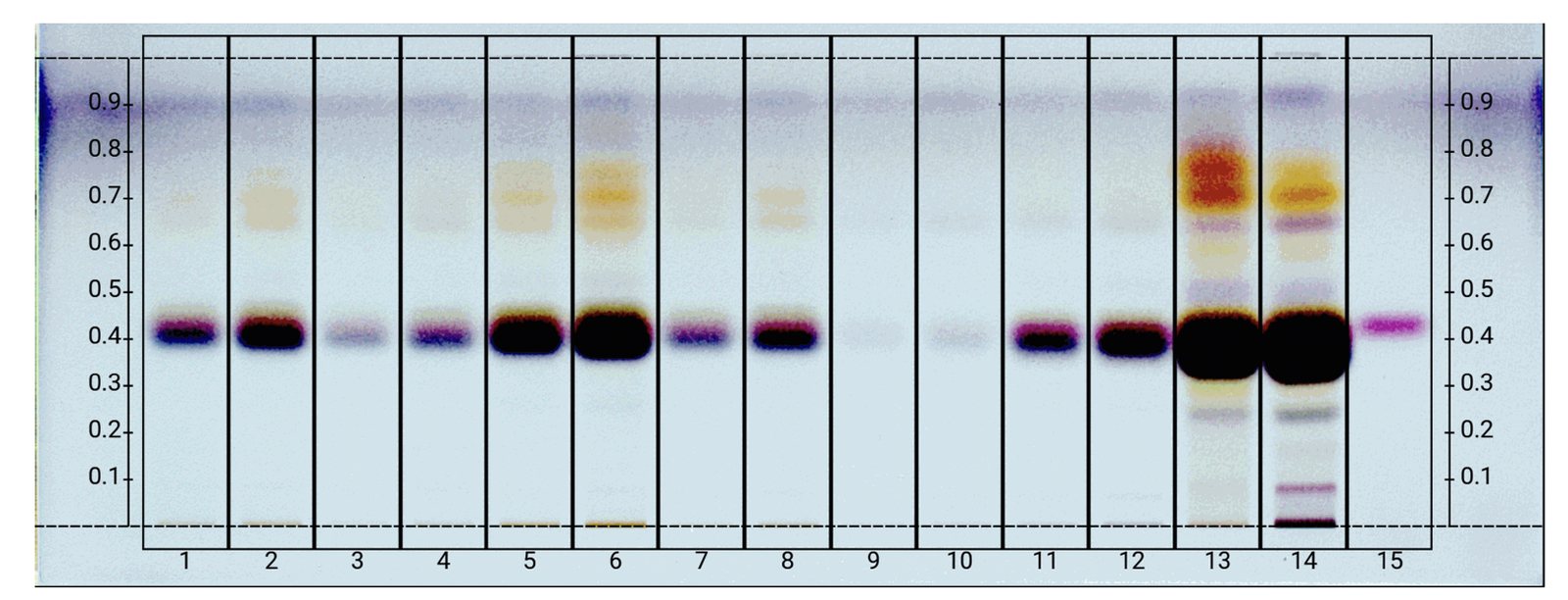
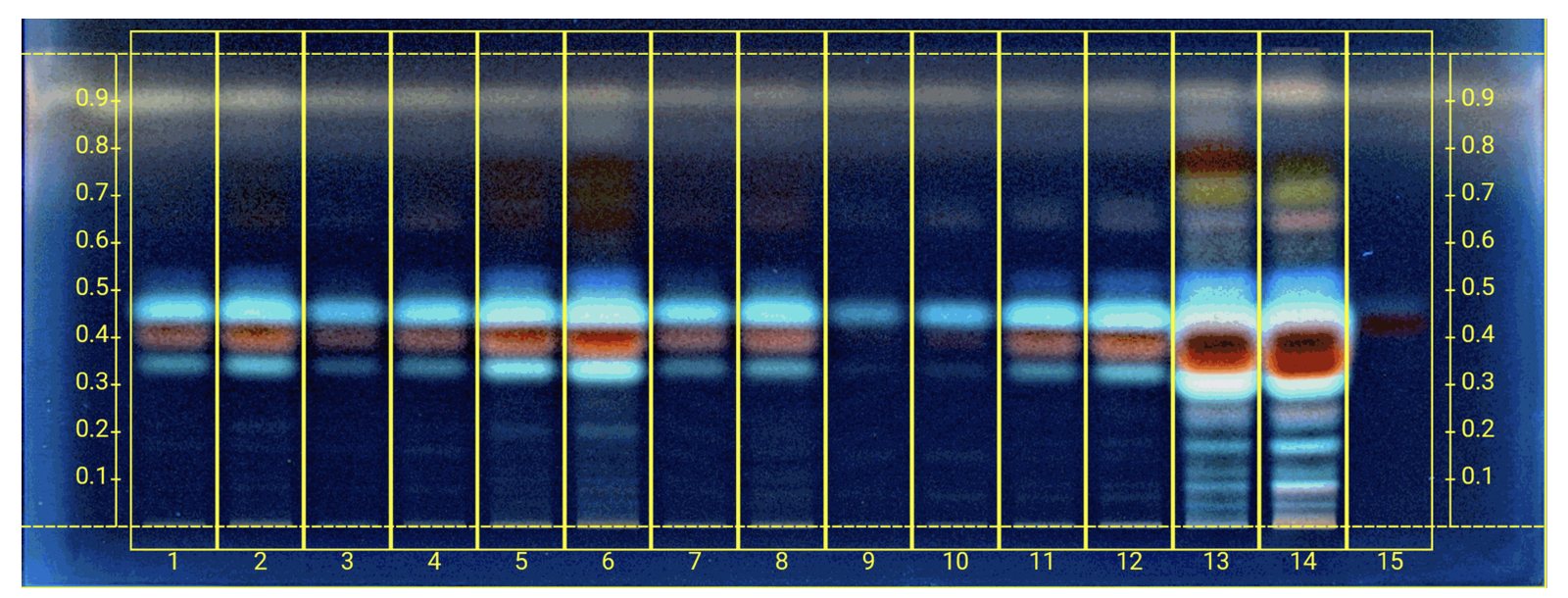
Flora Research Laboratories issued signed analytical reports for all three cultivars, each reporting the sample as consistent with the reference profile for Piper methysticum root. Full analytical reports are available from the corresponding author on reasonable request.
The results confirmed by HPTLC that the American P. methysticum cultivars propagated and grown under continental United States greenhouse conditions retain the authentic botanical identity and phytochemical profile of Kava. The present results establish that Kali-Hiwa, Kali-ISA, and Kali-Rogu are chemically and botanically authentic kava, providing the necessary foundation for interpreting the mass-balance, chemotype, and potency data reported in subsequent sections of this study.
Quantitative HPLC analysis of the dried starting materials corroborated the HPTLC identification. Kali-ISA exhibited a total kavalactone content of 14.29% (w/w dry weight, single characterized lot, reported as the mean of duplicate HPLC injections) with a chemotype of 254631 (dihydrokavain > dihydromethysticin > kavain > methysticin > yangonin > desmethoxyyangonin); methysticin and kavain occurred at near-identical concentrations in this lot (within 0.02 percentage points), placing this result within ordinary measurement resolution of the canonical “ISA” chemotype (254631/256431) reported for cultivars grown in both Papua New Guinea and Hawaii. Kali-Hiwa exhibited a total kavalactone content of 7.09% (w/w dry weight, single characterized lot, reported as the mean of duplicate HPLC injections) with a chemotype of 463251, consistent with established noble kava chemotype distributions commonly grown in Hawaii, Tonga, and Fiji; the first-material lot (n = 1), not part of this pooled figure, showed a total kavalactone content of 10.64% and a total flavokavain content of 0.234%, with the same chemotype. Kali-Rogu exhibited a total kavalactone content of 9.98% (w/w dry weight, single characterized lot, reported as the mean of duplicate HPLC injections) with a chemotype of 423561 (kavain > dihydrokavain > yangonin > dihydromethysticin > methysticin > desmethoxyyangonin), matching the canonical, gold-standard “Borogu” chemotype long established for this variety in Vanuatu (Lasme et al., 2008; Teschke, Sarris & Lebot, 2011) and confirming the mainland-grown material as chemically authentic to a canonical cultivar, just as the Kali-Hiwa and Kali-ISA profiles were. By chemotype classification, two of the three characterized lots are noble-classified — Kali-Hiwa at 463251 and Kali-Rogu at 423561 — while Kali-ISA at 254631 is an Isa-type profile, in which dihydrokavain and dihydromethysticin lead rather than kavain; Kali-ISA is accordingly described as Isa-type rather than as noble throughout this work. Flavokavain levels and flavokavain-to-kavalactone ratios were low in all three cultivars, including the Isa-type lot, and were consistent with those expected of beverage-grade drinking material rather than of tudei-type material (Lebot et al., 2019; Lebot, Kaoh & Legendre, 2020), further supporting botanical authenticity. The total kavalactone contents measured here also fall within the range reported for noble kava grown in established Pacific districts: a survey of 77 noble cultivars across the Taveuni, Qamea, and Rabi Islands of Fiji found 7.2–14.1 wt.% total kavalactones in dried roots (mean 10.1 ± 1.8 wt.%), with a kavain-dominant root code of 4[632][51] (Devi & Pasinszki, 2025), bracketing the 7.09–14.29% observed across the three mainland-grown cultivars.
Total extraction efficiency
Kali-ISA
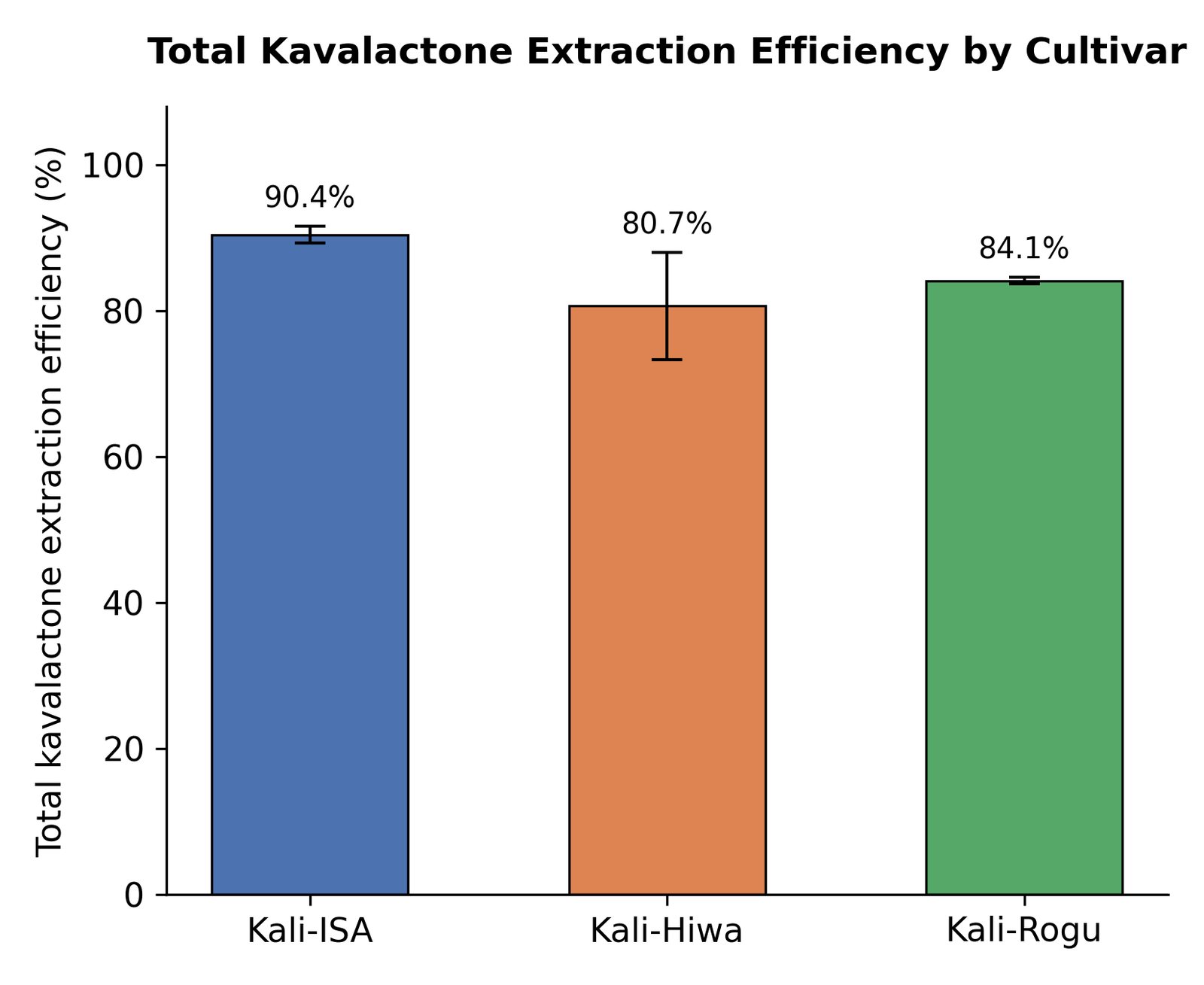
Each run began from an initial dry weight (DW₀) of 110.6 g with a total starting kavalactone content (KL₀) of 15.81 g; dried marc mass ranged from 30.84 to 33.72 g across the three runs, yielding a mean total beverage kavalactone mass (KLb) of 14.30 g. This corresponded to an overall extraction efficiency of 90.4% ± 1.2% (mean ± SD, n = 3), the highest of the three cultivars, and a beverage potency of 441–452 mg total kavalactones per 125 mL serving. Dry-matter pass-through the 150 µm strainer averaged 71.1% ± 1.4%.
| Kavalactone | KL0 (%) | KLm (%) | KLb (g) | KLp (g) | KLp (%) | NPF (g) | NPF (%) | Eff. (%) | mg / 125 mL |
| M | 2.31 | 0.92 ± 0.08 | 2.26 | 1.82 | 71.1 ± 1.4 | 0.444 | 17.39 ± 0.75 | 88.5 ± 1.4 | 70.7 ± 1.2 |
| DHM | 3.07 | 1.06 ± 0.08 | 3.06 | 2.42 | 71.1 ± 1.4 | 0.642 | 18.92 ± 0.47 | 90.1 ± 1.2 | 95.6 ± 1.3 |
| K | 2.33 | 0.73 ± 0.05 | 2.34 | 1.83 | 71.1 ± 1.4 | 0.510 | 19.79 ± 0.41 | 90.9 ± 1.1 | 73.2 ± 0.85 |
| DK | 4.00 | 1.06 ± 0.08 | 4.09 | 3.15 | 71.1 ± 1.4 | 0.938 | 21.21 ± 0.45 | 92.3 ± 0.98 | 127.7 ± 1.3 |
| Y | 1.74 | 0.66 ± 0.06 | 1.71 | 1.37 | 71.1 ± 1.4 | 0.345 | 17.90 ± 0.61 | 89.0 ± 1.4 | 53.6 ± 0.83 |
| DMY | 0.843 | 0.30 ± 0.02 | 0.835 | 0.663 | 71.1 ± 1.4 | 0.172 | 18.42 ± 0.40 | 89.6 ± 1.2 | 26.1 ± 0.36 |
| Total KL | 14.3 | 4.73 ± 0.36 | 14.3 | 11.3 | 71.1 ± 1.4 | 3.05 | 19.29 ± 0.45 | 90.4 ± 1.2 | 447 ± 5.8 |
| Total FK | 0.354 | 0.074 ± 0.008 | 0.368 | 0.279 | 71.1 ± 1.4 | 0.0892 | 22.78 ± 0.59 | 93.9 ± 0.91 | 11.5 ± 0.11 |
| CMT (raw / calc. beverage) | 254631 | — | — | — | — | — | — | — | — |
Definitions:
DW₀, DWf = initial and final dry weights, DM = dried marc, KL₀, KLm, KLb = starting/marc/beverage kavalactone fraction, KLₚ = kavalactones in particles that passed through filter, NPF = non-particulate lactones, Eff. (%) = total extraction efficiency, KL mg / 125 mL = final beverage potency per serving
Kali-Hiwa
Kali-Hiwa was reported directly from its triplicate second-material runs (Table 1.2); the first-material run (n = 1) is also reported below and incorporated into the pooled mass-balance validation (Table 3.1). Each second-material run began from an initial dry weight (DW₀) of 114.6 g with a total starting kavalactone content (KL₀) of 8.12 g; dried marc mass ranged from 18.60 to 30.28 g across the three runs, yielding a mean total beverage kavalactone mass (KLb) of 6.55 g. This corresponded to an overall extraction efficiency of 80.7% ± 7.3% (mean ± SD, n = 3) — the most run-to-run variable of the three cultivars — and a beverage potency of 188–225 mg total kavalactones per 125 mL serving. Dry-matter pass-through the 150 µm strainer averaged 78.3% ± 5.1%. The first-material lot (n = 1), by comparison, had an initial dry weight of 127.6 g, a total starting kavalactone content of 13.58 g, a dried marc mass of 32.68 g retaining 2.90 g of kavalactones, an extraction efficiency of 78.7%, a dry-matter pass-through the 150 µm strainer of 74.4%, and a beverage potency of 334 mg total kavalactones per 125 mL serving.
| Kavalactone | KL0 (%) | KLm (%) | KLb (g) | KLp (g) | KLp (%) | NPF (g) | NPF (%) | Eff. (%) | mg / 125 mL |
| M | 1.36 | 1.38 ± 0.22 | 1.21 | 1.22 | 78.3 ± 5.1 | -0.014 | -0.9 ± 3.5 | 77.4 ± 8.6 | 37.7 ± 4.2 |
| DHM | 0.858 | 0.76 ± 0.14 | 0.789 | 0.770 | 78.3 ± 5.1 | 0.019 | 1.9 ± 2.6 | 80.2 ± 7.8 | 24.7 ± 2.4 |
| K | 1.77 | 1.33 ± 0.26 | 1.69 | 1.59 | 78.3 ± 5.1 | 0.101 | 5.0 ± 1.7 | 83.3 ± 6.4 | 52.8 ± 4.1 |
| DK | 1.20 | 0.72 ± 0.19 | 1.19 | 1.08 | 78.3 ± 5.1 | 0.113 | 8.2 ± 1.6 | 86.5 ± 5.8 | 37.2 ± 2.5 |
| Y | 1.26 | 1.34 ± 0.21 | 1.10 | 1.13 | 78.3 ± 5.1 | -0.028 | -1.9 ± 3.8 | 76.4 ± 8.9 | 34.5 ± 4.0 |
| DMY | 0.637 | 0.62 ± 0.08 | 0.573 | 0.572 | 78.3 ± 5.1 | 0.002 | 0.2 ± 2.2 | 78.5 ± 7.3 | 17.9 ± 1.7 |
| Total KL | 7.09 | 6.1 ± 1.1 | 6.55 | 6.36 | 78.3 ± 5.1 | 0.194 | 2.4 ± 2.2 | 80.7 ± 7.3 | 205 ± 19 |
| Total FK | 0.133 | 0.090 ± 0.020 | 0.130 | 0.119 | 78.3 ± 5.1 | 0.011 | 6.94 ± 0.93 | 85.2 ± 5.8 | 4.06 ± 0.28 |
| CMT (raw, all 3 runs) | 463251 | — | — | — | — | — | — | — | — |
Kali-Rogu
Kali-Rogu is reported directly from its triplicate second-material runs (Table 1.3). Each run began from an initial dry weight (DW₀) of 87.0 g with a total starting kavalactone content (KL₀) of 8.68 g; dried marc mass ranged from 23.62 to 25.84 g across the three runs, yielding a mean total beverage kavalactone mass (KLb) of 7.31 g. This corresponded to an overall extraction efficiency of 84.1% ± 0.5% (mean ± SD, n = 3) — the most run-to-run reproducible of the three cultivars — and a beverage potency of 227–229 mg total kavalactones per 125 mL serving. Dry-matter pass-through the 150 µm strainer averaged 71.7% ± 1.3%.
| Kavalactone | KL0 (%) | KLm (%) | KLb (g) | KLp (g) | KLp (%) | NPF (g) | NPF (%) | Eff. (%) | mg / 125 mL |
| M | 1.32 | 0.88 ± 0.05 | 0.932 | 0.824 | 71.7 ± 1.3 | 0.108 | 9.4 ± 1.6 | 81.2 ± 0.53 | 29.1 ± 0.19 |
| DHM | 1.33 | 0.76 ± 0.06 | 0.972 | 0.830 | 71.7 ± 1.3 | 0.142 | 12.3 ± 1.9 | 84.0 ± 0.69 | 30.4 ± 0.25 |
| K | 2.58 | 1.25 ± 0.08 | 1.94 | 1.61 | 71.7 ± 1.3 | 0.327 | 14.6 ± 1.6 | 86.3 ± 0.42 | 60.5 ± 0.30 |
| DK | 2.40 | 0.99 ± 0.07 | 1.84 | 1.50 | 71.7 ± 1.3 | 0.347 | 16.6 ± 1.6 | 88.4 ± 0.41 | 57.7 ± 0.27 |
| Y | 1.65 | 1.29 ± 0.05 | 1.12 | 1.03 | 71.7 ± 1.3 | 0.0895 | 6.2 ± 1.1 | 78.0 ± 0.84 | 35.0 ± 0.38 |
| DMY | 0.698 | 0.45 ± 0.01 | 0.497 | 0.436 | 71.7 ± 1.3 | 0.0616 | 10.1 ± 1.0 | 81.9 ± 0.42 | 15.5 ± 0.08 |
| Total KL | 9.98 | 5.61 ± 0.33 | 7.31 | 6.23 | 71.7 ± 1.3 | 1.08 | 12.4 ± 1.5 | 84.1 ± 0.46 | 228 ± 1.2 |
| Total FK | 0.162 | 0.084 ± 0.005 | 0.120 | 0.101 | 71.7 ± 1.3 | 0.0193 | 13.7 ± 1.4 | 85.5 ± 0.29 | 3.76 ± 0.01 |
| CMT (raw / calc. beverage) | 423561 | — | — | — | — | — | — | — | — |
Definitions:
DW₀, DWf = initial and final dry weights, DM = dried marc, KL₀, KLm, KLb = starting/marc/beverage kavalactone fraction, KLₚ = kavalactones in particles that passed through filter, NPF = non-particulate lactones, Eff. (%) = total extraction efficiency, KL mg / 125 mL = final beverage potency per serving
Extraction efficiencies for individual kavalactones followed similar patterns within each variety, though with substantially greater run-to-run spread in Kali-Hiwa's second-material triplicate. In Kali-Hiwa, individual kavalactone extraction efficiencies ranged from 76.4% (yangonin) to 86.5% (dihydrokavain), with SD of 5.8–8.9 percentage points per compound across the three runs which was a markedly higher variance than the other two cultivars. In Kali-ISA, extraction efficiencies were consistently higher, ranging from 88.5% to 92.3% across all six major kavalactones. In Kali-Rogu, individual kavalactone extraction efficiencies across the three triplicate runs ranged from 78.0% (yangonin) to 88.4% (dihydrokavain). Total kavalactone extraction from the starting material into the beverage was 90.4%, 80.7%, and 84.1% for Kali-ISA, Kali-Hiwa, and Kali-Rogu respectively (Figure 3). The rank order of individual-compound efficiency was consistent across the three lots and tracked published aqueous solubility: dihydrokavain, the most water-soluble of the six, transferred most completely in all three lots (92.3% Kali-ISA, 86.5% Kali-Hiwa, 88.4% Kali-Rogu), and yangonin, the least soluble, transferred least in Kali-Hiwa (76.4%) and Kali-Rogu (78.0%), with methysticin marginally below yangonin in Kali-ISA (88.5% versus 89.0%). The spread between the most and least efficiently transferred compound is nonetheless narrow relative to the total transferred, consistent with a delivery route in which solubility modulates, rather than governs, the quantity reaching the beverage.
Partitioning of kavalactones within the finished beverage
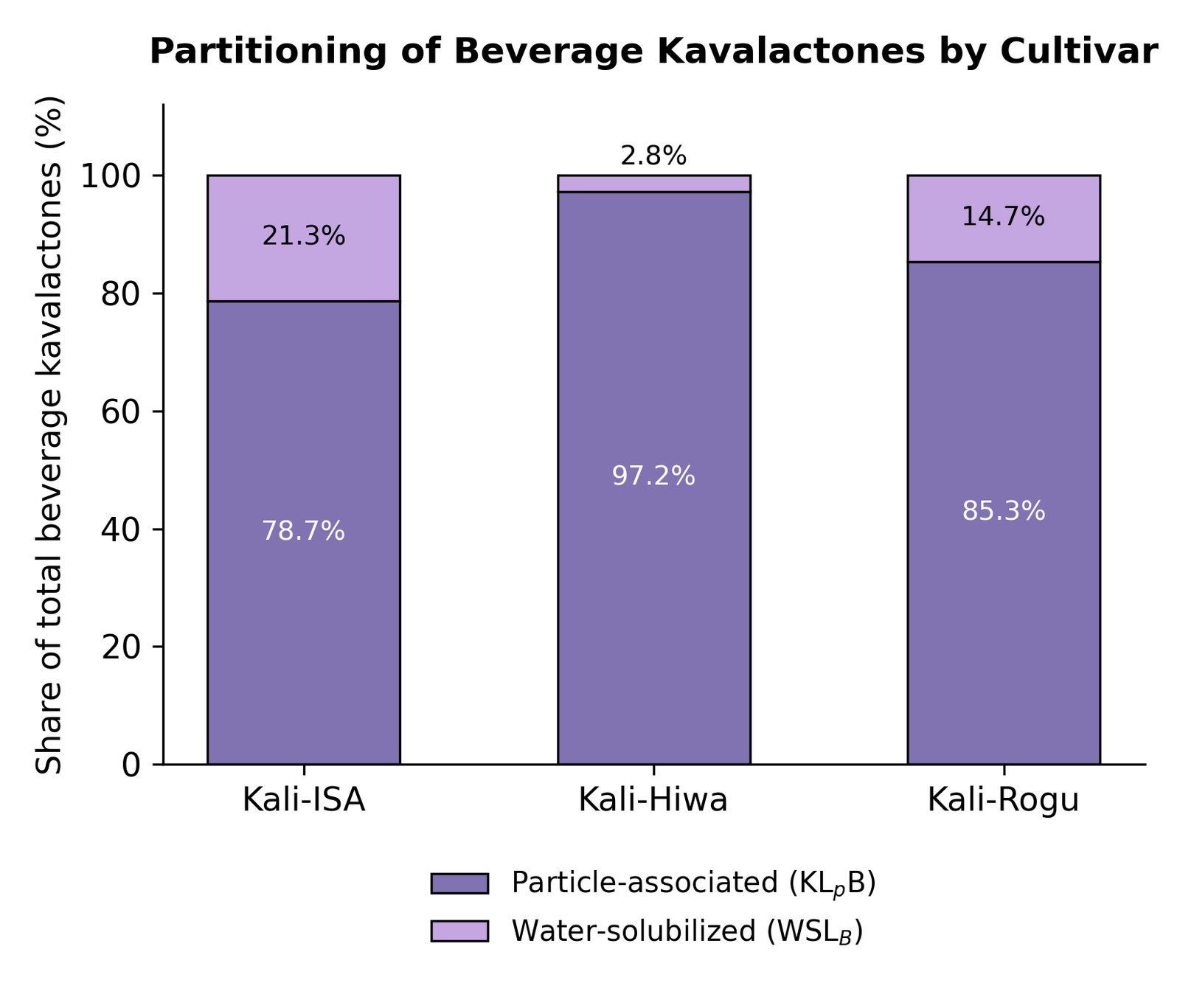
To characterize the physical distribution of kavalactones within the finished beverages, total beverage kavalactones (KLb) were partitioned into particle-associated kavalactones (KLₚ), retained in suspended solids passing through the 150 µm strainer, and non-particulate kavalactones (NPF), calculated as KLb − KLₚ. Partitioning values are reported as percentages of total beverage kavalactones.
In the Kali-ISA beverage (mean of n = 3 triplicate runs), total kavalactones amounted to 14.30 g, of which 11.25 g (78.7%) were particle-associated and 3.05 g (21.3%) were non-particulate. Partitioning was relatively uniform across all six kavalactones, with non-particulate fractions ranging from 19.6% (methysticin) to 23.0% (dihydrokavain), with low run-to-run variance (SD ≤ 0.8 percentage points per compound across the three replicates). Complete partitioning data for Kali-ISA are reported in Table 2.1; a cross-cultivar comparison of pooled partitioning behavior is provided in Table 2.4 and visualized in Figure 4.
| Kavalactone | KLb (g) | KLp (g) | NPF (g) | KLp B (%) | NPF B (%) |
| M | 2.26 | 1.82 | 0.444 | 80.4 ± 0.82 | 19.6 ± 0.82 |
| DHM | 3.06 | 2.42 | 0.642 | 79.0 ± 0.66 | 21.0 ± 0.66 |
| K | 2.34 | 1.83 | 0.510 | 78.2 ± 0.68 | 21.8 ± 0.68 |
| DK | 4.09 | 3.15 | 0.938 | 77.0 ± 0.73 | 23.0 ± 0.73 |
| Y | 1.71 | 1.37 | 0.345 | 79.9 ± 0.71 | 20.1 ± 0.71 |
| DMY | 0.835 | 0.663 | 0.172 | 79.4 ± 0.61 | 20.6 ± 0.61 |
| Total KL | 14.3 | 11.3 | 3.05 | 78.7 ± 0.67 | 21.3 ± 0.67 |
| Total FK | 0.368 | 0.279 | 0.0892 | 75.7 ± 0.83 | 24.3 ± 0.83 |
| Chemotype (CMT) by fraction | |||||
| Raw material | 254631 | ||||
| Marc (residual, dried) | 256431 | ||||
| Beverage, calculated (KLb) | 254631 | ||||
| Particle-associated (KLp) | 254631 | ||||
| Non-particulate (NPF) | 254631 | ||||
Definitions:
DW₀, = initial dry weight, DM = dried marc, Total KL = total Kavalactones, Total FK = total Flavokavains A+B+C, CMT = chemotype, KLb = beverage kavalactone weights, KLₚ = kavalactones in particles that passed through filter, NPF = non-particulate lactones, KLₚB (%) = Percent of Kavalactones in beverage from particle fraction, NPF B (%) = Percent of beverage kavalactones in the non-particulate fraction
In the Kali-Hiwa beverage (mean of n = 3 second-material triplicate runs), total kavalactones amounted to 6.55 g, of which 6.36 g (97.2%) were particle-associated and 0.19 g (2.8%) were non-particulate. Particle dominance was observed for most individual kavalactones, though methysticin and yangonin showed small negative non-particulate values, a known modeling artifact discussed below, not a true negative dissolved quantity. Non-particulate proportions ranged from −2.9% (yangonin) to 9.5% (dihydrokavain), with substantial run-to-run variance of SD 1.6–5.4 percentage points per compound. Complete partitioning data for Kali-Hiwa are reported in Table 2.2. The first-material run (n = 1) showed a more particle-dominant distribution by comparison: 10.10 g of 10.68 g total, 94.6% particle-associated, 5.4% non-particulate.
| Kavalactone | KLb (g) | KLp (g) | NPF (g) | KLp B (%) | NPF B (%) |
| M | 1.21 | 1.22 | -0.014 | 101.5 ± 4.7 | -1.5 ± 4.7 |
| DHM | 0.789 | 0.770 | 0.019 | 97.8 ± 3.0 | 2.2 ± 3.0 |
| K | 1.69 | 1.59 | 0.101 | 94.1 ± 1.6 | 5.9 ± 1.6 |
| DK | 1.19 | 1.08 | 0.113 | 90.5 ± 1.6 | 9.5 ± 1.6 |
| Y | 1.10 | 1.13 | -0.028 | 102.9 ± 5.4 | -2.9 ± 5.4 |
| DMY | 0.573 | 0.572 | 0.002 | 99.9 ± 2.7 | 0.1 ± 2.7 |
| Total KL | 6.55 | 6.36 | 0.194 | 97.2 ± 2.4 | 2.8 ± 2.4 |
| Total FK | 0.130 | 0.119 | 0.011 | 91.9 ± 0.78 | 8.1 ± 0.78 |
| Chemotype (CMT) by fraction | |||||
| Raw material | 463251 | ||||
| Marc (residual, dried) | 634521 | ||||
| Beverage, calculated (KLb) | 462351 | ||||
| Particle-associated (KLp) | 463251 | ||||
| Non-particulate (NPF) | 245163 | ||||
In the Kali-Rogu beverage (mean of n = 3 triplicate runs), total kavalactones amounted to 7.31 g, of which 6.23 g (85.3%) were particle-associated and 1.08 g (14.7%) were non-particulate — an intermediate distribution between Kali-ISA and Kali-Hiwa. Non-particulate proportions ranged from 8.0% for yangonin to 18.8% for dihydrokavain across the six major kavalactones, with low run-to-run variance (SD 1.3–2.2 percentage points per compound across the three replicates). Complete partitioning data for Kali-Rogu are reported in Table 2.3; a cross-cultivar comparison of pooled partitioning behavior for all three cultivars is provided in Table 2.4.
| Kavalactone | KLb (g) | KLp (g) | NPF (g) | KLp B (%) | NPF B (%) |
| M | 0.932 | 0.824 | 0.108 | 88.4 ± 1.9 | 11.6 ± 1.9 |
| DHM | 0.972 | 0.830 | 0.142 | 85.4 ± 2.2 | 14.6 ± 2.2 |
| K | 1.94 | 1.61 | 0.327 | 83.1 ± 1.7 | 16.9 ± 1.7 |
| DK | 1.84 | 1.50 | 0.347 | 81.2 ± 1.7 | 18.8 ± 1.7 |
| Y | 1.12 | 1.03 | 0.0895 | 92.0 ± 1.4 | 8.0 ± 1.4 |
| DMY | 0.497 | 0.436 | 0.0616 | 87.6 ± 1.3 | 12.4 ± 1.3 |
| Total KL | 7.31 | 6.23 | 1.08 | 85.3 ± 1.7 | 14.7 ± 1.7 |
| Total FK | 0.120 | 0.101 | 0.0193 | 84.0 ± 1.6 | 16.0 ± 1.6 |
| Chemotype (CMT) by fraction | |||||
| Raw material | 423561 | ||||
| Marc (residual, dried) | 342651 | ||||
| Beverage, calculated (KLb) | 423561 | ||||
| Particle-associated (KLp) | 423561 | ||||
| Non-particulate (NPF) | 245631 | ||||
| Kavalactone | Kali-ISA KLp B (%) | Kali-ISA NPF B (%) | Kali-Hiwa KLp B (%) | Kali-Hiwa NPF B (%) | Kali-Rogu KLp B (%) | Kali-Rogu NPF B (%) |
| M | 80.4 | 19.6 | 101 | -1.47 | 88.4 | 11.6 |
| DHM | 79.0 | 21.0 | 97.8 | 2.22 | 85.4 | 14.6 |
| K | 78.2 | 21.8 | 94.1 | 5.94 | 83.1 | 16.9 |
| DK | 77.0 | 23.0 | 90.5 | 9.48 | 81.2 | 18.8 |
| Y | 79.9 | 20.1 | 103 | -2.94 | 92.0 | 8.00 |
| DMY | 79.4 | 20.6 | 99.9 | 0.10 | 87.6 | 12.4 |
| Total KL | 78.7 | 21.3 | 97.2 | 2.81 | 85.3 | 14.7 |
| Total FK | 75.7 | 24.3 | 91.9 | 8.14 | 84.0 | 16.0 |
Definitions:
DW₀, = initial dry weight, DM = dried marc, Total KL = total Kavalactones, Total FK = total Flavokavains A+B+C, CMT = chemotype, KLb = beverage kavalactone weights, KLₚ = kavalactones in particles that passed through filter, NPF = non-particulate lactones, KLₚB (%) = Percent of Kavalactones in beverage from particle fraction, NPF B (%) = Percent of beverage kavalactones in the non-particulate fraction
Chemotype outcomes
The raw-material chemotype for Kali-Hiwa's triplicate was 463251. In the finished beverage, the pooled bulk chemotype based on total kavalactones in the beverages (KLb), was 462351 — a minor yangonin/dihydrokavain near-tie relative to the raw-material order, of the same measurement-level-proximity type already noted for Kali-ISA's methysticin/kavain pair, rather than a genuine shift; direct HPLC analysis of the recovered dehydrated beverages returned 463251 in three of the four validated Kali-Hiwa runs (Table 3.1), supporting this interpretation. However, analysis of the non-particulate fraction revealed a distinct chemotype relative to the bulk beverage. As shown in Table 2.2, the pooled non-particulate kavalactones from Kali-Hiwa exhibited a chemotype of 245163 (dihydrokavain > kavain > dihydromethysticin > desmethoxyyangonin > methysticin > yangonin), consistent across the first and third replicate runs, while the second run returned 425631, a kavain/dihydrokavain exchange at the top two ranks accompanied by reordering of the three near-zero tail compounds. This differs substantially from the particle-dominated bulk beverage chemotype of 462351, indicating that Kali-Hiwa's non-particulate fraction preferentially concentrates dihydrokavain and kavain relative to the other four kavalactones. The first-material run (n = 1) showed a related but distinct non-particulate chemotype of 42(3,6,5)1, having kavain and dihydrokavain as the dominant lactones with the middle three amounts too close in concentration to establish a definitive order, followed by desmethoxyyangonin last — the same qualitative pattern (a dihydrokavain/kavain-enriched non-particulate fraction) as the second-material triplicate, expressed with different exact rank digits. A paired t-test on the dihydrokavain/kavain difference across the second-material triplicate did not reach significance (p = 0.375, Table 4), consistent with the rank exchange observed in the second of the three replicate runs; the point estimate favors dihydrokavain in both the first- and second-material lots, but this specific rank position should be treated as provisional rather than firmly established at this sample size.
For Kali-ISA, the reported chemotype was 254631, observed in the characterized second-material lot and preserved in the finished beverage when total kavalactones were considered. Methysticin and kavain occurred at near-identical concentrations (within 0.02 percentage points) in this lot, placing this result within ordinary measurement resolution of the canonical “ISA” chemotypes (254631/256431) reported for this cultivar grown in Papua New Guinea and Hawaii, rather than reflecting a genuine chemotype shift. In contrast to Kali-Hiwa, partitioning of kavalactones in Kali-ISA did not result in a chemotype shift between phases. As shown in Table 2.1, both the particle-associated fraction and the non-particulate fraction retained the same chemotype as the bulk beverage (254631) in all three runs, indicating proportional extraction of all six major kavalactones across phases. The residual marc showed a slightly different pooled chemotype (256431, vs. 254631 for every other fraction), reflecting an exchange of methysticin and kavain at rank positions three and four. A paired t-test across the three replicate runs found this particular rank difference to be statistically supported (mean difference 0.19 percentage points; t(2) = 6.84, p = 0.021, Table 4), indicating a genuine, if small, marc-specific enrichment of methysticin relative to kavain rather than measurement noise. The marc's top two ranks (dihydrokavain vs. dihydromethysticin) are by contrast statistically indistinguishable (p = 0.912, Table 4), which accounts for the run-to-run variation between 256431 and 526431 observed in the individual marc replicates.
For Kali-Rogu, the raw-material chemotype was 423561 (kavain > dihydrokavain > yangonin > dihydromethysticin > methysticin > desmethoxyyangonin), matching the established canonical “Borogu” chemotype of Vanuatu (Lasme et al., 2008; Teschke, Sarris & Lebot, 2011) and confirming, alongside the HPTLC and total-kavalactone-content results above, that the mainland-grown cultivar is chemically consistent with the Vanuatuan Borogu cultivar just as 463251 and 256431 confirm Kali-Hiwa and Kali-ISA, respectively. Raw material, calculated beverage, directly measured (HPLC) beverage, and the particle-associated fraction all returned 423561 in all three replicate runs, with no exceptions. Two other fractions, however, departed from this pattern: The residual marc showed a distinct pooled chemotype of 342651 (yangonin and kavain exchanging the top two ranks relative to the bulk profile; one of the three runs showed a further near-tie between these same two compounds, 432651), and the non-particulate fraction shifted further still, to 245631 (dihydrokavain and kavain dominant), consistent across all three runs. Kali-Rogu is therefore not phase-stable overall. Rather, its marc and non-particulate fractions both diverge chemotypically from its own raw material, beverage, and particle-associated fractions, placing it alongside Kali-Hiwa rather than apart from it. These two shifts differ substantially in statistical strength (Table 4): the non-particulate dihydrokavain/kavain difference is highly consistent across all three replicates and reaches significance (p = 0.005), while the marc yangonin/kavain difference does not (p = 0.33, with one replicate reversing sign) and should be treated as a near-tie rather than an established rank order.
Thus, while total beverage chemotypes remained consistent with (Kali-Hiwa, Kali-ISA) or distinctly but stably expressed relative to (Kali-Rogu) their respective starting materials, phase-specific analysis demonstrated that the non-particulate fraction exhibits a chemotype distinct from both the starting material and the bulk beverage in two of the three cultivars (Kali-Hiwa: 245163; Kali-Rogu: 245631), with only Kali-ISA retaining a single conserved chemotype (254631) across particle-associated and aqueous fractions alike. The residual marc also departed from the bulk/raw chemotype in all three cultivars to varying degrees, most modestly in Kali-ISA, which presented a single rank exchange, 256431 vs. 254631, and most substantially in Kali-Hiwa, whose marc chemotype additionally varied considerably from run to run. Kali-Rogu’s raw-material chemotype 423561 is itself distinct from Kali-Hiwa and Kali-ISA, but this cultivar-level distinctiveness does not extend to phase-stability. Like Kali-Hiwa, its aqueous fraction chemotype diverges from its bulk and particle-associated fractions, indicating that phase-dependent chemotype shifting in the non-particulate fraction is the more general pattern among all three American-grown cultivars rather than a Kali-Hiwa-specific phenomenon.
Mass Balance Method Validation
Mass-balance accuracy was validated in triplicate across all three cultivars using independent second-material extraction runs conducted under fixed SWWE conditions with no physicochemical parameters were varied across runs. For Kali-Hiwa, this second-material triplicate lot (roots and chips) was chemically distinct from the first-material (lateral roots) lot. Kali-Hiwa’s raw starting-material dry-weight total kavalactone content was 7.09% (w/w, DW₀ = 114.6 g, KL₀ = 8.12 g), compared with 14.29% (w/w, DW₀ = 110.6 g, KL₀ = 15.81 g) for Kali-ISA and 9.98% for Kali-Rogu. Mass-balance calculations were performed by quantifying the total kavalactones in the starting dry material (KL₀), the dried spent marc (KLm), and the finished beverage (KLb), where KLb was calculated as KL₀ − KLm for measured analytical values. Beverage potency was expressed as total kavalactones per 125 mL serving, scaled from the total beverage volume (4000 mL). One additional Kali-Hiwa first-material (lateral root) run was also validated; having genuine independent beverage-HPLC data, it is pooled directly into the Kali-Hiwa mass-balance validation statistic (n = 4 total) rather than reported as a separate addition (Table 3.1).
To validate the accuracy of the mass-balance framework, total kavalactone content calculated for each finished beverage (KLb) was compared against direct HPLC-UV quantification of the fully recovered, gravimetrically measured dehydrated beverage matrices. Across all ten individually validated beverage runs (one Kali-Hiwa lateral-root run, three Kali-Hiwa second-material runs, three Kali-ISA runs, and three Kali-Rogu runs), the mass-balance–derived value for total kavalactones differed from the independently measured HPLC value by a mean absolute relative difference of 2.8% (SD 2.2%; 95% CI 1.2–4.4%; n = 10). Because the interval excludes zero, a systematic difference of a few percent cannot be excluded, and the failure to detect a directional bias at this sample size should not be read as demonstrated equivalence. Agreement was strongest for Kali-ISA with a mean absolute difference 0.4%, intermediate for Kali-Hiwa (3.2% ± 2.0%, n = 4, pooling its first-material run (n = 1) together with the second-material triplicate), and 4.5% for Kali-Rogu. One Kali-Hiwa second-material run (Beverage 3) was excluded from the pooled group because a documented sample-handling error during processing compromised that run, and the pre-planned contingency replicate (Beverage 4) was used in its place (see Methods, Validation of the Mass-Balance Method Against Direct HPLC Analysis of Dehydrated Beverages); both are reported for transparency. The calculations for each individual extraction, together with pooled absolute differences per material, are reported in Table 3.1 (Kali-Hiwa), Table 3.2 (Kali-ISA), and Table 3.3 (Kali-Rogu). The overall cross-cultivar validation, combining per-material and all-run pooled summaries, is presented in Table 3.4. Agreement for total flavokavains across the same ten runs was correspondingly looser at 7.9 ± 5.0% (Table 3.4). Flavokavains are present at roughly 2% of the absolute kavalactone mass in these lots, so an equivalent absolute analytical uncertainty represents a substantially larger relative difference; the flavokavain figures are reported for completeness and are not advanced as a validation of the estimator at that scale.
| Run | DW0 (g) | DM (g) | Total KL Actual (mg) | Total KL MB-calc. (mg) | Total KL |Diff.| (%) | Total FK Actual (mg) | Total FK MB-calc. (mg) | Total FK |Diff.| (%) | CMT |
| Laterals (Bev. 1, n = 1) | 127.6 | 32.68 | 338 | 334 | 1.3 | 7.21 | 7.68 | 6.5 | 463251 |
| 2nd material Bev. 1 | 114.6 | 30.28 | 178 | 188 | 5.8 | 4.45 | 3.83 | 14 | 462351 |
| 2nd material Bev. 2 | 114.6 | 18.60 | 233 | 225 | 3.6 | 3.94 | 4.37 | 11 | 463251 |
| 2nd material Bev. 3 (excluded) | 114.6 | 22.80 | 237 | 209 | 12 | 4.10 | 4.12 | 0.6 | 463251 |
| 2nd material Bev. 4 | 114.6 | 25.70 | 197 | 201 | 2.1 | 3.36 | 3.98 | 19 | 463251 |
| Pooled (n = 4: Laterals, Bev. 1, 2, 4) | — | — | — | — | 3.2 ± 2.0 | — | — | 12.5 ± 5.1 | — |
| Run | DW0 (g) | DM (g) | Total KL Actual (mg) | Total KL MB-calc. (mg) | Total KL |Diff.| (%) | Total FK Actual (mg) | Total FK MB-calc. (mg) | Total FK |Diff.| (%) | CMT |
| Beverage 1 | 110.6 | 33.72 | 442 | 441 | 0.30 | 10.9 | 11.4 | 4.2 | 254631 |
| Beverage 2 | 110.6 | 31.20 | 451 | 448 | 0.80 | 10.9 | 11.5 | 5.5 | 254631 |
| Beverage 3 | 110.6 | 30.84 | 451 | 452 | 0.22 | 11.0 | 11.6 | 5.2 | 256431 |
| Pooled (n = 3) | — | — | — | — | 0.44 ± 0.32 | — | — | 4.9 ± 0.7 | — |
| Run | DW0 (g) | DM (g) | Total KL Actual (mg) | Total KL MB-calc. (mg) | Total KL |Diff.| (%) | Total FK Actual (mg) | Total FK MB-calc. (mg) | Total FK |Diff.| (%) | CMT |
| Beverage 1 | 87.0 | 23.62 | 244 | 229 | 6.2 | 3.99 | 3.77 | 5.5 | 423561 |
| Beverage 2 | 87.0 | 24.28 | 237 | 227 | 4.1 | 3.99 | 3.75 | 6.1 | 423561 |
| Beverage 3 | 87.0 | 25.84 | 236 | 229 | 3.1 | 3.86 | 3.77 | 2.4 | 423561 |
| Pooled (n = 3) | — | — | — | — | 4.5 ± 1.6 | — | — | 4.7 ± 2.0 | — |
| Kavalactone | Kali-Hiwa (n = 4 pooled) | Kali-ISA (n = 3 pooled) | Kali-Rogu (n = 3 pooled) | Mean of materials (n = 3) | Grand pooled all runs (n = 10) mean ± SD |
| M | 2.17 | 2.60 | 3.38 | 2.72 | 2.7 ± 2.3 |
| DHM | 2.19 | 0.46 | 5.37 | 2.67 | 2.6 ± 2.6 |
| K | 5.83 | 1.23 | 3.29 | 3.45 | 3.7 ± 3.5 |
| DK | 5.12 | 1.20 | 5.79 | 4.04 | 4.1 ± 3.2 |
| Y | 5.01 | 1.66 | 4.07 | 3.58 | 3.7 ± 3.8 |
| DMY | 2.97 | 0.55 | 4.62 | 2.72 | 2.7 ± 2.4 |
| Total KL | 3.21 | 0.44 | 4.47 | 2.71 | 2.8 ± 2.2 |
| Total FK | 12.5 | 4.93 | 4.66 | 7.35 | 7.9 ± 5.0 |
To formally test whether the mass-balance-calculated and HPLC-measured values differ systematically, a paired-samples t-test was performed across all ten individually validated beverage runs (Total KL, mg per 125 mL). The mean difference (HPLC-measured minus mass-balance-calculated) was 3.5 mg (95% CI: −1.8 to 8.7 mg; t(9) = 1.48, p = 0.173), indicating no statistically significant systematic bias between the two methods at this sample size; with n = 10 the test has limited power, so this is an absence of detected bias rather than a demonstration of equivalence. Bland-Altman analysis of the same paired differences yielded a bias of 3.5 mg with 95% limits of agreement of −11.0 to +17.9 mg. The two measures were also strongly correlated (Pearson r = 0.998, R² = 0.996; linear regression of calculated on measured values gave a slope of 1.00 and intercept of −3.7 mg); this correlation is reported for completeness only, since the wide range of beverage concentrations spanned by the validation set (188–452 mg per 125 mL) is sufficient to produce a high coefficient irrespective of agreement at any single concentration. The slope near unity and the limits of agreement are the informative quantities (Table 4).
| Comparison | Test | Statistic | p-value | Effect size / Agreement | Interpretation |
| Mass-balance vs. HPLC (Total KL, n = 10 runs) | Paired t-test | t(9) = 1.48 | 0.173 | — | No bias detected (n = 10; limited power) |
| Mass-balance vs. HPLC agreement | Bland-Altman | Bias = 3.5 mg | — | 95% LoA: −11.0 to +17.9 mg | Consistent with method validity |
| Mass-balance vs. HPLC correlation | Pearson correlation / linear regression | r = 0.998 | — | R² = 0.996; slope = 1.00 | Strong linear agreement (range-driven; see text) |
| Extraction efficiency by lot (n = 3 process replicates/lot) | One-way ANOVA | F(2,6) = 3.95 | 0.080 | η² = 0.57 | Large effect; not confirmed at this n |
| Particle-associated partitioning by lot (n = 3 process replicates/lot) | One-way ANOVA | F(2,6) = 85.3 | <0.0001 | η² = 0.97 | Highly significant (lot-level) |
| Dihydrokavain vs. kavain — non-particulate fraction, Kali-Rogu (n = 3; drives 245631) | Paired t-test | t(2) = 14.0 | 0.005 | Mean difference = 0.0201 g | Rank order statistically supported |
| Dihydrokavain vs. kavain — non-particulate fraction, Kali-Hiwa (n = 3; drives 245163) | Paired t-test | t(2) = 1.14 | 0.375 | Mean difference = 0.0116 g | Not distinguishable at this n; provisional |
| Methysticin vs. kavain — residual marc, Kali-ISA (n = 3; drives 256431 vs. 254631) | Paired t-test | t(2) = 6.84 | 0.021 | Mean difference = 0.19 percentage points | Rank order statistically supported |
| Dihydrokavain vs. dihydromethysticin — residual marc, Kali-ISA (n = 3; top two ranks) | Paired t-test | t(2) = 0.12 | 0.912 | Mean difference = 0.003 percentage points | Not distinguishable; explains run-to-run variation |
| Yangonin vs. kavain — residual marc, Kali-Rogu (n = 3; drives 342651) | Paired t-test | t(2) = 1.28 | 0.329 | Mean difference = 0.03 percentage points | Near-tie; not established |
Note: Rows 1–3 (mass-balance method validation) pool the Kali-Hiwa lateral-root run (n = 1) together with its second-material triplicate, giving n = 10 total paired runs. Rows 4–5 (cross-cultivar ANOVAs) use each cultivar’s primary second-material triplicate only (n = 3/cultivar; n = 9 total), excluding that single run to preserve a balanced design across cultivars. See Methods and Discussion for rationale.
Beyond the potency-based (HPLC-vs-mass-balance) agreement above, a complementary gravimetric check, comparing initial dry weight (DW₀) against the sum of recovered dried marc and dried beverage solids, was performed for every validated run. Kali-ISA closed almost completely as the mean gravimetric loss was −0.4% ± 1.5% SD across three runs. Kali-Rogu showed a small, highly consistent loss (10.1% ± 0.5% SD across three runs). Kali-Hiwa showed both the highest mean gravimetric loss (12.4% ± 5.5% SD across the four runs including the excluded Beverage 3) and, notably, far greater run-to-run variability in the underlying dried-marc and dried-beverage weights themselves (coefficients of variation of 20.2% and 14.3%, respectively) than either Kali-ISA (4.9% and 0.2%) or Kali-Rogu (4.6% and 2.7%). By contrast, Kali-Hiwa’s lateral-root run (n = 1) closed as cleanly as Kali-ISA (−2.9%), indicating that the elevated variability is a property of the second-material lot or its processing rather than an intrinsic feature of the Kali-Hiwa cultivar. This finding is addressed further in the Discussion. Because unrecovered dry matter is assigned to the beverage by construction, incomplete closure propagates directly into fₚ; gravimetric closure is accordingly the best available index of how far a given lot’s partition estimates should be relied upon. On that criterion the Kali-ISA estimates are the best supported in this dataset and those of the Kali-Hiwa second-material lot the least.
Discussion
This study evaluates short warm-water extraction (SWWE) as a beverage-preparation method for kava using a quantitative mass-balance framework that directly measures kavalactone transfer from starting material into the finished beverage. Prior to extraction, botanical identity of all three American-grown cultivars was confirmed as authentic Piper methysticum by HPTLC and further supported by HPLC. Across all three authenticated varieties, SWWE achieved substantial total extraction efficiencies (80.7–90.4%).
The results demonstrate that mainland American-grown Kali-Hiwa, Kali-ISA, and Kali-Rogu cultivars of Piper methysticum produce high-potency aqueous beverages with largely canonical kavalactone chemotypes. Bulk beverage chemotypes matched each cultivar’s established canonical profile — 462351 for Kali-Hiwa (within measurement resolution of the canonical 463251), 254631 for Kali-ISA (within measurement resolution of the canonical 256431), and 423561 (the recognized “Borogu” chemotype of Vanuatu) for Kali-Rogu — and were preserved relative to input material across all three cultivars. Total per-serving potencies of 188–452 mg per 125 mL were comparable to or exceeded those reported in prior beverage-focused studies, after accounting for differences in serving volume (Table 5).
| Study | Cultivar / Product | Preparation Method | Serving Volume | Total Kavalactones per Serving | Source / Location |
| This study | Kali-ISA, Kali-Hiwa, Kali-Rogu (triplicate ranges) | SWWE | 125 mL | 188–452 mg | Mainland USA (Sacramento, CA) |
| Brown et al. (2007) | Traditional Hawaiian kava | Cold-water, traditional | 250 mL (shell) | 178 mg (mean); ≈ 89 mg normalized to 125 mL | Hawaii, USA |
| Jhoo et al. (2006) | Water infusion prepared by the traditional method | Aqueous infusion | 240 mL (1 cup) | ≈ 220–332 mg; ≈ 115–173 mg normalized to 125 mL | Traditional-method infusion, USA |
| Balick & Lee (2002) | Traditional Micronesian sakau | Traditional | 125–180 mL (half coconut shell) | ≈ 250 mg; ≈ 174–250 mg normalized to 125 mL | Pohnpei, Micronesia |
Mass Balance as Beverage-State Standard
By calculating total beverage kavalactones as the difference between input and residue (KL₀ − KLm), this study defines a beverage-state analytical framework distinct from solvent-recovery methodologies. Prior analytical studies by Jhoo et al. (2006) and Wang et al. (2015) characterized kavalactone content and chemotype in kava beverages and raw materials using solvent-assisted methods, either quantifying recoverable kavalactones from dried or solvent-extracted material or determining beverage concentrations following solvent-assisted sample cleanup. Those foundational methods provided critical information on chemical recovery potential and solvent–solute selectivity, but their endpoints are not equivalent to what a strained beverage actually delivers. The mass-balance approach instead measures what is transferred into the finished beverage, including the particle-associated fraction, which is not resolved when beverage aliquots are clarified or subjected to solvent cleanup prior to analysis, complementing rather than replacing solvent-based approaches. The magnitude of that difference can be stated directly from the present data: the non-particulate share of delivered kavalactone ranged from 2.8% to 21.3% of the beverage total across the three lots. An analytical method that filters or centrifuges a traditional kava beverage and assays only the clarified phase would therefore be expected to account for approximately 3–21% of the kavalactone actually delivered to the consumer under these preparation conditions, with the remainder discarded together with the solids. The resulting error is systematic and unidirectional rather than random, and it carries directly into any potency verification, compliance determination or exposure estimate built on a clarified-phase assay.
SWWE as a Defined Commercial Protocol
The SWWE parameters employed here (38 °C water, defined blending energy, triple extraction cycle, and 150 μm filtration) constitute a reproducible preparation protocol applicable to commercial fresh-frozen kava production. Full optimization across a broader range of cultivars and preparation parameters remains to be demonstrated.
Beverage structure and particle-associated kavalactones
Partitioning analysis confirms that traditional-style kava beverages function primarily as aqueous suspensions rather than true solutions. In the Kali-Hiwa beverage, 97.2% of total kavalactones were particle-associated in its second-material triplicate (94.6% in the first-material run, n = 1), with the remainder present in the non-particulate fraction. Kali-ISA exhibited a more balanced distribution, though particle-associated kavalactones still dominated (78.7% across its triplicate). Kali-Rogu fell between the two, with particle-associated kavalactones accounting for 85.3% of total beverage kavalactones across its triplicate. A companion mass-balance analysis of three American and one Papua New Guinea variety prepared with a mechanized straining system at a 70 µm aperture reached the same qualitative conclusion under different mechanical conditions and a different filtration threshold (Blythe & Bowman, 2026), which supports particle transport as a general property of strained kava beverages rather than an artifact of the apparatus used here.
These findings explain how aqueous kava beverages can exhibit high potency despite limited intrinsic water solubility of most kavalactones. The particulate phase serves as the principal carrier of kavalactones, and beverage strength is therefore governed largely by particle retention, filtration characteristics, and matrix disruption rather than molecular dissolution alone. This observation aligns with traditional preparation practices that emphasize coarse straining rather than clarification (Lebot, Merlin & Lindstrom, 1997; Shimoda et al., 2012).
Lot-level differences in extraction and partitioning
Although all three varieties maintained (or, for Kali-Rogu, stably expressed) their chemotype in the bulk beverage, clear differences were observed between the three lots in extraction efficiency and phase partitioning. Kali-ISA showed the highest overall extraction efficiency and relatively uniform solubilization across all six major kavalactones, with approximately 21% of each compound present in the aqueous phase in its validation triplicate. Kali-Hiwa exhibited the lowest total extraction efficiency and highly selective solubilization, with most kavalactones remaining overwhelmingly particle-associated. Kali-Rogu occupied an intermediate position on both measures (84.1% extraction efficiency; 14.7% aqueous-phase kavalactones).
One-way ANOVAs were performed across the three cultivars’ second-material triplicates (n = 3 per cultivar). Cultivar had a highly significant effect on particle-associated partitioning (F(2,6) = 85.3, p < 0.0001, η² = 0.97), confirming that the phase-partitioning differences described above are not attributable to run-to-run noise. Total extraction efficiency also showed a large apparent effect of cultivar (η² = 0.57) but did not reach statistical significance at this sample size (F(2,6) = 3.95, p = 0.080); with only three replicates per cultivar, this result should be read as inconclusive rather than as evidence that extraction efficiency is cultivar-independent (Table 4).
These differences are consistent with structural and compositional variation in root matrices. The more fibrous anatomy of Kali-ISA root tissue may plausibly facilitate more proportional kavalactone release into both the particle-associated and non-particulate fractions. We hypothesize that a lower-starch matrix may limit emulsification and aqueous partitioning, but these structural explanations remain speculative and should be tested through direct microstructural characterization and starch quantification in future work.
A related lot-level signal emerged from the gravimetric mass-balance check (initial dry weight versus recovered marc plus beverage solids, independent of kavalactone potency). Kali-ISA closed almost perfectly (−0.4% ± 1.5% mean loss across three runs) and Kali-Rogu showed a small, tightly reproducible loss (10.1% ± 0.5%), whereas Kali-Hiwa’s second-material lot showed the largest mean loss (12.4% ± 5.5%) and markedly higher variability in the underlying component weights (CV 20.2% for dried marc, 14.3% for dried beverage solids). This was specific to that lot, since Kali-Hiwa’s first-material run (n = 1) closed as cleanly as Kali-ISA (−2.9%), pointing to lot- or batch-specific processing behavior rather than an intrinsic property of the cultivar.
Phase-specific chemotype behavior
While bulk beverage chemotypes mirrored (Kali-Hiwa, Kali-ISA) or were distinctly but stably expressed relative to (Kali-Rogu) starting materials across all three varieties, phase-resolved analysis revealed additional structure. In Kali-Hiwa, the non-particulate fraction exhibited a chemotype distinct from the bulk beverage and particle-associated fraction, reflecting preferential solubilization of dihydrokavain and kavain enough to shift the chemotype from 462351 to 245163 in its second-material triplicate. Kali-Rogu showed a related pattern: its particle-associated fraction retained the bulk chemotype (423561), but its non-particulate fraction shifted to 245631. Only Kali-ISA showed no chemotype shift between phases, with both fractions retaining the bulk chemotype (254631) in all three runs, indicating that full phase-stability across both particle and aqueous fractions is the exception among the cultivars studied rather than the common pattern.
These findings demonstrate that bulk chemotype measurements can obscure chemically distinct sub-fractions whose relative contributions depend on lot-specific matrix and structural factors. Phase-specific analysis therefore provides additional resolution beyond conventional beverage-level chemotyping.
A methodological caveat applies to the particle/non-particulate partitioning calculation itself. Because KLₚ (particle-associated kavalactones) is estimated by applying a single bulk dry-matter transfer fraction, fₚ = (DW₀ − DM) / DW₀, uniformly across all six kavalactones, the residual non-particulate term (NPF = KLb − KLₚ) can occasionally compute as slightly negative for an individual compound whose own extraction efficiency exceeds that bulk-average assumption. Such values are reported without alteration, for transparency; they are a known artifact of the assumption stated in the Methods, not a negative physical quantity, and do not affect the reported total-kavalactone (KLb) or gravimetric figures. Testing this model against measurement rather than inference would require direct physical fractionation of the finished beverage — centrifuging or membrane-filtering a known volume and assaying the recovered solids and the clarified supernatant separately — which would convert KLₚ and NPF from derived quantities into measured ones and would establish whether transferred particulates do in fact carry kavalactones at bulk concentration. This is the single most informative follow-on experiment for the partitioning component of this work.
Interpretation of residual marc composition
The kavalactone content retained in spent marcs (9.5–19.3% of starting material across the three cultivars) should not be interpreted as extraction failure. The marc retains insoluble matrix material and kavalactones bound within it, while the beverage captures both the non-particulate and suspended particulate fractions passing the 150 μm filter.
Implications for preparation and standardization
Collectively, these results indicate that beverage potency is governed less by maximizing chemical solubility and more by managing suspension properties, filtration thresholds, and varietal matrix behavior. SWWE achieves high potency while avoiding excessive temperatures and prolonged mechanical input, conditions that can alter sensory properties and increase extraction of undesirable constituents (Olsen et al., 2011; Lebot et al., 2019). A practical corollary follows directly from the partitioning result. Because the majority of delivered kavalactone is carried on suspended solids rather than dissolved, a finished beverage will not remain compositionally uniform on standing, and the dose contained in any individual serving depends on the extent to which the vessel is re-suspended before pouring. Re-agitation immediately prior to dispensing is therefore a dose-control step rather than a presentational one, and any protocol for sampling a kava beverage for assay should specify a defined settling interval and re-suspension step for the same reason.
Implications for consumer dosing and quality control
Reliable consumer dosing has been a persistent challenge in the kava literature and marketplace, in part because analytical frameworks have characterized kava as an organic solvent extract or a clarified aqueous solution rather than the particulate suspension actually consumed. Raw-material quality compounds this uncertainty: commercial powdered kava has been found deficient in active constituents by approximately 22–29%, although the nature of the adulterants was not established (Duve & Prasad, 1981); more recent product surveys have likewise reported substantial discrepancies between labelled and measured kava content (Mamallapalli et al., 2022). The literature has long called for quality standards distinguishing traditional beverages from solvent-based preparations (Teschke & Lebot, 2011; Lebot, 2018). The present mass-balance, phase-resolved approach addresses this gap by quantifying kavalactone delivery in the finished beverage as prepared and consumed, enabling consumption-relevant dose reporting (mg per serving) rather than theoretical extractable maxima. Combined with the use of fresh or properly preserved material, beverage-state mass-balance quantification separates intrinsic plant chemistry from post-harvest degradation and market adulteration effects.
Adoption of beverage-relevant mass-balance metrics would improve quality control by enabling batch-to-batch comparability, transparent per-serving labeling, and objective verification of preparation practices, grounding kava evaluation in measured mass quantities rather than abstract extract chemistry. A further practical property of the framework is that it is internally auditable. Because it requires the spent marc to be weighed and assayed alongside the beverage, the recovered fractions either close against the starting mass or they do not, and a failure to close is visible within the dataset rather than concealed inside a single beverage measurement. Gravimetric closure is reported here for that reason, and is proposed as a routine reporting requirement wherever the estimator is applied.
Limitations and Future Work
This study provides a foundational quantitative assessment of SWWE for kava beverage preparation. Several methodological and interpretive limitations bound its conclusions.
None of the three cultivars was characterized by a separate single primary run; each is reported from its second-material triplicate (n = 3), with triplicate replication performed additionally for the mass-balance validation component. For Kali-Hiwa, a first-material (lateral root) extraction (n = 1) is reported separately as an exploratory point estimate for extraction efficiency and partitioning, and its validation result is pooled with the second-material triplicate (n = 4 total) rather than treated as an independent primary dataset.
More fundamentally, the three replicate extractions performed for each cultivar were carried out on subsamples of a single characterized lot, and therefore constitute process (run-to-run) replicates rather than biological replicates. The cross-cultivar ANOVAs consequently test whether three independently sourced lots behaved differently under SWWE; they cannot separate a genotype-level cultivar effect from lot-level variation arising from growing site, harvest age, plant maturity, or post-harvest handling. Cultivar-level differences are accordingly framed throughout as lot-level results, and attributing them to cultivar identity would require independent biological replicates drawn from multiple plants and harvests per cultivar.
With only three replicates per cultivar, these ANOVAs have limited power to detect small-to-moderate effects, and a non-significant result at this sample size should not be read as evidence of no true difference. A related constraint applies to raw-material chemotype near-ties, such as the methysticin/kavain proximity noted for Kali-ISA: each certificate value is itself the mean of duplicate HPLC injections of the same homogenized lot sample, giving analytical (injection-level) precision only, and that single lot-level mean is then applied across all three extraction runs for the same lot rather than being re-measured per run. No process-level replicate variance therefore exists to subject those rank positions to the paired t-test used elsewhere in this study. Marc- and non-particulate-fraction near-ties, by contrast, were measured independently in each extraction run and tested directly on that process-level variance (Table 4).
Validation itself rests on ten runs conducted under one fixed set of conditions (Tables 3.1–3.4), and supports the KL₀ − KLm estimator only within the resolution that sample size affords. The Kali-Hiwa first-material run (n = 1), reported separately from the second-material triplicate in Tables 1.2 and 2.2, was conducted under this same validated method; its accuracy is underwritten by the cross-cultivar validation rather than by independent replication of that specific lot.
Matrix-specific recovery was not independently established. The HPLC-UV procedure applied here is an AOAC single-laboratory validated method adapted from Liu et al. (2018), whose published performance characteristics were determined on dried root powder. Spike-and-recovery data specific to the dehydrated beverage matrix and to the dried marc matrix were not generated in this study, and both matrices differ from dried root in solids composition and in the proportion of non-kavalactone co-extractives present. A systematic matrix effect in either fraction would propagate into the mass-balance terms derived from it, and matrix-matched recovery work is warranted before the estimator is applied to material prepared outside the conditions reported here.
Sampling of the finished beverage is incompletely documented. The elapsed interval between the final straining cycle and withdrawal of the validation aliquot, and whether the beverage was re-agitated immediately before that aliquot was drawn, were not recorded on a per-run basis. In a suspension in which the majority of the analyte is particle-associated, both conditions can influence the measured concentration of an individual aliquot, and they are a plausible contributor to the run-to-run variability observed in the Kali-Hiwa second-material lot. Future applications of this protocol should fix and record both.
Three kava varieties were evaluated, selected in part because Kali-Hiwa and Kali-ISA exhibited distinct contrasting chemotypes and Kali-Rogu was subsequently found to express a third, previously uncharacterized chemotype. Although broader than the original two-cultivar design, three cultivars cannot support generalization across the full diversity of Piper methysticum, and cross-varietal solubility trends and chemotype modulation would require additional Pacific Island and American-grown varieties to establish.
All extraction and validation runs were conducted under a single fixed set of physicochemical conditions: water at pH 8.0 and 38 °C, 30 s blending, and fixed filtration parameters. These values were chosen to emulate a specific commercial beverage preparation and may not reflect optimal extraction kinetics, thermal sensitivity thresholds, or the range of preparation methodologies used in traditional and commercial settings; the findings therefore apply to this operational regime and should not be extrapolated to longer maceration, hand kneading, or multiple-cycle blending without further verification. A full characterization of how aqueous pH, ionic strength, and water hardness independently influence kavalactone solubility, suspension stability, and phase-resolved chemotype expression is beyond the scope of this study. Planned follow-on work includes a systematic matrix varying temperature (25 °C, 38 °C, 50 °C) and blending duration (15 s, 30 s, 60 s), together with controlled variation of these physicochemical parameters across multiple cultivars.
No comparator preparation method was included: neither traditional cold-water extraction nor a dried-kava-based preparation was evaluated alongside SWWE, which limits direct comparison with established beverage forms and with the body of literature characterizing kavalactone delivery from dried or solvent-extracted material. The investigation also addressed chemical composition exclusively, without evaluating organoleptic quality, consumer perception and preference, or pharmacological endpoints. Future work should add parallel comparator arms, trained sensory panels, and in vitro bioassays or controlled human trials.
Together, these constraints define the present study as a foundational methodological assessment rather than a definitive characterization of warm-water kava preparation. Expanded chemotype diversity, controlled physicochemical variables, and sensory or bioassay endpoints will be needed to translate these findings into physiological and practical significance.
Conclusion
This study establishes that mainland American-grown varieties of Piper methysticum (Kali-ISA, Kali-Hiwa, and Kali-Rogu) are botanically authenticated as genuine kava by HPTLC and produce chemically authentic, potent traditional-style beverages when prepared by a defined short warm-water extraction (SWWE) protocol, representing among the first botanical verifications of American-grown kava cultivars. All three lots were beverage-grade material of low flavokavain content; by chemotype, two are noble-classified (Kali-Hiwa, 463251; Kali-Rogu, 423561) and the third, Kali-ISA (254631), is an Isa-type profile led by dihydrokavain and dihydromethysticin rather than by kavain. Kavalactone transfer was quantified using a validated difference estimator (KL₀ − KLm, input minus residue) and compared against direct HPLC-UV analysis of gravimetrically recovered dehydrated beverages across ten individual runs, with a mean absolute relative difference of 2.8% (SD 2.2%; 95% CI 1.2–4.4%; n = 10). On this basis, SWWE delivers consumption-relevant potencies of 188–452 mg total kavalactones per 125 mL serving from frozen fresh roots under moderate thermal and mechanical conditions, without secondary solvent extraction.
Bulk beverage chemotypes matched each cultivar’s established canonical profile, while phase-resolved analysis showed that kavalactone delivery is predominantly particle-associated in all three cultivars and that the non-particulate fraction expresses a distinct, dihydrokavain- and kavain-enriched chemotype in Kali-Hiwa and Kali-Rogu but not in Kali-ISA (Tables 2.1–2.4). Varietal matrix properties therefore influence partitioning behavior and gravimetric process consistency while overall chemical authenticity is preserved under traditional-style preparation. Together these outcomes establish SWWE as a scalable commercial preparation protocol and provide a defensible analytical basis for standardized potency labeling, batch comparability, quality control, and regulatory evaluation. The HPTLC-plus-mass-balance framework presented here constitutes a complete authentication and quantification pipeline applicable to any American-grown Piper methysticum cultivar, positioning domestic kava production within established scientific and regulatory expectations for traditional Pacific kava beverages.
Supplementary Materials
No supplementary files accompany this submission. The signed HPTLC and HPLC analytical reports issued by Flora Research Laboratories (FRL Job ID J25-0930-H) and the mass-balance calculation workbook underlying Tables 1.1–3.4 are available from the corresponding author on reasonable request.
Author Contributions
Conceptualization, T.B., J.B. and M.M.; methodology, T.B.; investigation, T.B.; formal analysis, T.B.; data curation, T.B.; visualization, T.B.; writing—original draft preparation, T.B.; writing—review and editing, J.B. and M.M.; project administration, T.B. All authors have read and agreed to the published version of the manuscript.
Funding
This research received no external funding. All materials, analytical services, and laboratory costs were borne by the authors.
Institutional Review Board Statement
Not applicable. This study did not involve humans or animals.
Informed Consent Statement
Not applicable.
Data Availability Statement
The data presented in this study are available from the corresponding author on reasonable request. This includes the signed Flora Research Laboratories HPTLC and HPLC analytical reports for all raw materials, beverages, and residual marcs, and the mass-balance calculation workbook from which Tables 1.1–3.4, Tables 4 and 5, and Figures 3 and 4 were derived.
Acknowledgments
The authors thank Flora Research Laboratories (Grants Pass, OR, USA) for performing the HPTLC and HPLC analyses reported in this study. During the preparation of this manuscript, the authors used Claude Opus 4.6 (Anthropic) for the purposes of compiling analytical data into tabular form, constructing manuscript tables, and checking mass-balance arithmetic, and ChatGPT 5.2 (OpenAI) for grammar and language editing. The authors have reviewed and edited the output and take full responsibility for the content of this publication.
Conflicts of Interest
The authors declare the following interests, and readers should weigh the findings in light of them. All three authors are commercially engaged in the kava trade and are owners and operators of kava nurseries and kava businesses in California and Florida, which produce the American cultivars evaluated in this study and are actively engaged in the commercial cultivation and propagation of kava in the United States. T.B. holds an ownership interest in Root of Happiness Kava, which was the named client on the analytical reports commissioned for this study; J.B. is affiliated with Nakava LLC and M.M. with Kavafied. The plant material was grown by T.B. in the American Kava Association research greenhouse, and all three authors are members of that organization. The authors therefore stand to benefit commercially from favorable findings regarding American-grown kava, and this study does report favorable findings regarding it. Against that, all analytical data were generated by an independent accredited laboratory from samples submitted without any of the interpretations offered here; none of the authors participated in the analyses; and the points at which the evidence is weakest — the negative non-particulate values, the confounding of cultivar with lot, and the absence of matrix-specific recovery data — are stated explicitly in the text. The study was designed, conducted, analyzed, and reported independently, and no external commercial funding influenced the experimental design, data collection, data interpretation, or publication of the results. No comparison against any competing preparation method or apparatus was performed, and no claim of superiority over manual preparation or over any other device is made or supported here.
Editorial process
Tyler Blythe is the founder of the American Kava Association, which publishes this journal, and is the journal's Editor-in-Chief; he handled this manuscript. Before acceptance the manuscript underwent Computational Manuscript Review (CMR; see editorial policies) and was then accepted on the editor's decision. No editorial review independent of the authors took place. Corrections, if any, are issued as dated notices linked from this page; the version of record is not amended silently.
References
Balick, M. J., & Lee, R. (2002). Traditional use of sakau (kava) in Pohnpei: lessons for integrative medicine. Alternative Therapies in Health and Medicine, 8(4), 96–98. PMID: 12126179.
Bilia, A. R., Scalise, L., Bergonzi, M. C., & Vincieri, F. F. (2004). Analysis of kavalactones from Piper methysticum (kava kava). Journal of Chromatography B: Analytical Technologies in the Biomedical and Life Sciences, 812(1–2), 203–214. https://doi.org/10.1016/j.jchromb.2004.07.038
Blythe, T., & Bowman, J. (2026). Standardized preparation and extraction efficiency of traditional aqueous kava beverages: A comparative mass-balance analysis of three American and one Papua New Guinea kava variety prepared with the Alu Bottle Shaker® system (American Kava Association Technical White Paper No. 5). American Kava Association, Las Vegas, NV.
British Herbal Medicine Association. (1996). British Herbal Pharmacopoeia (4th ed.). British Herbal Medicine Association, Exeter, UK. [Piper methysticum (kava-kava) monograph; thin-layer chromatographic identity test.]
Brown, A. C., Onopa, J., Holck, P., Kaufusi, P., Kabasawa, D., Craig, W. J., Dragull, K., Levine, A. M., & Baker, J. D. (2007). Traditional kava beverage consumption and liver function tests in a predominantly Tongan population in Hawaii. Clinical Toxicology, 45(5), 549–556. https://doi.org/10.1080/15563650701365875
Brunton, R. (1988). A harmless substance? Anthropological aspects of kava in the South Pacific. In J. Prescott & G. McCall (Eds.), Kava: Use and Abuse in Australia and the South Pacific (National Drug and Alcohol Research Centre Monograph No. 5, pp. 13–25). Kensington, NSW: University of New South Wales.
Chua, H. C., Christensen, E. T. H., Hoestgaard-Jensen, K., Hartiadi, L. Y., Ramzan, I., Jensen, A. A., Absalom, N. L., & Chebib, M. (2016). Kavain, the major constituent of the anxiolytic kava extract, potentiates GABAₐ receptors: Functional characteristics and molecular mechanism. PLoS ONE, 11(6), e0157700. https://doi.org/10.1371/journal.pone.0157700
Denham, A., McIntyre, M., & Whitehouse, J. (2002). Kava—The unfolding story: Report on a work in progress. Journal of Alternative and Complementary Medicine, 8(3), 237–263. https://doi.org/10.1089/10755530260127943
Devi, D. D., & Pasinszki, T. (2025). Kavalactone content and profile of kava cultivated on Taveuni, Qamea, and Rabi Islands of Fiji. Agriculture, 15(5), 478. https://doi.org/10.3390/agriculture15050478
Duve, R. N., & Prasad, J. (1981). Quality evaluation of yaqona (Piper methysticum) in Fiji. Fiji Agricultural Journal, 43(1), 1–8.
Duve, R. N., & Prasad, J. (1983). Changes in chemical composition of yaqona (Piper methysticum) with time. Fiji Agricultural Journal, 45(2), 45–50.
Duve, R. N., & Prasad, J. (1984a). Efficacy of extraction of constituents in the preparation of yaqona beverage. Part 1: General constituents. Fiji Agricultural Journal, 46(1), 5–9.
Duve, R. N., & Prasad, J. (1984b). Efficacy of extraction of constituents in the preparation of yaqona beverage. Part 2: Major active constituents. Fiji Agricultural Journal, 46(1), 11–16.
Furgiuele, A., Kinnard, W., Aceto, M., & Buckley, J. (1965). Central activity of aqueous extracts of Piper methysticum. Journal of Pharmaceutical Sciences, 54(2), 247–252. https://doi.org/10.1002/jps.2600540218
Gautz, L. D., Kaufusi, P., Jackson, M. C., Bittenbender, H. C., & Tang, C.-S. (2006). Determination of kavalactones in dried kava (Piper methysticum) powder using near-infrared reflectance spectroscopy and partial least-squares regression. Journal of Agricultural and Food Chemistry, 54(17), 6147–6152. https://doi.org/10.1021/jf060964v
Jhoo, J.-W., Freeman, J. P., Ang, C. Y. W., & Mihalov, J. J. (2006). Assessment of kavalactones in kava beverage products and aqueous infusions. Journal of Food Science, 71(6), C345–C351. https://doi.org/10.1111/j.1750-3841.2006.00102.x
Koch, M., Plat, M., Mehri, H., Saillant, J.-P., & Kornowski, H. (1973). Dosage des kawalactones totales et des dihydro-5,6 kawalactones dans les préparations de kawa. Annales Pharmaceutiques Françaises, 31(2), 133–138.
Lasme, P., Davrieux, F., Montet, D., & Lebot, V. (2008). Quantification of kavalactones and determination of kava (Piper methysticum) chemotypes using near-infrared reflectance spectroscopy for quality control in Vanuatu. Journal of Agricultural and Food Chemistry, 56(13), 4976–4981. https://doi.org/10.1021/jf800439g
Lebot, V. (2018). Recent advances in the quality control of kava, the traditional beverage of the Pacific Islands. Acta Horticulturae, 1205, 483–492. https://doi.org/10.17660/ActaHortic.2018.1205.59
Lebot, V., Kaoh, J., & Legendre, L. (2020). High-throughput analysis of flavokawains in kava (Piper methysticum Forst. f.) roots, chips and powders and correlations with their acetonic extracts absorbance. Food Analytical Methods, 13(8), 1583–1593. https://doi.org/10.1007/s12161-020-01781-9
Lebot, V., Labouisse, J.-P., Rivallan, R., Kaoh, J., & Davrieux, F. (2024). Use of SSR markers and FTIR chemometrics to assess the nobility of kava cultivars from the Pacific. Food Control, 164, 110598. https://doi.org/10.1016/j.foodcont.2024.110598
Lebot, V., & Lévesque, J. (1989). The origin and distribution of kava (Piper methysticum Forst. f., Piperaceae): A phytochemical approach. Allertonia, 5(2), 223–281.
Lebot, V., Merlin, M., & Lindstrom, L. (1992). Kava: The Pacific Drug. Yale University Press, New Haven.
Lebot, V., Merlin, M., & Lindstrom, L. (1997). Kava: The Pacific Elixir: The Definitive Guide to Its Ethnobotany, History, and Chemistry. Healing Arts Press, Rochester, VT.
Lebot, V., Michalet, S., & Legendre, L. (2019). Kavalactones and flavokavins profiles contribute to quality assessment of kava (Piper methysticum G. Forst.), the traditional beverage of the Pacific. Beverages, 5(2), 34. https://doi.org/10.3390/beverages5020034
Liu, Y., Lund, J. A., Murch, S. J., & Brown, P. N. (2018). Single-lab validation for determination of kavalactones and flavokavains in Piper methysticum (kava). Planta Medica, 84(16), 1213–1218. https://doi.org/10.1055/a-0637-2400
Mamallapalli, J., Henderson, A., Berthold, E., Yoon, S. L., Ray, D., Lowe, M., & Grundmann, O. (2026). Prevalence and use patterns of kava (Piper methysticum) in a US nationally representative sample. Journal of Ethnopharmacology, 355, 120617. https://doi.org/10.1016/j.jep.2025.120617
Mamallapalli, J., Kanumuri, S. R. R., Corral, P., Johnston, E., Zhuang, C., McCurdy, C. R., Sharma, A., Xing, C., & Mathews, C. A. (2022). Characterization of different forms of kava (Piper methysticum) products by UPLC-MS/MS. Planta Medica, 88(14), 1348–1359. https://doi.org/10.1055/a-1708-1994
Merlin, M., & Raynor, W. (2004). Modern use and environmental impact of the kava plant in remote Oceania. In M. K. Steinberg, J. J. Hobbs, & K. Mathewson (Eds.), Dangerous Harvest: Drug Plants and the Transformation of Indigenous Landscapes (pp. 274–293). Oxford University Press, New York. https://doi.org/10.1093/oso/9780195143201.003.0020
Olsen, L. R., Grillo, M. P., & Skonberg, C. (2011). Constituents in kava extracts potentially involved in hepatotoxicity: A review. Chemical Research in Toxicology, 24(7), 992–1002. https://doi.org/10.1021/tx100412m
Pittler, M. H., & Ernst, E. (2003). Kava extract versus placebo for treating anxiety. Cochrane Database of Systematic Reviews, (1), CD003383. https://doi.org/10.1002/14651858.CD003383
Pont-Fernandez, S., Kheyfets, M., Rogers, J. M., Smith, K. E., & Epstein, D. H. (2023). Kava (Piper methysticum) in the United States: the quiet rise of a substance with often subtle effects. The American Journal of Drug and Alcohol Abuse, 49(1), 85–96. https://doi.org/10.1080/00952990.2022.2140292
Sarris, J., Stough, C., Bousman, C. A., Wahid, Z. T., Murray, G., Teschke, R., Savage, K. M., Dowell, A., Ng, C., & Schweitzer, I. (2013). Kava in the treatment of generalized anxiety disorder: A double-blind, randomized, placebo-controlled study. Journal of Clinical Psychopharmacology, 33(5), 643–648. https://doi.org/10.1097/JCP.0b013e318291be67
Shimoda, L. M. N., Park, C., Stokes, A. J., Gomes, H. H., & Turner, H. (2012). Pacific Island ʻawa (kava) extracts, but not isolated kavalactones, promote proinflammatory responses in model mast cells. Phytotherapy Research, 26(12), 1934–1941. https://doi.org/10.1002/ptr.4652
Siméoni, P., & Lebot, V. (2002). Identification of factors determining kavalactone content and chemotype in kava (Piper methysticum Forst. f.). Biochemical Systematics and Ecology, 30(5), 413–424. https://doi.org/10.1016/S0305-1978(01)00093-X
Soares, R. B., Dinis-Oliveira, R. J., & Oliveira, N. G. (2022). An updated review on the psychoactive, toxic and anticancer properties of kava. Journal of Clinical Medicine, 11(14), 4039. https://doi.org/10.3390/jcm11144039
Teschke, R., & Lebot, V. (2011). Proposal for a kava quality standardization code. Food and Chemical Toxicology, 49(10), 2503–2516. https://doi.org/10.1016/j.fct.2011.06.075
Teschke, R., Sarris, J., & Lebot, V. (2011). Kava hepatotoxicity solution: A six-point plan for new kava standardization. Phytomedicine, 18(2–3), 96–103. https://doi.org/10.1016/j.phymed.2010.10.002
Wang, J., Qu, W., Bittenbender, H. C., & Li, Q. X. (2015). Kavalactone content and chemotype of kava beverages prepared from roots and rhizomes of Isa and Mahakea varieties and extraction efficiency of kavalactones using different solvents. Journal of Food Science and Technology, 52(2), 1164–1169. https://doi.org/10.1007/s13197-013-1047-2
How to cite
Blythe, T.; Bowman, J.; Masifilo, M. Quantitative Mass-Balance Determination of Kavalactone Transfer, Partitioning, and Chemotype Behavior in American-Grown Kava (Piper methysticum) Beverages. J. Am. Kava 2026, 1, 002. https://journalofamericankava.org/articles/kavalactone-mass-balance
Please cite this version of record. The earlier preprint (10.5281/zenodo.22838480) is superseded by it.